


It’s been a long time coming. That first article where simulations said a hypothetical 5.0-liter LS engine could hang with the Coyote from the first LS vs. Coyote Shootout was eight years ago. Six years ago, we finally convinced the powers that be that it would be a good real-life project, teasing with the words:
“[DynoSim] has played a large part in the pre-planning stages of several projects around the office, as well as inspired several others that are currently just ‘on paper.’ However, if you ever see a 5.0-liter LS engine project pop up, it’s a safe bet you know where the idea came from,” in April of 2020. Fast forward to January 2021, and we published the official introduction to Project LS5.0.
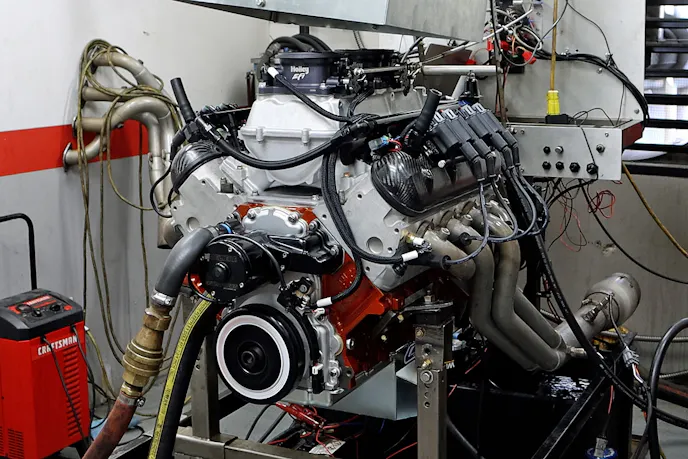
So, to say this has been a long journey, fraught with challenges and delays, would be an understatement. However, the wait is over, as we load the engine up and head down to Outlaw Race Engines in Phoenix, AZ to finally see what kind of numbers we can make with our hypothetical 5.0-liter LS turned into reality.
A Recap Of The Build
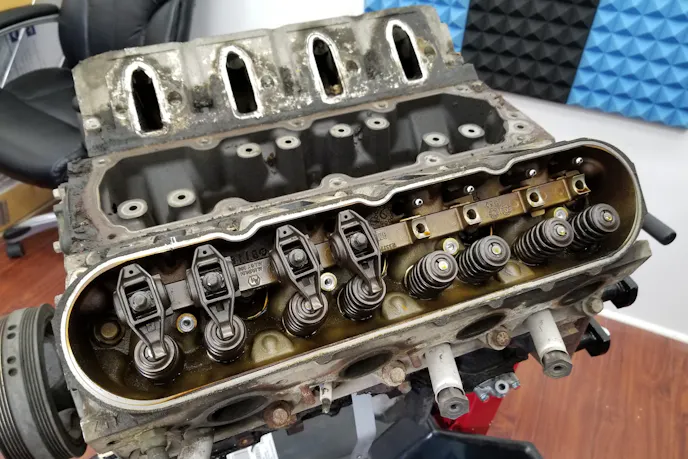
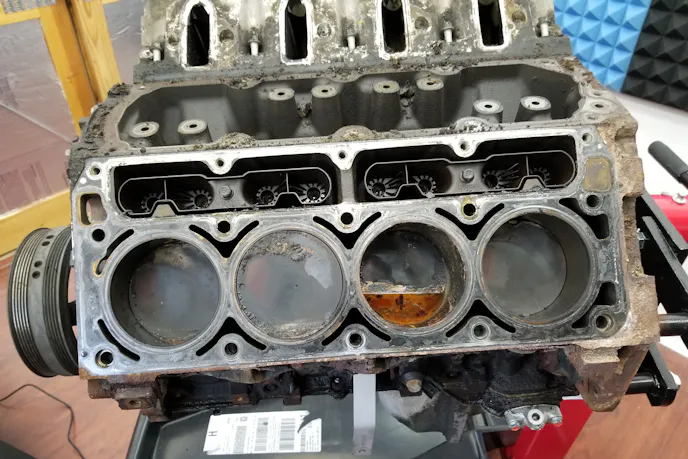
If you haven’t been following the LS5.0 build, you can check it out at our Projects page, where all nine previous articles are listed. For those who would prefer a more succinct summing-up of the project, here you go. We started with a Gen-IV LY2 4.8-liter core engine. From there, we had the whole thing Magnafluxed, decked, and bored out to 3.858 inches by Beck Racing Engines.
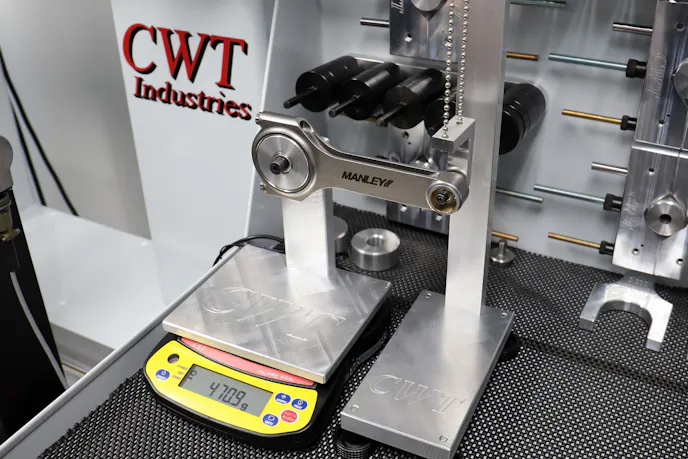
Since this is a naturally aspirated build, and there isn’t much available in the realm of affordable short-stroke aftermarket crankshafts, we decided to retain the stock crank. We then added a set of 6.300-inch Manley Performance H-beam connecting rods and a set of custom 3.858-inch diameter Diamond Pistons with a 6.0cc dome. A Total Seal 1.0mm, 1.2mm, 3.0mm ring pack wrapped the pistons, and everything sat in King Engine Bearings XPC pMax Kote bearings.
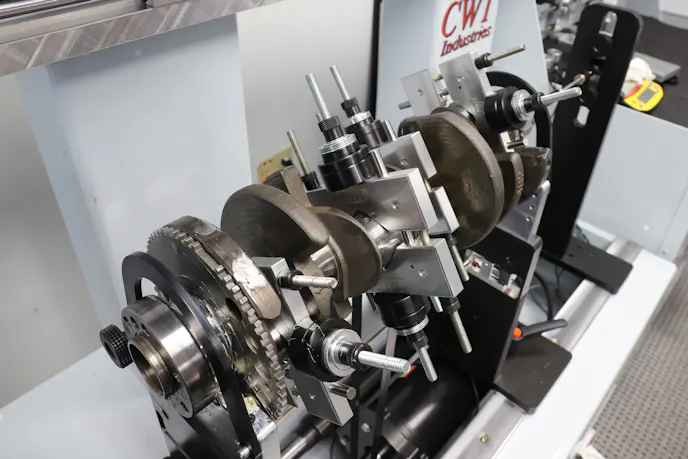
We then learned all about engine balancing at CWT Industries, using LS5.0’s rotating assembly as the teaching tool. Randy Neal walked us through the entire process, and while it was like drinking from a firehose, some of it stuck, so we walked away with both a balanced rotating assembly and some incredible knowledge.
From there, we used a set of Cometic MLX head gaskets with some aggressive sizing to seal the 799 heads that came on our LY2. They aren’t just any 799 heads, though, having been worked over by the pros at Lingenfelter Performance Engineering, with ports that flow 320cfm and chambers worked over and then decked to 60cc. Since they knew our RPM goals, they also fitted a set of 2.020-inch and 1.575-inch hollow-stem stainless steel valves.
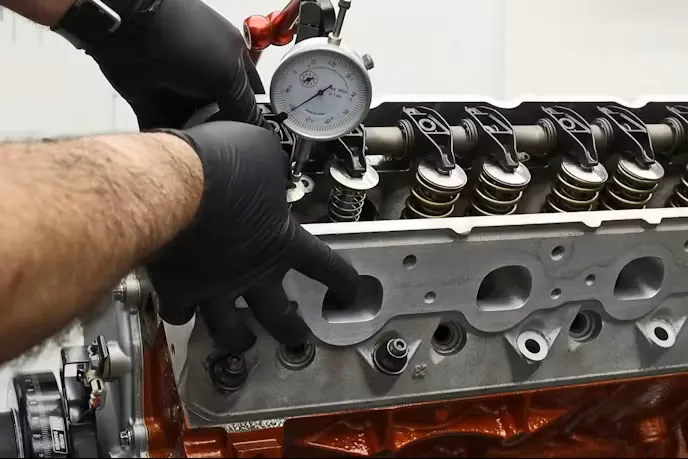
For the high-RPM valvetrain, we went with COMP Cams new Evolution hydraulic roller lifters, XD-A adjustable pushrods, and the tried-and-true BSR shaft rocker kit. That complemented the off-the shelf COMP LSR camshaft we chose. Topping it all off, we chose a Holley Low-Ram intake manifold with the Performance Design carbon fiber 105mm lid, with Holley EFI 105mm throttle body attached. The idea being the short runners would help us in the higher RPM range.
For oiling, we decided to stick with the factory wet-sump system — at least for the first round of testing — to stay within the ruleset of the original LS vs. Coyote Shootout. We utilized a Canton Racing road race oil pan, designed to use the full-length OEM windage tray, along with the Melling Performance version of the OEM Gen-IV oil pump. The engine will be filled with AMSOIL 30-weight Break-In oil and then Dominator Racing Oil. Comparing the budget of LS5.0 to the original budgets from LS vs. Coyote, we were well under the $9,999 cost of building those two engines.
Heading To The Dyno
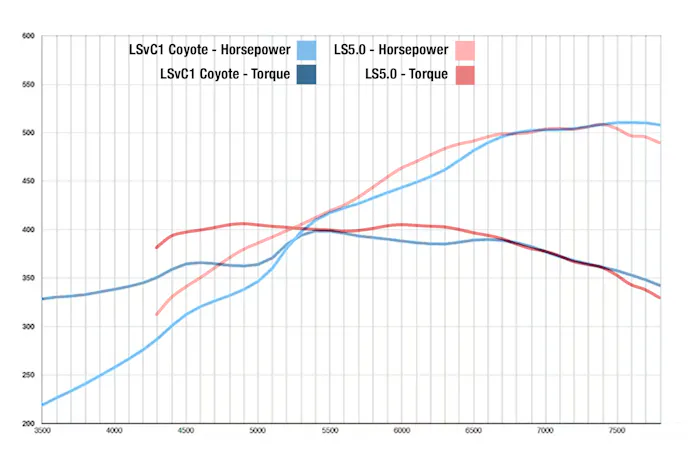
With the engine loaded up on our new Speedway Motors BlockDock lift plate and engine cradle, we headed down to Outlaw Race Engines in Phoenix, Arizona. Our goal with this was simple: try to match the Coyote’s peak power and powerband (510 horsepower at 7,600 rpm) from the original LS vs. Coyote shootout.
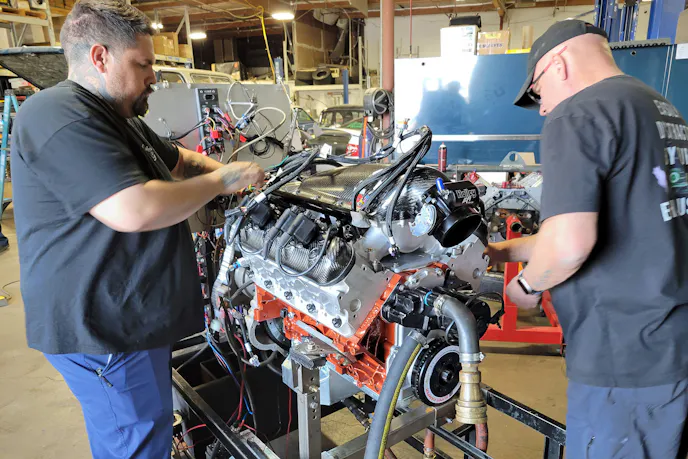
Fortunately for us, Outlaw is well-acquainted with not only the LS platform, but high-RPM platforms as well. Their experience in engine building and dyno tuning are great assets to be able to utilize, as your author’s tuning skills are not to LS5.0’s level. The first step was to wire up the Holley Terminator X system. Thanks to its simple plug-and-play design. that was not an issue in the slightest.
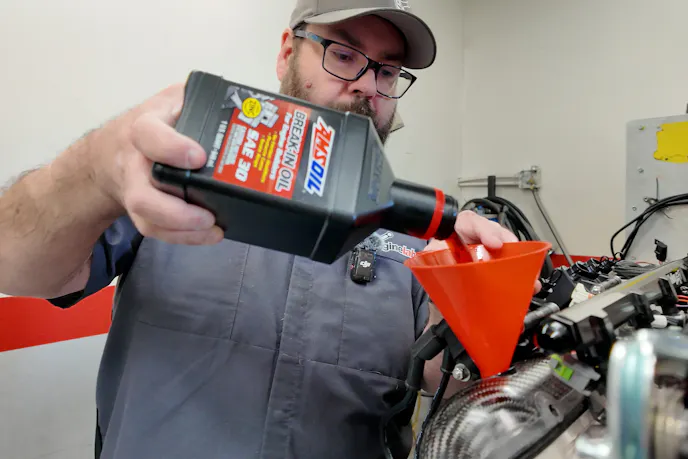
Getting the engine full of AMSOIL break-in oil, the only thing left to do was fill the cell with 91-octane Chevron out of the pump, fire it up, and hear the first sounds of combustion in this engine after the more-than-five-year journey. And what a sweet sound it was, although, the idle was surprisingly smooth… almost disappointingly so.
Baby Steps
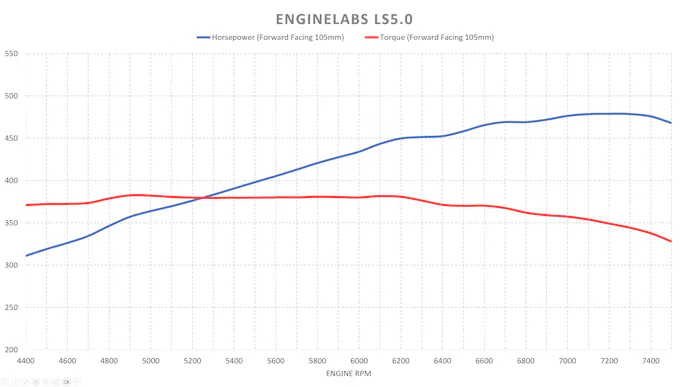
Loading up the engine and breaking in the rings was an uneventful process. Once complete, it was time to start making power pulls. However, the smart and safe thing to do, was to take baby steps. The first pull was only 4,000 to 5,800 rpm. Then 4,000 to 6,000. Then to 6,500. A few fuel and timing changes at that point picked up another 15 horsepower.
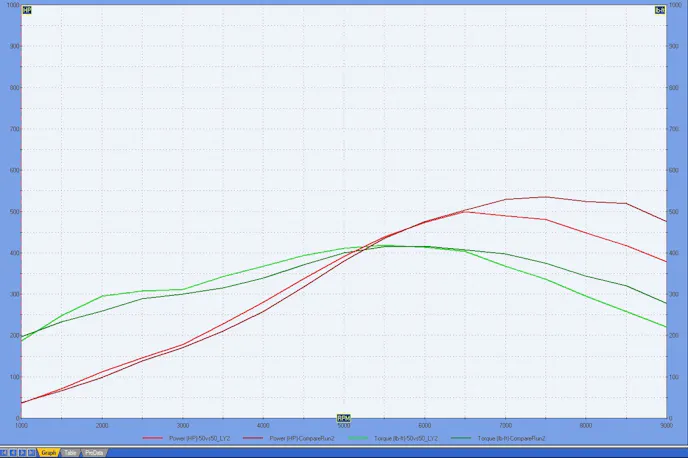
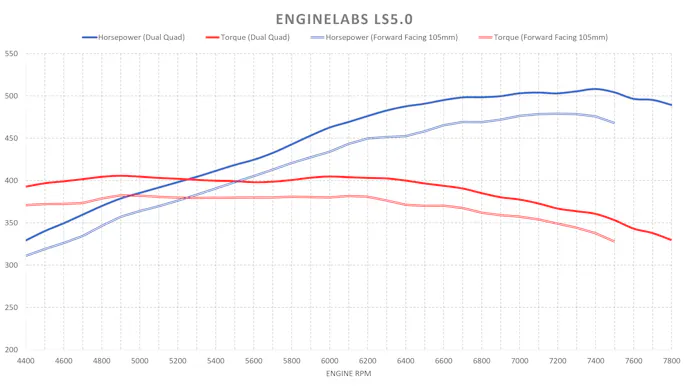
Since everything was looking and sounding good, the next pull went to 7,000 rpm. Power was continuing to climb. Some more fueling and timing adjustments, and more power. So, another 500 rpm. And that was when the first nose-over appeared — at 7,200 rpm. A little more timing, another pull to 7,500… no change. Unfortunately, we weren’t where we wanted to be with the forward-facing intake combination, but the numbers don’t lie. 479 horsepower at 7,200 rpm and 385 lb-ft at 5,900 rpm. But, we weren’t done. We had an ace up our sleeve.
Swapping To The Dual Quad
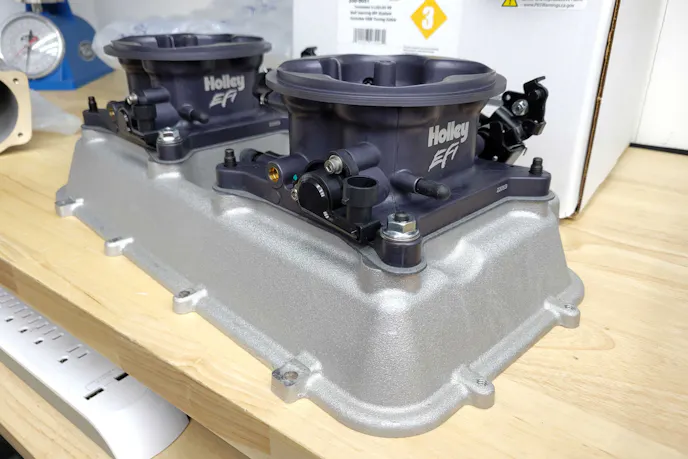
One thing that we wanted to test early on, was Holley’s Dual-Quad lid for the Low-Ram. Using it, along with a pair of 4150-pattern throttle bodies, should give the engine all of the air it could possibly need. While we typically think of a 105mm throttle body not being a restriction for most applications, we have heard where LS engines will pick up power from simply going to a 120mm throttle body. So, we weren’t ruling anything out.
Swapping the lid onto the lower intake, with zero other changes to the tuneup, immediately showed promise with about 10 additional horsepower across the board. Plus, the horsepower and torque peaks appeared to have moved up a few hundred RPM. So, it was time to go up in RPM a little bit.
The first pull to 7,800 showed no gains, but the engine was happy, so a little fuel, a little timing. Another five horsepower and five pound-feet. Another tweak, another six horsepower. Another tweak, another four horsepower and the first pull above 500 horsepower. At this point, it was revealed to the dyno team that we were shooting for 510 horsepower. The boys at Outlaw took that as a challenge.
The big gains were gone, and now we were picking up little bits over the next few pulls. Oddly, the control panel was showing numbers higher than what was being recorded, dangling the carrot oh so close, with one pull flashing 510 horsepower on the screen, but only recording 508 for the pull. That ended up being the peak, as changes past that resulted in lower numbers, and then even lower numbers.
Final Results
The final number for the day was 508.12 horsepower at 7,390 rpm and 405.66 lb-ft of torque at 4,904 rpm, which is a bit misleading, as the double-hump torque curve saw 404.4 lb-ft at 6,056 rpm. Did we achieve our goal? I’d say it was close enough to say yes, we did. But, close enough only counts in horseshoes and hand grenades, and LS5.0 is neither.
Looking at the relative numbers as opposed to absolute, the engine made 101.6 horsepower per liter, which isn’t anything to sneeze at. That translates to 1.66 horsepower per cubic inch, and 1.33 lb-ft of torque per cubic inch. There’s definitely some room for optimization in those numbers, but, as it sits, we’re in OEM 5.2-liter Voodoo engine territitory, if not a couple of hundred RPM shy of its rev limit.
We were two horsepower and 200 rpm shy of perfectly matching the Coyote, and we weren’t really within the original LS vs. Coyote rules with the dual-quad lid. So, we’re going to take another shot at it. We’re going to add a little bit of camshaft, and try the Holley Hi-Ram base with both of our current lids. While the Low-Ram sounded like the move when it was released, in the subsequent years, we’ve seen that if hood clearance isn’t a consideration, the Hi-Ram seems to consistently outperform the Low-Ram, even in high-RPM situations.
Then, we’re also going to swap to a Gen-III Melling oil pump. The Gen-IV’s standard pump is higher volume to account for the AFM and VCT systems that LS5.0 doesn’t have. That led to higher-than-expected oil pressures which, in and of themselves, can cause some increased pumping losses.
Also, we need to not overlook that the dual-quad lid picked up 10 horsepower with zero tuning, and 29 horsepower and 20 lb-ft with tuning. Plus, it moved the peak power up 200 rpm. Not to mention, how fast and responsive the engine was with all that airflow. Rapping the throttle sounded mean as hell with the dual four-barrel throttle bodies.
We aren’t done yet. However, LS5.0 version 2.0 will have to wait a bit, as we make these changes and take another shot at this. Like we said in one of the DynoSim articles, I don’t think anyone expected the powerbands of an LS and a Coyote to actually be this similar. Will we be able to match that 510 horsepower with the forward-facing lid with the changes? We’re going to find out!
You might also like
Torque and Clamping Force: Why Lubricant Choice Matters
Engine builders depend on torque wrenches, but torque alone doesn't tell the whole story. Friction can dramatically change clamping force.