


Engine builders depend on torque wrenches when assembling everything from connecting rods to cylinder heads. However, the relationship between torque and clamping force is a complicated one and doesn’t always tell the complete story on the surface.
A recent Race Industry Now webinar from Epartrade examined what actually happens when a critical fastener is tightened. P1 Manufacturing’s Shannon Strother joined by AERA’s Chuck Lynch to discuss torque input, friction, and fastener clamp load. Strother, P1’s Director of Future Technology, has been involved with the company since its earliest development of performance fasteners. His role includes technical support and product development. Lynch brings more than 36 years of industry experience as AERA’s Vice President of Technical Services.
Their discussion highlighted an important point. A torque wrench measures resistance to rotation. It does not directly measure the clamp load applied to an assembly. That distinction matters because friction consumes most of the torque applied during tightening. Lubricant choice can dramatically change the resulting clamp load, even when the torque specification stays the same.
What is Fastener Torque?
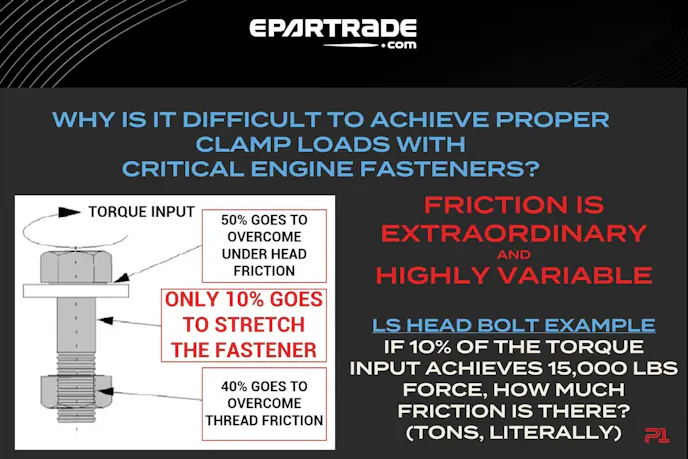
Clamp load is the force a tightened fastener applies to the assembled components. Producing that force requires stretching the fastener. However, only a relatively small portion of applied torque actually stretches the fastener. Strother explained that generally about 50 percent of the torque overcomes friction beneath the bolt head or nut. Approximately 40 percent goes towards overcoming friction in the threads. That leaves only about 10 percent of the applied torque for stretching the fastener.
This makes friction an enormous variable when tightening critical engine fasteners. Changing friction can change clamp load, all without changing the torque wrench setting. P1 uses the familiar “T=kDP” relationship when predicting clamp load. “T” represents torque, “k” represents friction, “D” represents the fastener diameter, and “P” represents clamp load.
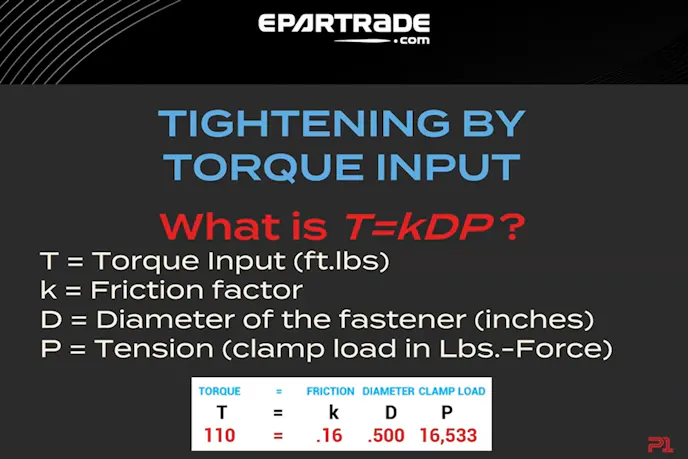
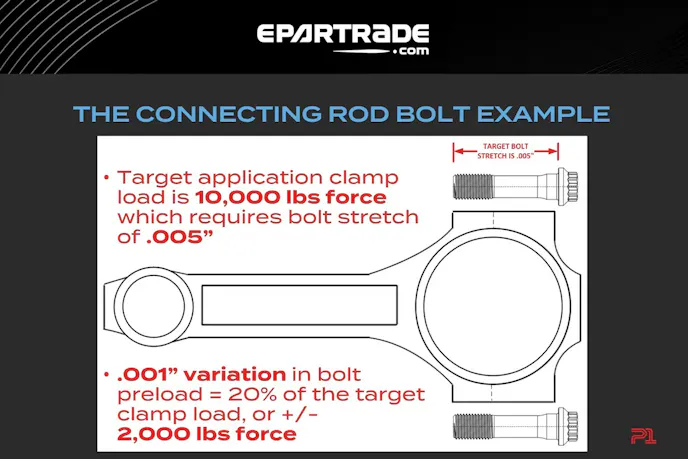
For a particular fastener and specified torque, diameter remains constant. That leaves friction as the primary variable the installer can influence. Small differences in fastener stretch can also produce substantial differences in clamp load. P1 illustrated this using a hypothetical connecting-rod bolt.
In the example, 0.005-inch stretch produced a 10,000-pound target clamp load. A +/- 0.001-inch variation represented 20 percent of that target clamp load. That could leave one bolt at 8,000 pounds while another reaches 12,000 pounds. Lynch added that more clamp load is not necessarily better. The surrounding components must also withstand the forces being applied to them.
Torque-plus-angle strategies can help reduce some dependence on torque alone. Initial torque seats the assembly and begins producing clamp load. A specified rotation angle then controls additional fastener stretch more precisely. For more on how torque-plus-angle tightening can improve fastener consistency, check out our Fastener Torque Vs. Stretch tech talk.
Putting Lubricants to the Test
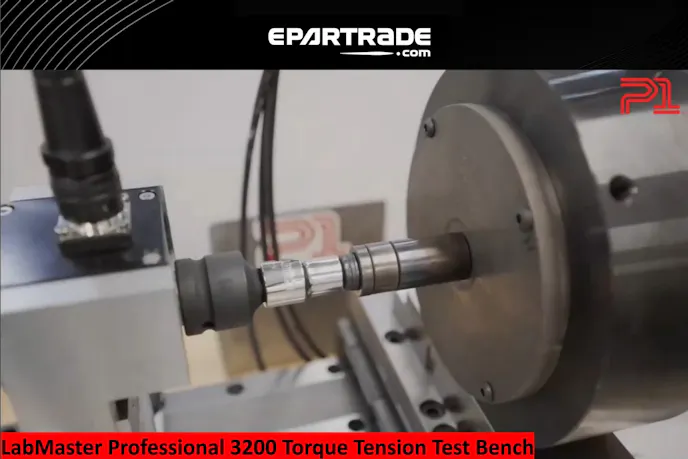
The Race Industry Now webinar explains how dramatically lubricant choice can affect clamp load. P1 demonstrated those differences using its torque-tension testing equipment. Strother described the instrument as the company’s “Bolt Dyno.” It measures several important variables during a single test. Those measurements include clamp load, torque input, rotation angle, under-head friction, and total friction.
P1 typically takes the fastener into yield during testing. Engineers can then examine the torque-to-clamp-load relationship. For the lubricant comparison, P1 used a half-inch stud (SQ9E) manufactured from its 190,000-psi E190 material. Testing also used their standard half-inch nut (NB9F) and washer (WG9T). The calculated target was approximately 16,700 pounds of clamp load. Torque remained constant at 110 lb-ft while P1 changed the lubricant. With their P1Torque Point lubricant, the fastener produced the targeted clamp load of approximately 16,700 pounds. The resulting curve remained nearly linear. The fastener rotated approximately 150 degrees while reaching the intended clamp load.
P1 then substituted 5W-30 engine oil without changing the 110 lb-ft torque setting. Clamp load dropped to approximately 10,200 pounds, leaving the fastener more than 6,000 pounds below the target. Strother identified the irregularities in a test curve as stiction, where the assembly was grabbing during tightening. While having such a large effect on clamp load, that resistance could still feel smooth during much of the tightening process. This can create a potentially misleading situation for an engine builder where the wrench can feel right, while the resulting clamp load remains wrong.
When Lubricant Becomes Too Slick
P1 next tested Detroit #2 lubricant, commonly called “Peanut Butter” because of its appearance. This lubricant represented the opposite problem. Detroit #2 was considerably slicker than the other lubricants P1 tested. At the same 110 lb-ft setting, the reduced friction significantly increased the fastener loading. The test carried the fastener well into yield (the point at which the fastener permanently deforms). The fastener also rotated more than 170 degrees before the torque wrench reached 110 lb-ft.
Strother explained that approximately 75 lb-ft of torque could produce a better result with that lubricant, as the lower-friction lubricant required a lower torque value to generate the same clamp load. P1 estimated the torque input would need to be decreased by roughly 30 to 35 percent with Detroit #2. That comparison drives home the importance of matching the lubricant with the torque specification.
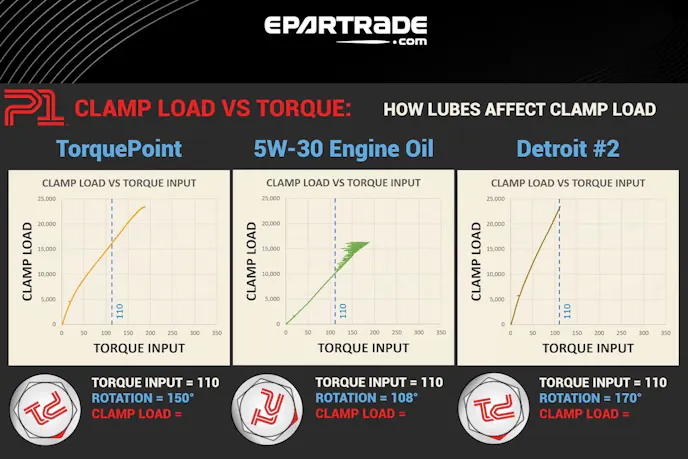
In the test, the fastener and a 110 lb-ft torque setting remain unchanged throughout the comparison; the lubricant was the variable producing the different results. The lubricant itself was not necessarily unsuitable. The problem was applying a torque value developed for a different friction level. P1’s data suggested that recalibrating the torque value would produce the desired clamp load.
P1 also evaluated CMD EPL (Chicago Manufacturing & Distribution Extreme Pressure Lubricant) because Strother said many engine builders use it. The CMD lubricant produced relatively consistent resistance and could feel good through the torque wrench. However, it did not produce P1’s desired clamp load. That means the fastener may remain below its limits while leaving the assembly under-clamped.
Repeatability is the Real Goal
They did not base those conclusions on a single rundown. P1 went beyond individual tests to examine how consistently each lubricant produced clamp load across repeated tightening cycles. The comparison included five fasteners, each tightened five separate times. That produced several cycles for evaluation. The repeated testing showed whether each lubricant could deliver similar results from one tightening cycle or another. Lynch described the variation between repeated tightening results as scatter.
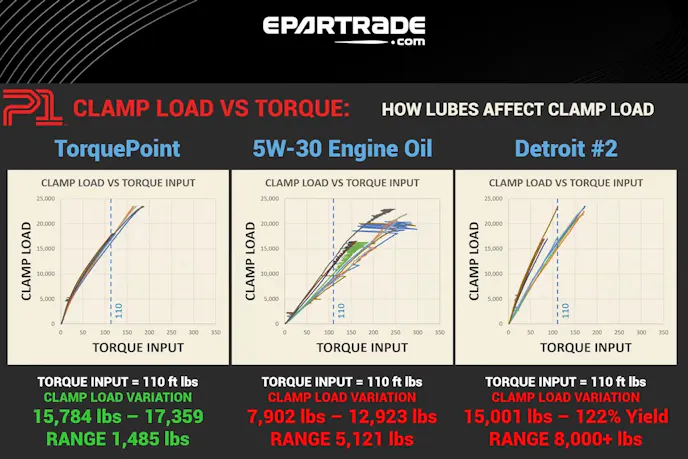
With P1’s Torque Point Lubricant, resulting clamp load varied roughly seven to eight percent. With several repetitions across the five fasteners, it showed a total clamp load variation of 1,485 pounds. Engine oil produced approximately three times that variation. It also never reached the lower end of P1’s desired clamp-load range. Detroit #2 produced much greater scatter. Some fasteners reached approximately 122 percent of yield during the repeated test. The total range between two tested fasteners approached 8,000 pounds. The results demonstrate why lubricant choice involves more than simply making a fastener easier to tighten. Consistent, predictable clamp load is equally important.
P1 recommends consistent load-bearing surfaces and hardened washers where the application permits, and applying lubricant uniformly to the specified threads and load-bearing surfaces. Most importantly, changing lubricants can significantly alter the resulting clamp load. Torque specification developed with one lubricant may produce a considerably different result when another is substituted. So, stick with the recommended lubricant.
For engine builders, the lesson is straightforward. A torque wrench measures resistance to rotation. Clamp load holds the engine together. Controlling friction helps make the relationship between them predictable. Follow the fastener manufacturer’s tested torque specification, lubricant, and installation procedure as a complete system.
You might also like
Tips from Erson Cams on Maintaining Better Valve Control
Maintaining valve control is a bit more complicated than just adding spring pressure and reducing valvetrain mass.