
In the old days, engine builders cut weight off the rotating assembly on their race engines by using the smallest damper possible. They reasoned the gain in acceleration rate was worth the reduced lifespan of bearings and other components, and would just rebuild the engine sooner. In fact, for the Chevrolet small block, swapping on one of Chevrolet’s small 6.75-inch dampers designed for smaller or low-power engines was practically a given.
But then we began learning how a properly sized damper not only improves engine durability but potentially also engine performance. Now here’s the good news: in a shocking development that proves you can sometimes have your cake and eat it too, smart manufacturers are designing harmonic dampers that both cut rotating weight and do a great job of controlling oscillations travelling up and down the crankshaft while the engine is at speed.
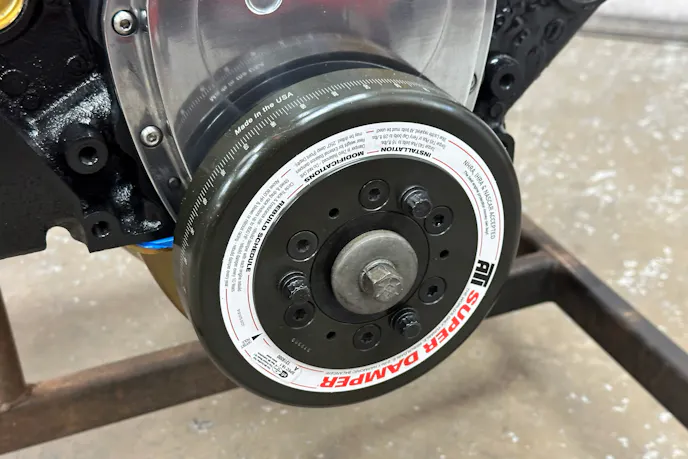
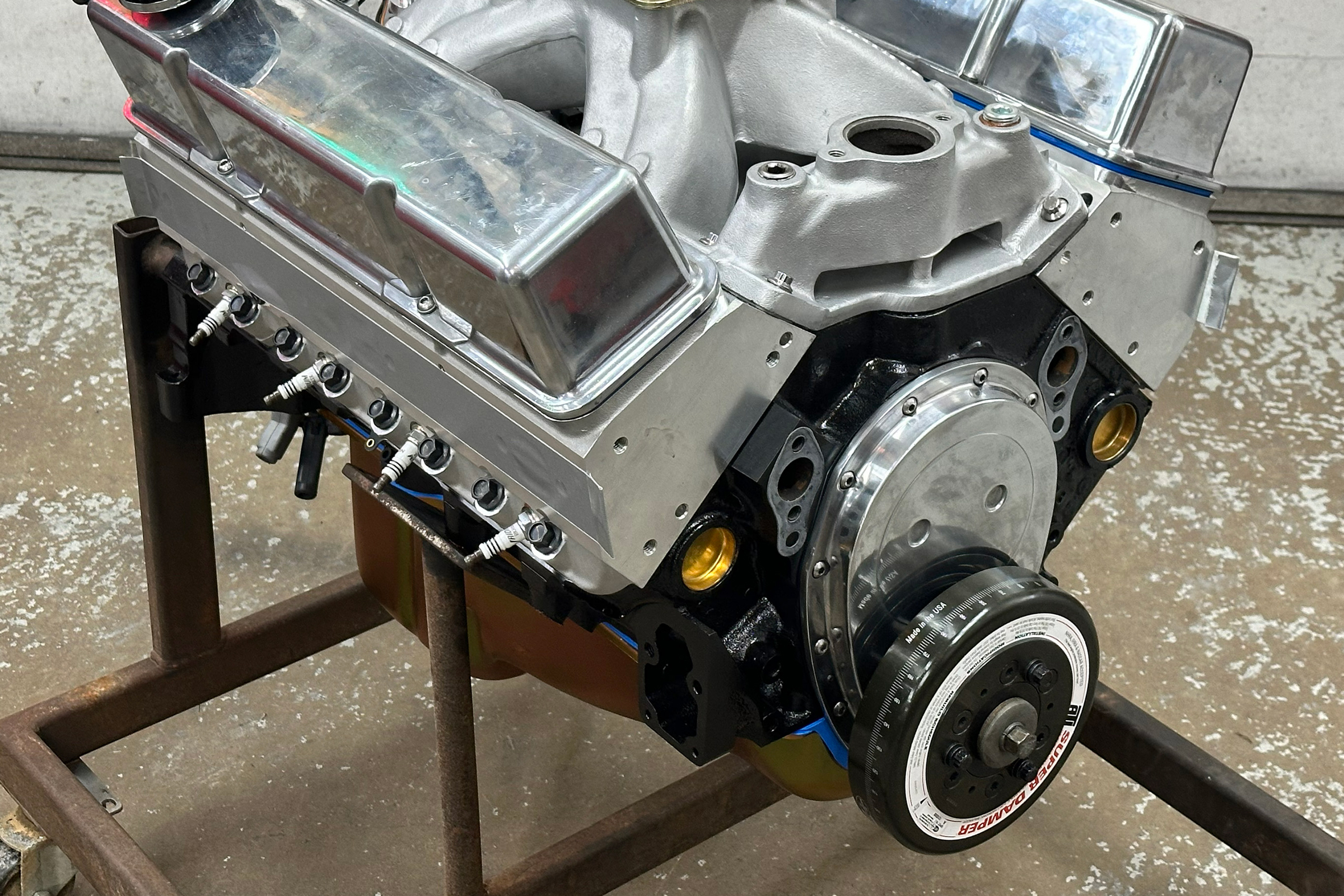
ATI does this by offering steel and aluminum options for both its Super Damper shells and crankshaft hubs, and we’re taking a close look at when you should choose each. A lightweight drag engine, a blown street bruiser, and an endurance oval-track race engine can all benefit from different combinations of those materials.
To sort out what belongs where, we talked with ATI owner JC Beattie, Jr. His advice for choosing the best damper for your needs starts with determining how the engine will be used and what the damper has to drive. That approach makes a lot more sense than picking whichever part looks raciest in the catalog.
Understand Where Weight Matters
A crankshaft feels pretty solid sitting on an engine stand, but when the engine is running, power pulses from combustion are strong enough to make it twist slightly as it rotates. The crank springs back between those pulses, which sounds good until you realize that sets up torsional vibrations that can run up and down the length of the crank. Let that motion get out of hand, and it can cost power and damage expensive parts.
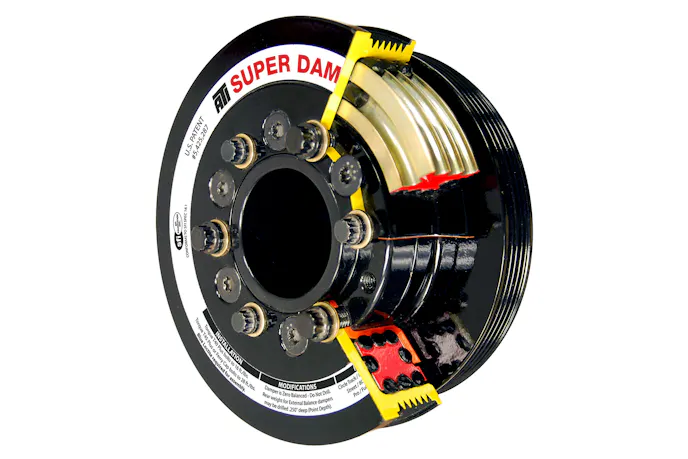
ATI’s Super Damper is by far the most popular engine damper used in professional racing. It works by using a steel inertia weight that reacts to power pulses moving through the crank through multiple elastomer O-rings. Those rings provide the spring and damping characteristics for the unit to work properly, and ATI selects their hardness (also known as durometer) specifically for the application. Inner and outer shells protect the working assembly, and the hub connects it to the nose of the crankshaft.
That construction explains how ATI can offer an aluminum damper without throwing away the mass needed to do its job. The inertia weight requires a certain amount of density, so it’s always going to be steel. Aluminum, however, can be used to form the surrounding shells, the hub, or both.
It’s the mass and diameter of the inertia weight that helps determine how the damper behaves. Cutting weight by simply making every piece lighter will leave an engine with less protection. ATI’s approach lets builders reduce surrounding weight while retaining the appropriate internal assembly.
There’s also a difference between weight on a scale and rotational inertia. Material farther from the crankshaft centerline takes more effort to accelerate than the same amount tucked close to the center. That makes the shells an attractive place to save weight. In practical terms, reducing their inertia means the engine expends less energy to accelerate as RPM climbs.
Where Aluminum Makes Sense
For a drag car without a crank-driven supercharger, Beattie says an aluminum hub paired with aluminum shells can work very well. He even puts his money where his mouth is by running that combination on his personal race car.
Across ATI’s range, he estimates that choosing aluminum components can typically remove around three pounds, although the exact savings depend on the damper. For a racer already chasing ounces in other parts of the car, that equals real weight savings.
And considering drag racers only subject their engines to relatively short periods under full power, that also suits the lightweight components. A weekend of quarter-mile passes actually equals a surprisingly low number of loaded engine cycles on a damper. That’s because loaded engine cycles really only come from WOT blasts. All your time at idle, warming up, or even cruising to the staging lanes, is practically free. Beattie says aluminum components can provide long service in the right application.
Circle-track racers can benefit, too, provided their rules allow the materials. However, the environment matters. Beattie says dirt track racers can experience erosion and damage to aluminum shells from debris. Still, some higher-level race teams are willing to accept that tradeoff and replace components as needed to retain the weight advantage.
That’s a maintenance decision worth making before you buy. Aluminum makes more sense when you value weight savings or a bit of durability and are willing to inspect the hardware regularly. Steel is more attractive when surviving a rough environment matters more than trimming the last couple of pounds.
Special Considerations for the Hub
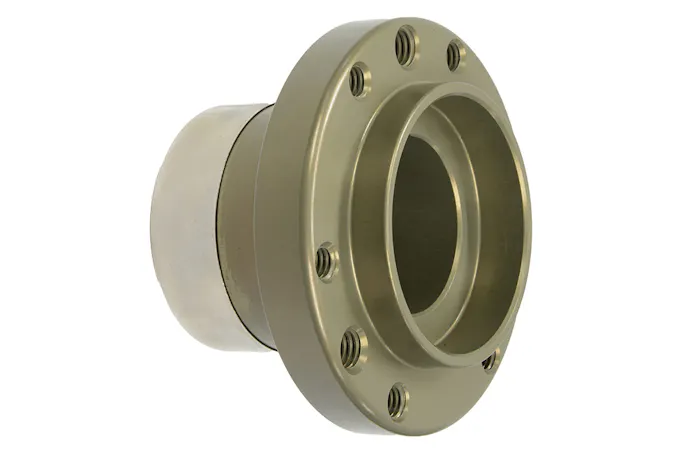
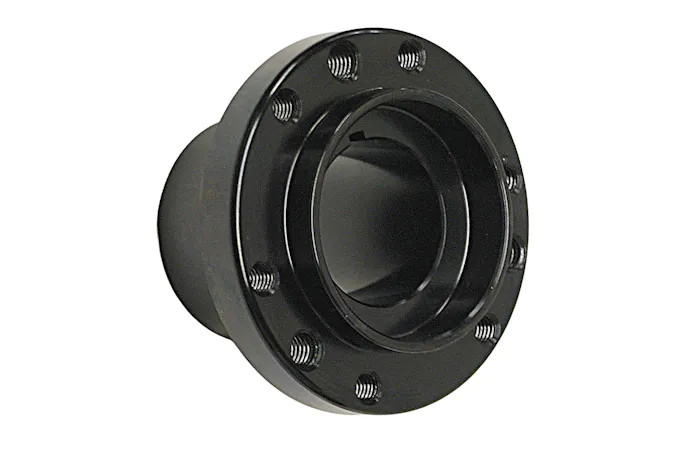
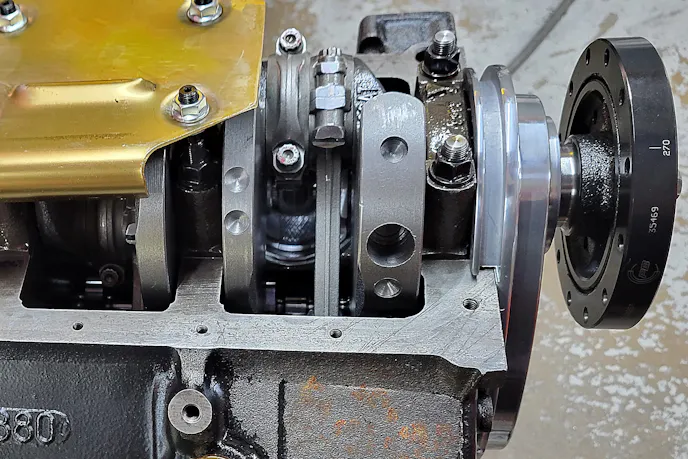
The hub is the interior piece of the damper that slides over the nose of the crankshaft. Because the blower pulley typically bolts directly to the damper, adding a supercharger changes the discussion when it comes to aluminum versus steel damper hubs. Driving a blower adds considerable load to the connection between the crank and the damper, so Beattie recommends steel for that job. That last thing you want is the key on the crankshaft ripping through an aluminum hub.
“It’s still okay to have an aluminum shell damper with a steel hub,” he explains. “So, you get the clamping force and the strength of the steel hub, and you still reduce a couple pounds of rotating and accelerating weight with the damper shells.”
That distinction is easy to miss when somebody casually refers to an “aluminum balancer.” Ask which components are aluminum. A steel hub with aluminum shells is an established ATI combination, including versions intended for supercharged engines. Just using the aluminum shell on a big block damper unit versus steel is usually enough to save about five pounds. That’s a big deal considering we’re talking about the farthest point out on the radius of the damper. An aluminum hub, meanwhile, can save an additional 1.5 pounds, but that’s also tight to the centerline of the crankshaft.
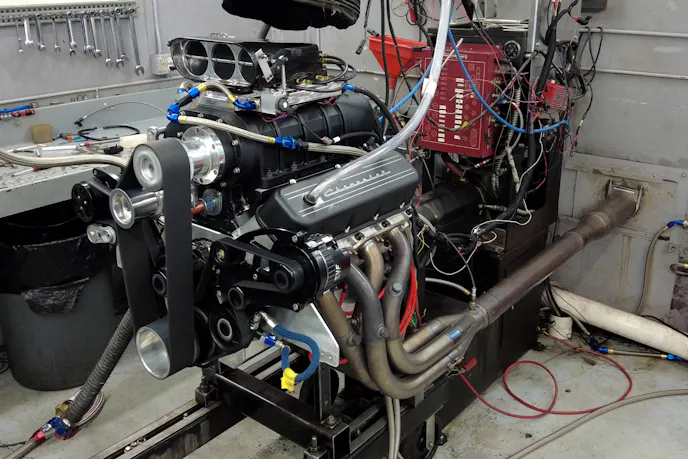
Of course, the correct hub still has to match the crank snout, keyway arrangement, pulley mounting, and blower application. Material choice is one part of selecting the complete assembly. A steel hub by itself doesn’t make every damper suitable for every supercharger.
Beattie also favors steel hubs with aluminum shells for boats, off-road vehicles, and drift cars that repeatedly come on and off the throttle. The combination keeps strength at the crankshaft connection while reducing weight farther out. It gives builders a useful option between the lightest available assembly and an all-steel damper.
Steel (Still) Earns Its Keep
For a street engine that will rack up miles, Beattie generally leans toward steel hubs and shells. The extra weight is a reasonable trade-off for improved durability when the car’s mission involves years of use rather than chasing a small acceleration advantage.
The same thinking applies to long-duration service where maintenance access may be limited, and weight savings offer little benefit. A damper on an engine expected to work continuously has different priorities from one on a carefully maintained race car. Beattie also emphasizes checking racing rules, since some classes require steel regardless of the builder’s preference.
Aluminum remains a legitimate safety-rated option. ATI says its Super Dampers exceed SFI 18.1 requirements, and that specification permits qualifying steel or aluminum construction. That means the ATI dampers have passed tests including material testing and a rotational-integrity test at 12,500 to 13,500 rpm for one hour. Of course, the engine still needs the correct damper size and tuning for its particular combination.
Whichever materials you choose, the damper will eventually require attention in the form of a rebuild. The elastomer rings should be considered a consumable wear item. Beattie points to worn elastomers, oil contamination from a leaking seal, and exposure to cleaners as problems that can undermine a Super Damper’s performance. A good-looking outer shell tells you very little about the condition of the rubber inside. “The damper is about like every other piece on your car,” he says. “It’s doing the job, and it’s going to wear out eventually,” says Beattie.
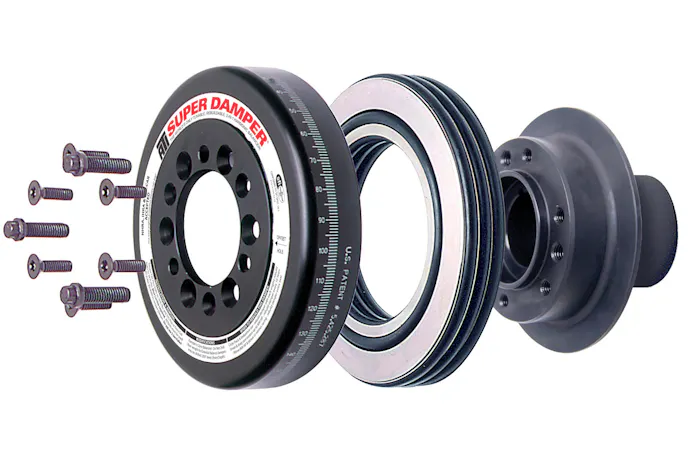
ATI’s published guidance suggests considering an end-of-season rebuild for professional racing engines or engines making more than 800 horsepower. Less demanding applications can have much longer intervals, but the schedule should match actual use. Beattie considers an engine rebuild a sensible opportunity to freshen the damper, too.
Here, ATI’s rebuildable construction offers another advantage. Individual parts can be inspected and replaced, and Beattie says compatible steel-shell assemblies can be converted to aluminum shells during service while retaining the usable internals. So it’s entirely possible to upgrade your damper during a refresh.
That flexibility lets the damper follow the needs of the engine, since they often evolve and make more power from one rebuild to the next. (We all know both racers and engine builders can never leave well enough alone.) So run steel where the loads and service life call for it, or choose aluminum where weight savings pay off. It’s up to you, and maybe your rulebook. After all, you’ve got plenty of money tied up behind that crank bolt. A few thoughtful choices up front will help you protect all of it.
You might also like
LABS: Discussing The Differences In Coyote Engine Blocks
15 years into the Coyote and the number of Coyote Blocks available has really blossomed, so we're going to sort through them all.