


There’s a certain point in high-end drag racing engine building where the conversation stops being about parts and starts being about intent. Not just what combination you’re running, big-block or not, but why every single decision was made and how far you’re willing to go to go rounds and claim wins.
That’s exactly where Sandy Wilkins lives.
Spend a day inside Wilkins Racing Engines in Mooresville, NC, and you realize pretty quickly this isn’t just a place where engines are assembled. They’re engineered, documented, measured, and tested to make sure everything is perfect. The 648 cubic-inch big-block build we had the opportunity to document is a perfect example of that mindset. Based on owner Sandy Wilkins’ own 646 Max (which itself is based on the iconic stock Chevrolet big-block bore spacing) engine and cylinder head package, the result is a nearly 1,400-horsepower naturally aspirated combination that’s expected to survive an entire season of drag racing in the ultra-competitive 4.50-second bracket class on 1/8-mile tracks.
That alone is enough to get our attention. But once you dig into the level of detail Wilkins obsesses over to reach his goals, you understand why he expects multiple championships from this mill.
Big Cubes Still Rule
There’s a reason combinations like this continue to dominate in certain forms of drag racing. Displacement is still king when you want instant torque and brutal acceleration without stressing the engine’s internal components. So, when you start with a big-inch big block, it’s easier to hit the power targets without spinning the engine to the moon.
But what separates a realistic championship winner from just another poser is how that displacement is managed. When you are dealing with a bore and stroke combination (4.600 by 4.875 inches) this large, everything from the cam specs, to the valve angles in the cylinder head and even valvetrain stability must be managed perfectly when you are hoping to fully meet the airflow demands of a beast like this at 7,700 rpm. You’re not just dealing with more air and fuel. You’re dealing with more stress everywhere.
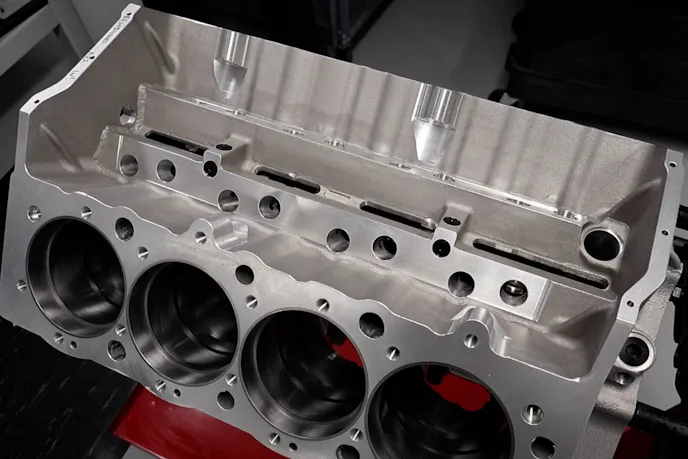
One of the first things that stands out is the level of attention paid to the smallest details. Wilkins starts with an aluminum block from JLine Performance. Owned in part by former NHRA Pro Stock champion Jason Line, these blocks are purpose-built for racing and include such touches as O-ringed freeze plugs and other fittings, and all the mains are either grooved or have a secondary-oiling hole to optimum lubrication. Also, the block architecture is designed to support large bores over 4.600 inches, and you can even get a raised cam tunnel that’s beefy enough to use roller bearings with a 60-millimeter cam.
Wilkins chooses to start every fresh build with a 4.600-inch bore, even though the block can go larger. That’s probably giving up a few horsepower by not going directly to 4.625 or so, but it can save the racer serious coin in the long term. Leaving room in the sleeves means the customer can freshen the engine multiple times before needing to replace either the sleeves or the block. In an era where peak performance often sacrifices service life, that’s a nice feature.
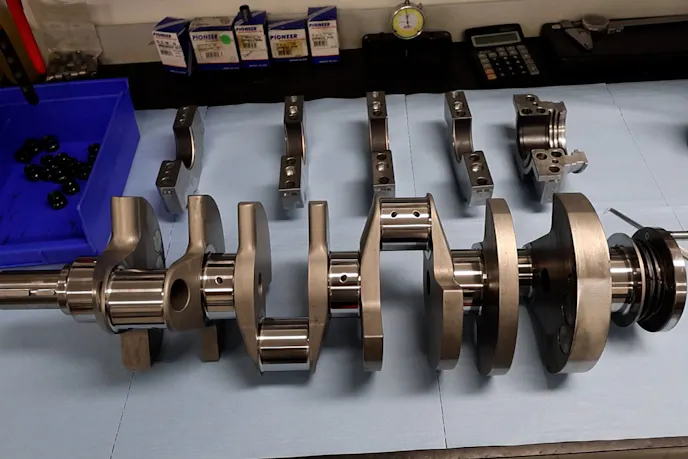
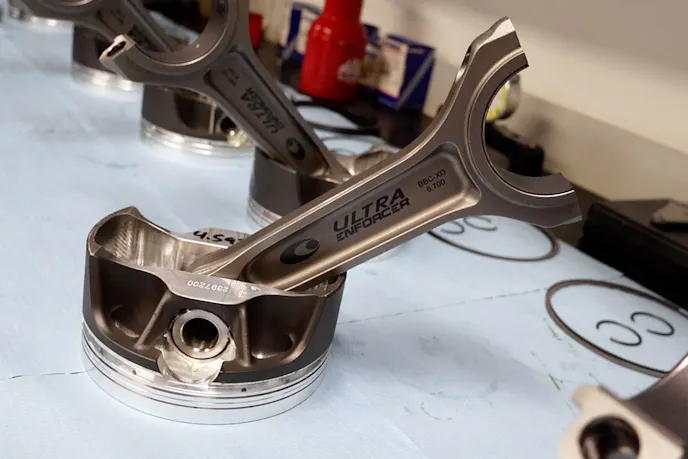
The Callies Magnum series crankshaft is manufactured from 4340 steel, has fully profiled counterweights to reduce windage, and despite its long stroke, is quite lightweight. The rods and pistons follow the same logic. Lightweight where possible, but never at the expense of integrity. For example, the expectation is to be able to run a full season, potentially making the final round at every event, before the engine requires a refresh. Wilkins calls this an “endurance drag racing engine,” so he chose to go with steel connecting rods over aluminum for durability.
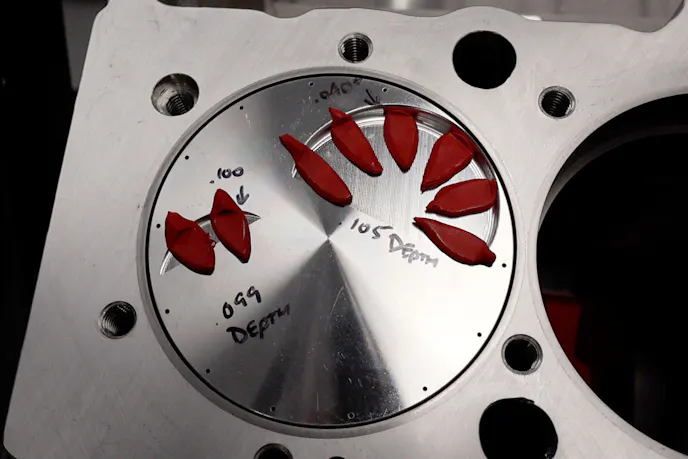
Everything is a balancing act. The steel construction of the connecting rods will definitely add grams of weight to the rotating assembly, but some of that is counteracted with the custom Diamond pistons. They are a slipper skirt design with the wrist pin bosses moved inboard. This not only helps cut weight from the piston, but it also shortens the wrist pins, which helps add strength while cutting down on mass.
No Such Thing As “Standard”
Ask about camshaft specs and you’ll get a smile and a deflection. That’s not unusual in this level of racing, because engine builders at this level invest a ton of R&D into finding the best possible camshaft profile. For example, when we asked about the valve lift, we were told that it was taller than a bullfrog’s butt but less than the statue of liberty.
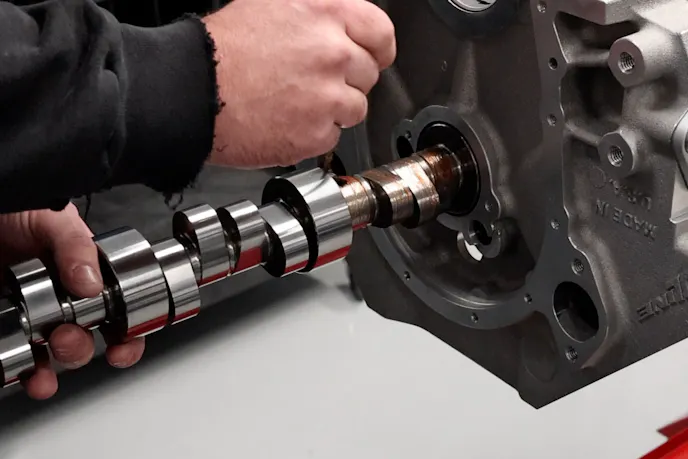
Every camshaft is his own design, tailored to the application. In this case, it’s a 60mm billet solid roller with profiles optimized for both naturally aspirated performance and a light shot of nitrous. As we said, the exact numbers will stay in-house, but the results speak for themselves.
What’s more interesting is how the cam is installed and verified.
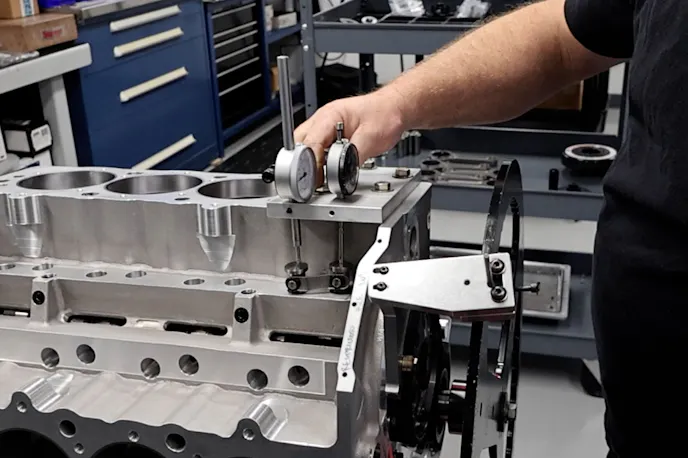
Most experienced builders are comfortable degreeing a cam with a standard wheel and indicator setup. Wilkins takes that several steps further with fixtures and flat-top lifters he’s fabricated in-house. One fixture ensures precise measurement of lifter motion by locking in the dial indicator at the same angle as the lifter. And that’s paired with an oversized degree wheel for increased accuracy when trying to dial in the valve events to within half a degree of crankshaft motion. The goal is accuracy down to fractions of a degree, and more importantly, repeatability across builds.
“The devil is in the details,” is a phrase that gets thrown around a lot in engine building. At Wilkins Racing Engines, that’s taken very seriously. Consider rod bolt stretch. Most builders zero out their gauge with the rod bolt loose in the rod cap, then measure the amount of stretch after torquing. Wilkins measures each bolt’s free length, then measures it again after installation, documenting both along with the stretch. That data is recorded for every engine, so when it comes back for service, every rod bolt gets checked so they can determine if it’s still good.
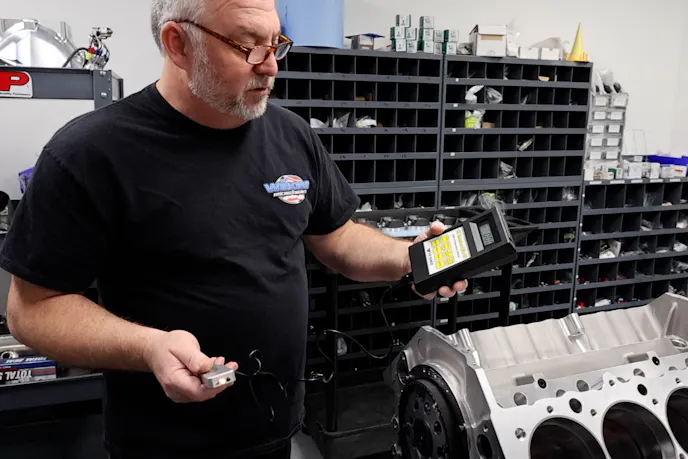
And then there’s something as simple as the timing belt. Instead of relying on feel or deflection, Wilkins measures belt tension by frequency using a calibrated gauge that measures the sound waves when the belt gets “plucked.” If the frequency is too high, the belt is too tight. Too low, and it’s too loose. It’s the same principle used in industrial applications, just adapted for race engines.
And yes, the gauge is validated with a calibrated tuning fork.
At this point, we realized absolutely nothing is left to chance.
Cylinder Heads and Valvetrain
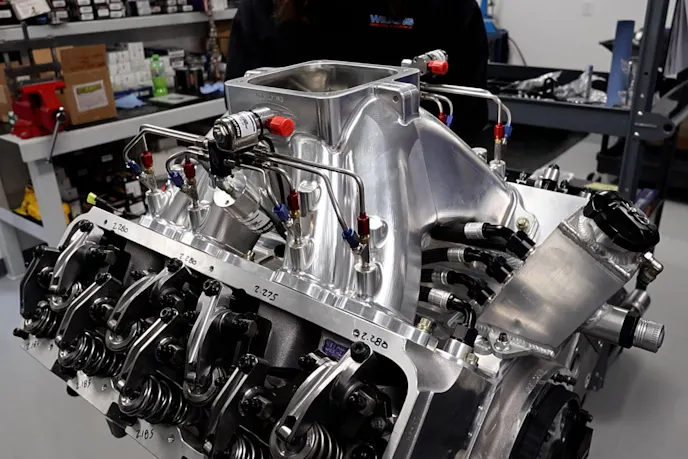
If displacement is the foundation, airflow is the force multiplier. Here, Wilkins uses his own 484 Max cylinder heads which are a proprietary design purpose-built to be the best thing going when it comes to generating power in a big-block Chevrolet with nitrous. There are also very intelligent design quirks to make life easier at the racetrack. For example, coolant exits from the cylinder heads into the valley cover and not the intake manifold, so a cylinder head can be pulled while the intake manifold (and all the nitrous plumbing) is still in place.
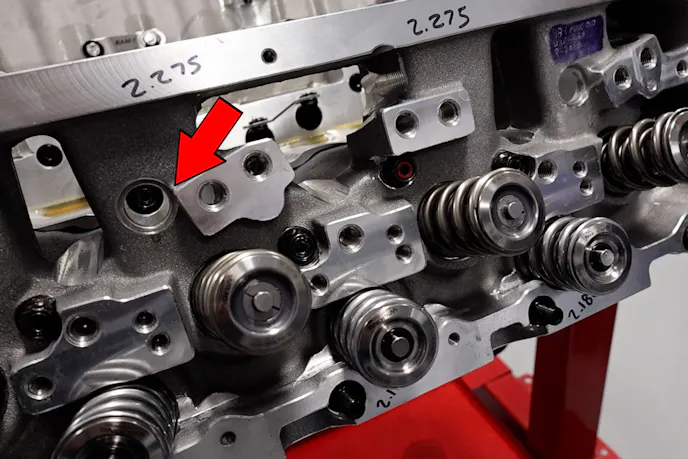
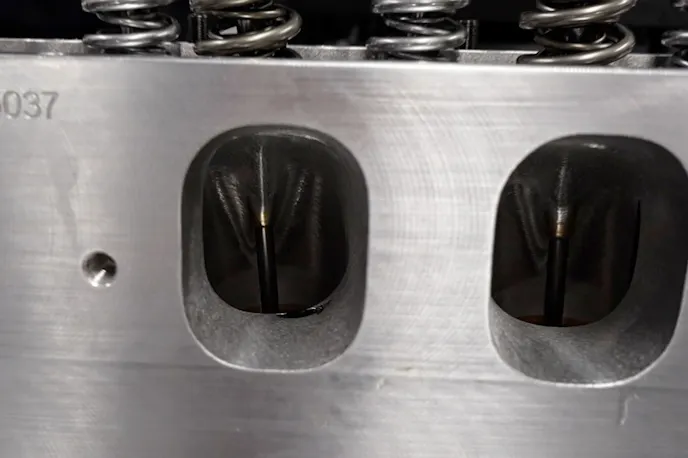
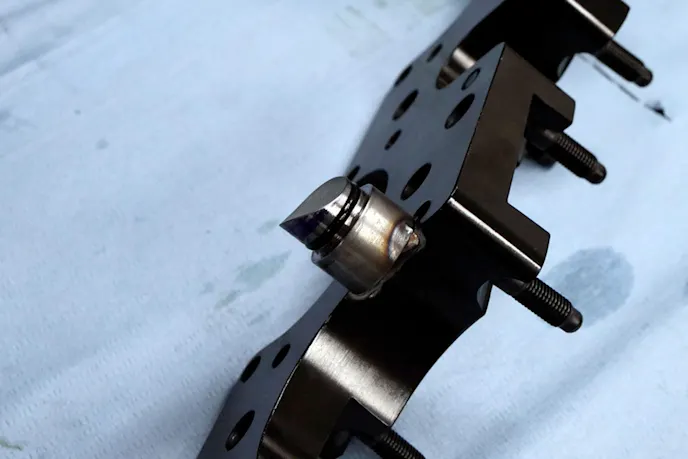
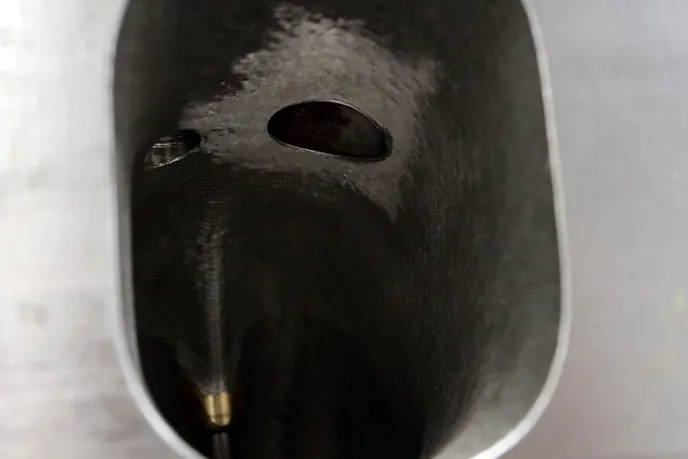
These heads prioritize intake flow above almost everything else. The ports are large, efficient, and shaped to keep the bulk of the airflow concentrated along the roof, where it matters most at high RPM. That leads to some unconventional packaging. In certain areas, the head studs actually intersect the intake ports. Rather than compromise the port shape, Wilkins works around it by using shorter studs, accessing them through access holes in the top of the ports, and then sealing everything meticulously to prevent leaks.
Air and fuel flow gets priority. Everything else adapts.
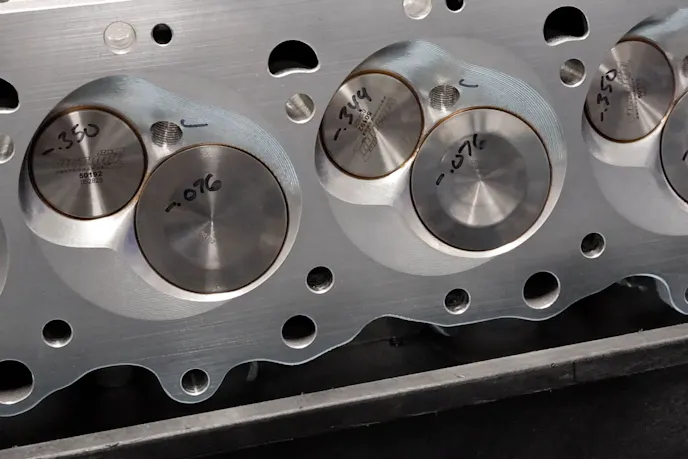
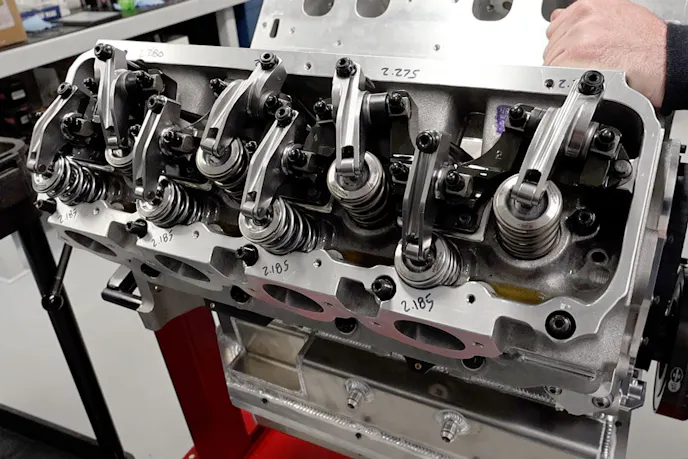
Valve size and placement are equally critical. With bore diameters this large, there’s room to run aggressive valve sizing. The intakes are sized at 2.550 inches, while the exhausts are 1.810, and both are constructed from titanium. In order to keep those big valves stable and also help move heat from the valves into the cylinder heads, the stems are slightly larger than usual at 5/16 for the intakes and 11/32 for the exhausts.
Massive half-inch pushrods minimize deflection, while shaft-mounted rocker systems with multiple offsets accommodate the aggressive port layout. Oil squirters in the rockers also help keep the valve springs alive under sustained high RPM, and both the locks are retainers are cut from titanium to reduce valvetrain mass.
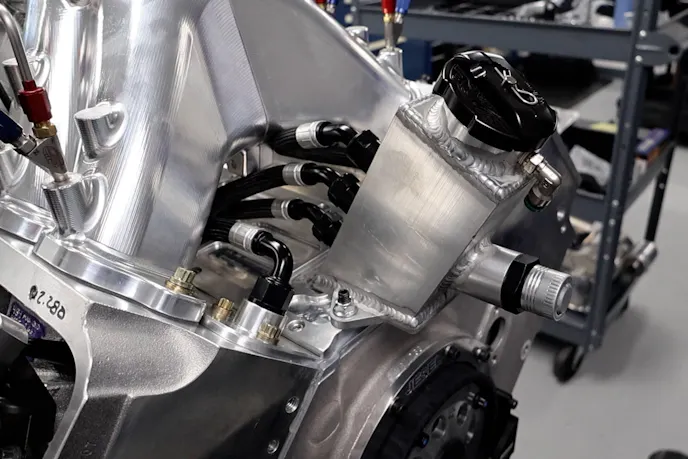
Again, none of this is revolutionary on its own. But together, it creates a system that can reliably spin to 7,700 rpm while making nearly 1,400 horsepower.
Dry Sump Efficiency and Smart Packaging
Oil control is another area where Wilkins leans heavily into efficiency. The engine uses a multi-stage dry sump system paired with a two-piece oil pan. The upper section is sealed directly to the block with silicone, eliminating the risk of gasket movement. The lower section bolts on with an O-ring seal, making it easy to access the bottom end of the engine at the track without creating a mess.
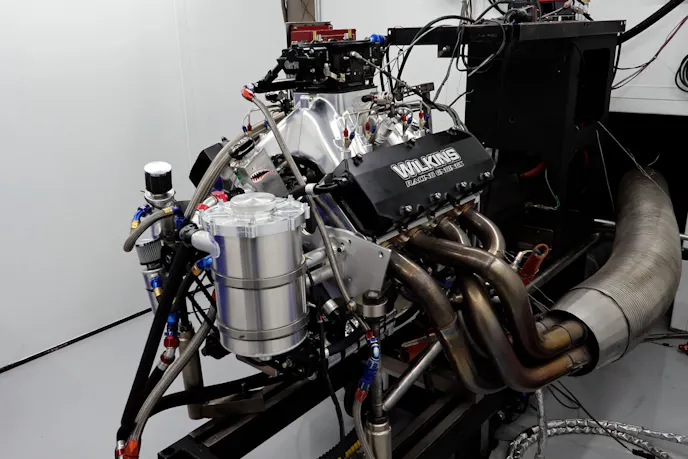
The pan itself is wide, pulling the walls away from the rotating assembly to reduce windage. It also leaves enough room for quick repairs — because even at this level, things happen. On the dyno we found that the dry sump system pulls around 11 inches of vacuum during operation, which plays a big role in reducing parasitic losses and improving ring seal.
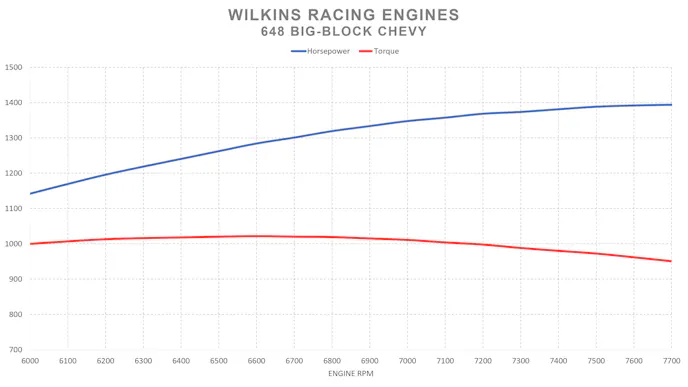
And speaking of the dyno, let’s get to the good stuff. After break-in and a handful of power pulls, the engine produced 1,387 horsepower at 7,700 rpm and over 1,200 lb-ft of torque at 6,600 rpm, all on Q16 fuel and a stout 16:1 compression ratio. And that’s without ever cracking the bottle on the nitrous system. Wilkins says that will be held in reserve for hot days at the track when the team feels they need a little bump to help them get to that 4.50-second index.
That’s serious power by any standard, but what makes it more impressive is how cleanly it’s delivered. This isn’t a peaky, fragile combination. It’s broad, repeatable, and built to live.
You might also like
Valve Spring Retainers: Discussing Durability Vs. Mass With Melling
Valve spring retainer material choice is a balance of durability, weight, and fitment based on application and use.