


For a long time, there have been a few stroker combinations for the 8.2-inch-deck-based small-block Ford engines that are the “go-to.” The king of those is the famous “347.” The combination is pretty straightforward: .400 inch of extra stroke, .030 of extra bore — both achievable from a stock 302 block — and boom, an extra 45 cubic inches (or about 15-percent more) of displacement. For decades this combination has been tried and true. And, it still is.
In 2026, the 347 combination is still not only effective, but easily done with no crazy custom parts thanks to the aftermarket support the small-block Ford platform enjoys. Simple, effective, and iconic: there really doesn’t need to be much more in the way of justification to build a 347. Especially if you have a 1993 Fox body like our compatriots over at Ford Muscle do, in Project Fox Dreams. This engine will be mostly period-correct, with a few advancements thanks to modern technology, and make some killer, reliable power. So, let’s jump into it.
The BOSS Is Back
Because we want the utmost in reliability, as well as a safety cushion to handle somewhere in the 700-horsepower range, a stock block was off the table. However, that doesn’t mean we’ll have a block without “Ford” on it. Ford Racing Parts offers their lineup of BOSS performance iron engine blocks, which are a perfect base for Throwback 347.
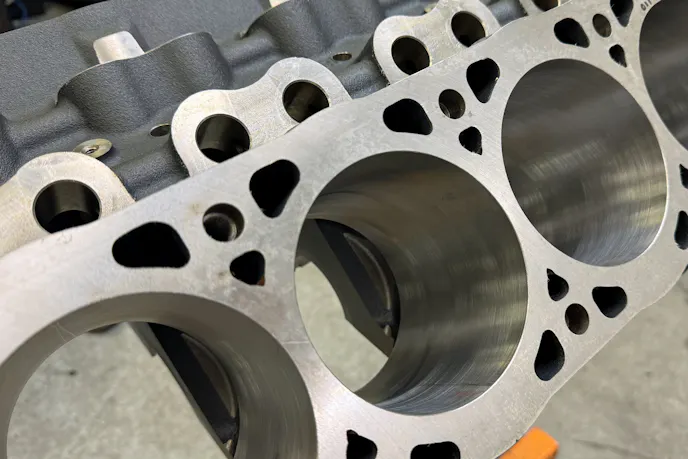
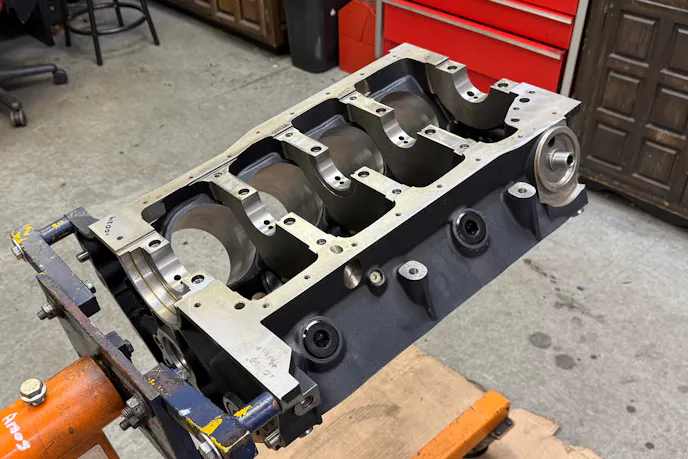
We’re starting with a BOSS 302 (P/N: M-6010-BOSS302), which is the 8.2-inch-deck variant of the block. Cast from diesel-grade iron, the block has material added in key areas for extra strength (as well as removed from some key areas, which we’ll talk about in a second), and will handle up to a 4.125-inch bore. However, for our purposes, we’re only adding .030 inch to the factory 4.000-inch bore, opting for the traditional overbore and the extra meat on the cylinder walls.
In addition to improved materials, there are a number of design improvements over the factory 302 block, including splayed four-bolt mains on numbers 2, 3, and 4, larger head-bolt holes for 1/2-inch diameter fasteners, revised oil routing, siamesed bores, and revised internal coolant routing. It even has a revised lower cylinder design, to allow clearance for strokers, eliminating the need for a die grinder. It’s an impressive block that combines aftermarket capabilities with OE fit and finish.
The 347 Rotating Assembly
With almost 50 years of aftermarket support, anything for the Fox body is pretty well scienced-out. Nothing proves that more than SCAT’s all-in-one 347 rotating assembly package. What was once something that required careful planning of parts to make sure that everything worked together and there were no last-minute surprises during assembly. Now, you just order P/N: 1-45310 directly from SCAT, and you not only get a forged rotating assembly, but balancer, rings, bearings, and flexplate as well.
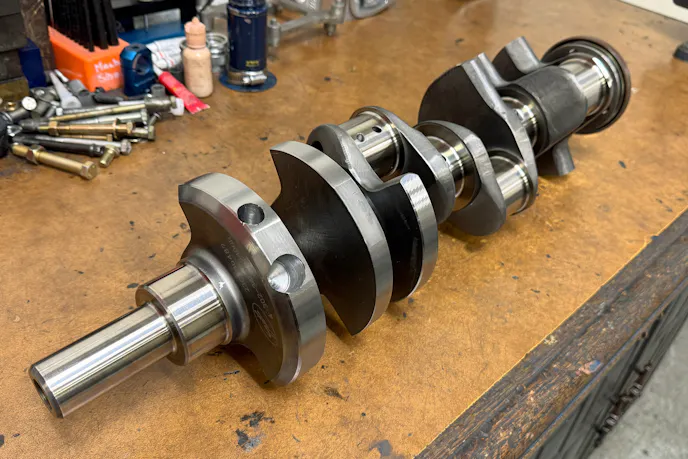
The core of the kit is SCAT’s forged standard-weight crankshaft (P/N: 4-302-3400-5400-2123). Made from a 4340 steel forging, the 3.400-inch-stroke crank is designed and manufactured with a 28-ounce imbalance, and the factory 302 main journal diameter (2.249 inches) and rod journal diameter (2.123 inches). The crank is precision machined and then nitride-hardened for extreme wear resistance. We opted for the standard weight version for maximum strength under boost.
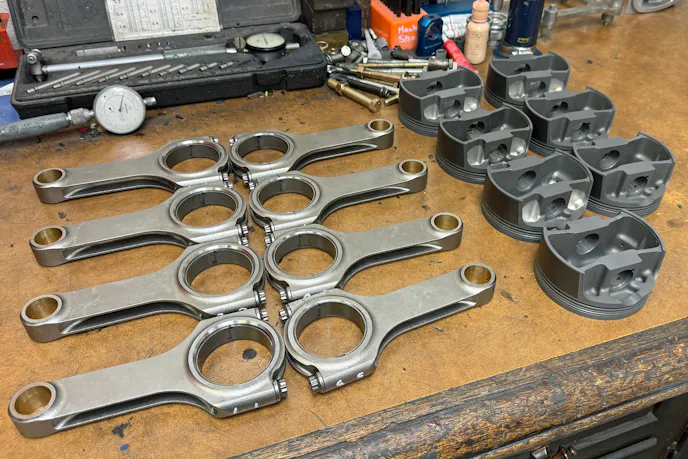
Also included in the kit are a set of eight SCAT 5.400-inch-long forged H-beam rods (P/N: 2-302-5400-2123-927). The H-beam design offers incredible compressive strength, while the caps are dowled, have been designed for improved stroker clearance, and upgraded with 7/16-inch-diameter 12-point ARP 8740 rod bolts. Like the crankshaft, the rods are made from forged 4340 steel and have a bushed, free-floating .927-inch small end.
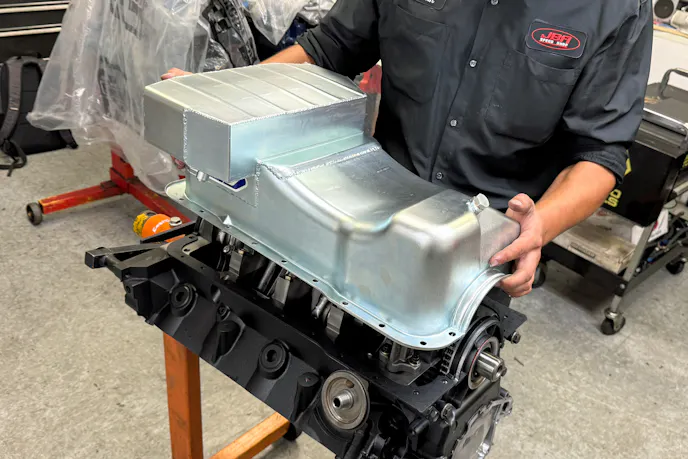
For pistons, the kit includes a set of MAHLE’s PowerPak forged flat-top pistons and rings. Designed specifically for a 347-cube application, MAHLE’s P/N: SBF090030F06 piston kit is made from forged 4032 aluminum and phosphate-coated, giving them the signature MAHLE gray appearance. The skirts feature MAHLE’s Grafal anti-friction coating, and the top ring land is hard-anodized for wear resistance under high cylinder pressure.
The PowerPak kit also comes with .927-inch heavy-duty wrist pins and pin locks, as well as a set of 1.5mm, 1.5mm. 3.0mm piston rings. The top ring is a ductile iron ring with a plasma-Moly coating, while the second ring is a cast iron reverse-taper design. The 3.0mm oil ring offers great oil control without undue drag in the bore.
Throwback 347’s Bottom End
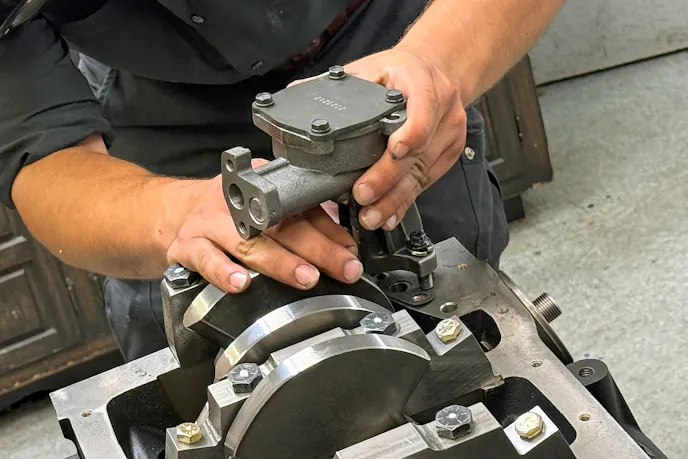
As mentioned earlier, the SCAT rotating assembly kit comes complete with Clevite main (MS-590H) and rod (CB-634HN) bearings, as well as SCAT’s 28-ounce, SFI-certified harmonic balancer (P/N: 8006) and 157-tooth flexplate. In order to provide oil to the bearings, we opted for a standard-volume Melling M68 oil pump, coupled with a Canton oil-pump pickup specifically designed for the rear-sump Fox Body Mustang oil pan (P/N: 15-640).
The Canton oil pan is a T-sump street oil pan design that adds volume through an expanded rear sump design, for a seven-quart capacity. It does so without increasing the depth of the pan, and incorporates a crank scraper to help control windage and a slosh baffle to keep the pickup submerged in oil at all times.
Wrapping up the short block is a Howards Cams double-roller timing chain kit with a three-way adjustable lower sprocket allowing 4 degrees of crankshaft advance or retard. A reproduction Fox Body front timing cover seals up the timing components and finishes off the bottom end of the engine.
The 347’s Top End
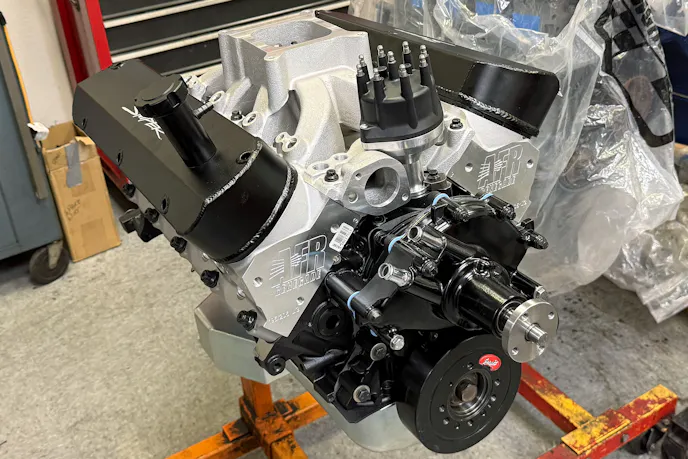
With the extra displacement of the stroker bottom ends (as well as the boost we’ll be applying), the key to efficiency lies in the cylinder heads. For those, we turned to an OG name in the small-block Ford game, Air Flow Research. They have a wide variety of cylinder head options, and for this combination, we opted for the Renegade series of cylinder heads with a 195cc intake runner volume (P/N: 1383-716).
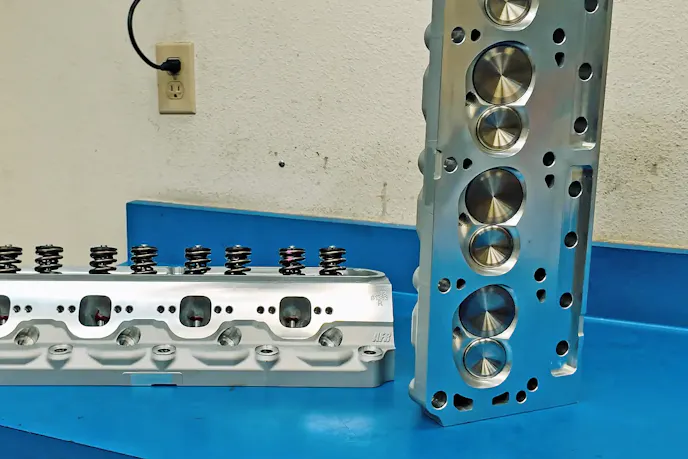
The Renegade series of heads all feature 100-percent CNC-machined intake and exhaust ports, as well as combustion chambers. Manufactured from A356 aluminum, the Renegade castings are then put through AFR’s complete CNC treatment to create a 195cc intake port, 70cc exhaust port, and 72cc combustion chamber volume to keep the compression ratio in check, since this will have to live on California pump gas.
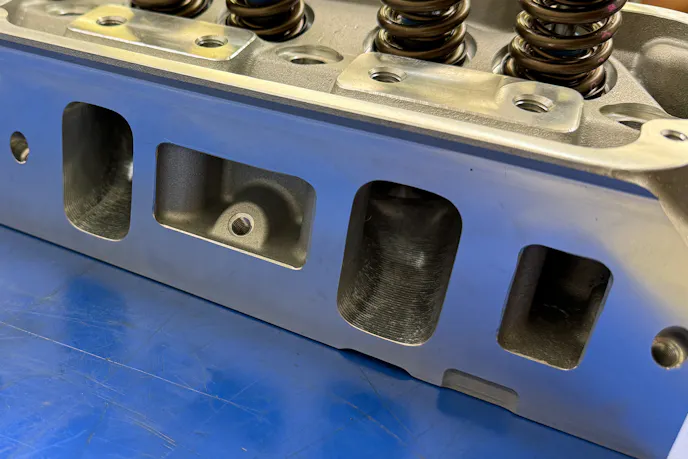
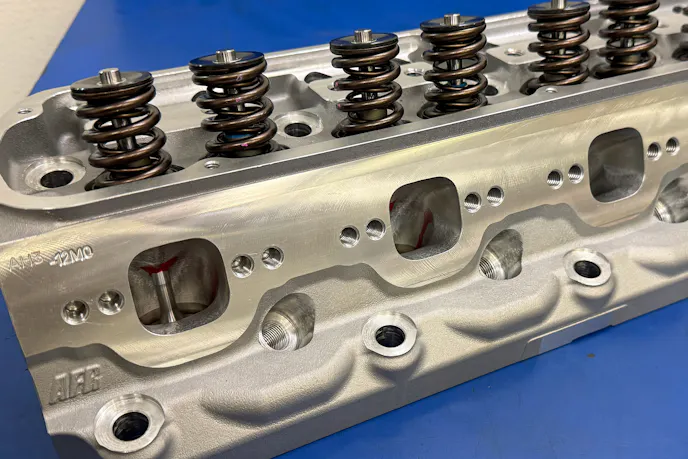
The Renegade 195cc heads come with 2.050-inch-diameter stainless steel intake valves, 1.600-inch stainless steel exhaust valves, and upgraded valve springs (P/N: 8019). The upgraded spring is made from chrome-silicon steel and has 155 pounds on the seat with a maximum valve lift of .650 inch. The intake ports flow 298cfm at .650 inch of lift, and the exhaust ports flow 231cfm at .650 inch of lift.
Sealing and securing the cylinder heads to the block under boost is no small task, so we made sure all the parts were up to snuff. Starting with a half-inch diameter ARP head stud kit, JBA Speed Shop opted for an FE head stud kit for additional length on the short studs to take up the extra depth of the BOSS block blind bolt holes. With .040-inch compressed-thickness Cometic MLS head gaskets (P/N: C5961-040) in place, the studs were torqued to a full 110 lb-ft, ensuring perfect sealing under all of the combustion pressure.
Controlling the valves is an Andrews custom camshaft. We asked them for a cam spec’d for a 700 horsepower street engine, and they whipped up a cam with .595 inch of lift on both the intake and exhaust lobes with 236 degrees of duration at .050 inch of lift, with a 114-degree lobe separation angle. Riding on the lobes of the cam are a set of Howards Cams Street Series hydraulic roller retrofit lifters (P/N: 91168). While the BOSS 302 block has provisions for the OEM-style spider and dogbone lifters, we opted for the link-bar retrofit style for ease of installation.
Sitting on top of those lifters are a set of Howards 6.250-inch-long, 5/16-inch-diameter, .080-inch wall-thickness chromoly pushrods (P/N: 95302-16). Up top, those pushrods sit inside a set of Howards billet aluminum rocker arms (90081). They are designed for the upgraded 7/16 stud mount of the AFR heads, and feature a roller tip and needle-bearing trunnion for maximum friction reduction. The bodies are designed for up to 800 pounds of spring force, while still providing plenty of spring and retainer clearance in the body design.
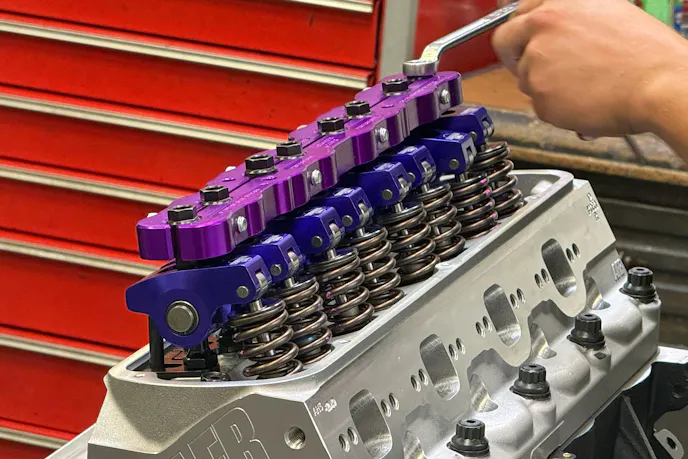
Then, to absolutely ensure valvetrain stability, a pair of Howards Maximum Effort Stud Girdles (P/N: 90201) were utilized. By attaching to the rocker arm studs and tying them all together with a rigid billet bar, the girdles reduce, if not eliminate completely, valvetrain flex and ensure that all of the cam’s commanded lift is delivered to the valves.
A Unique Topping
While there are a variety of retro and modern intake manifolds available for EFI small-block Fords, the engine’s owner decided to be somewhat unique here. Starting with a Holley 4150-flange single-plane intake manifold plumbed for fuel injectors (P/N: 300-276), a 90-degree throttle body intake elbow (P/N: 300-240) was added, along with a 102mm Sniper EFI LS-style throttle body (P/N: 860002-1). While it sounds fairly custom, with the 90-degree elbow aimed at the passenger side of the engine, the throttle body inlet should be in a relatively close-to-stock location.
And with that, our day at JBA Speed Shop was wrapped up. However, we aren’t done yet, as we still have to plumb the injectors and fuel system, and install the Vortech V-3 Ti-trim supercharger, as well as put the engine on the dyno. All of that is scheduled to happen in the next installment of Throwback 347.
You might also like
Piston Ring Tension: Understanding Force and Friction
Piston ring tension is more than a catalog number. Learn how force, friction, and testing methods affect your ring package.