


When it comes to motor oil chemistry and analysis, few people bring more knowledge and hands-on experience to the table than Lake Speed, Jr., better known as The Motor Oil Geek. Speed has been on a mission to separate fact from fiction in engine oils, putting popular products through rigorous laboratory testing instead of relying on marketing claims. Now he’s examining marine engine oil vs. Shell Rotella in gas engines to see how the different formulations compare.
In this latest video comparison, Speed tackles a question that many boat owners have probably wondered about: is marine-specific engine oil really necessary, or can a diesel engine oil like Shell Rotella provide the same protection? For this comparison, Speed tested several products at the High Performance Lubricants facility in Manteno, Illinois. They included three Rotella formulas, two Mercury Marine oils, and other marine and automotive products. He ran six tests, including two focused on moisture protection and foaming.
Comparing Foam Control: Keeping Air Out Of the Oil
Foam control matters because gasoline marine engines often run at sustained high speeds. For example, a ski boat may hold high RPM while towing a skier. Air trapped in the oil can reduce its ability to lubricate moving parts. So, Speed measured both foam formation and how quickly the bubbles collapsed.
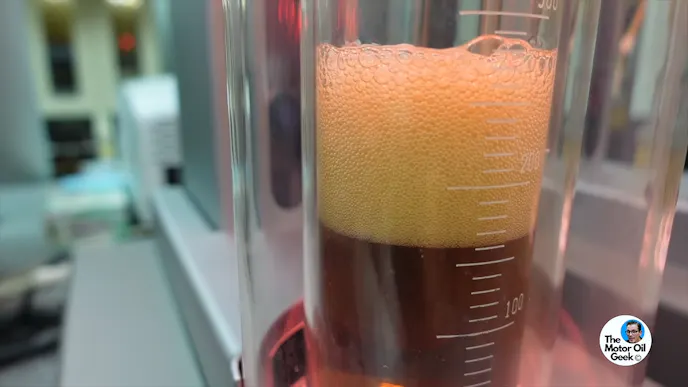
Honda and Yamaha tied for the quickest collapse at 26 seconds. Next came Lucas, at 33 seconds, Valvoline at 34, and Rotella T4 at 36. NAPA 10W-40 needed 42 seconds, while the Mercury oils took 53 and 56 seconds. In contrast, Rotella T5 and T6 left stable foam exceeding 50 milliliters after testing. Those results favor several of the marine formulations over Rotella for high-RPM foam control.
Shear Stability: How Shell Rotella Compared
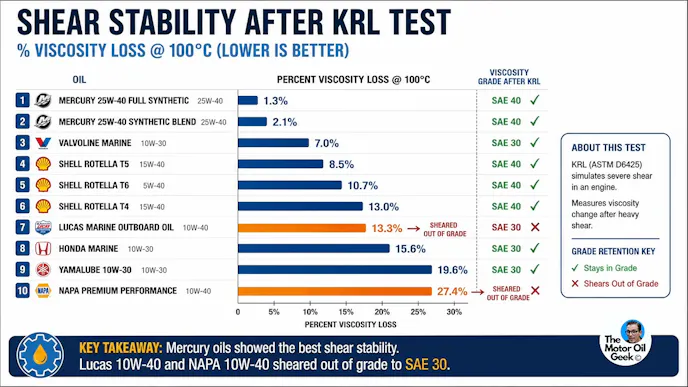
The KRL test measures an oil’s resistance to permanent viscosity breakdown under mechanical stress. As boats push through the water, their engines face sustained loads. The oil must maintain its viscosity despite that mechanical stress. Both of the 10W-40 products tested lost viscosity and sheared outside their specified grade. In contrast, all three Shell Rotella oils T4, T5, and T6 stayed within their specified grades.
Even Rotella T6 5W-40 remained within grade, despite its unusually wide viscosity spread. Speed credits more shear-stable viscosity modifiers for that difference. Meanwhile, Mercury 25W-40 recorded the least viscosity loss. The takeaway is simple: viscosity grade alone does not predict an oil’s shear stability.
Elemental Analysis: What’s in the Additive Package?
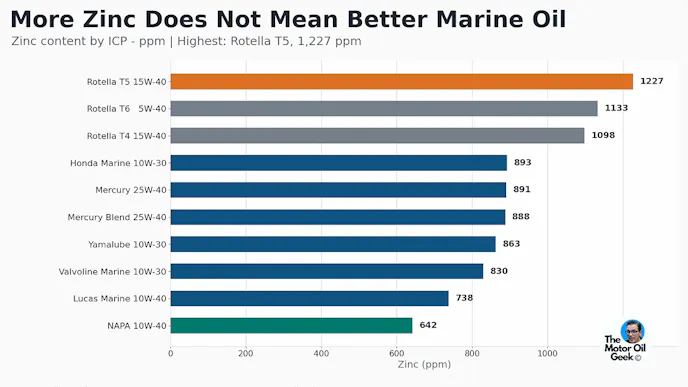
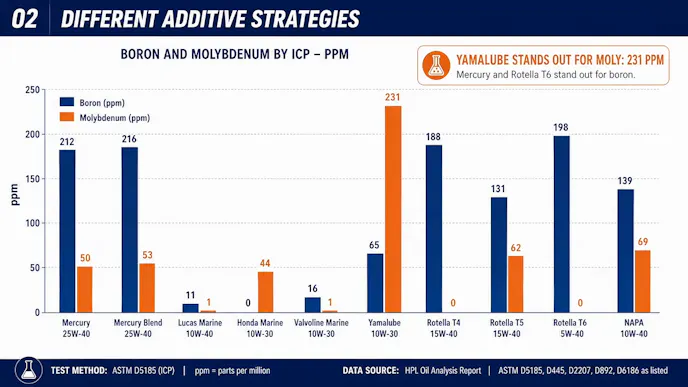
The ICP test identifies elements used in detergents and antiwear additives. In particular, Speed examined calcium because some high-calcium oils can contribute to low-speed pre-ignition (LSPI). This concern primarily affects certain gasoline direct-injection engines, especially turbocharged versions.
Speed used roughly 1,500 parts-per-million of calcium as a reference point. Every marine and diesel engine oil in the comparison exceeded that level. However, the API SP-rated NAPA oil came in below it. Zinc and phosphorus levels in the marine oils and NAPA fell within API SP limits. Meanwhile, the three diesel oils fell within API CK-4 limits. Boron and molybdenum (moly) levels also varied among the oils. However, Speed found nothing unusual in their antiwear additive levels. These measurements describe additive chemistry, not overall engine protection.
Oxidation Stability: How Shell Rotella Compares
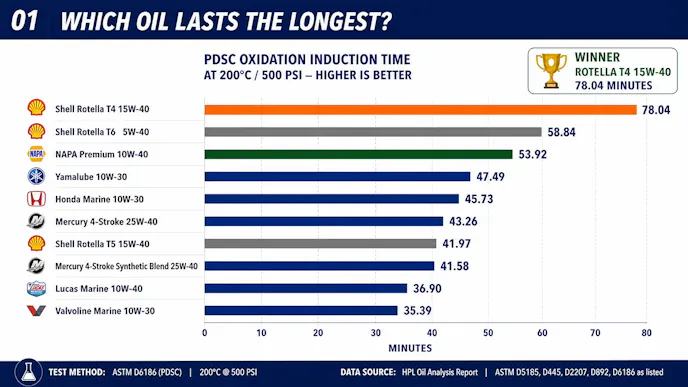
The PDSC test measures how long an oil resists oxidation under accelerated lab conditions. Oxidation breaks down engine oil over time, making its resistance important. Rotella T4 led decisively at 78 minutes. Surprisingly, a conventional oil hung with Rotella T6 in the fight for second place. And the remaining oils ranged from 35 to 48 minutes. Still, these are comparative laboratory numbers. They do not establish safe oil change intervals for your boat.
FTIR: A Chemical Fingerprint
FTIR uses infrared spectroscopy to examine an oil’s molecular chemistry. The technique can identify oxidation products, contamination, and chemical changes associated with additive depletion. The test highlights differences between used motor oil and a fresh sample. Combined with other tests, FTIR offers a more complete picture of an oil’s chemical characteristics and performance.
Marine Oil vs. Shell Rotella: Corrosion Protection
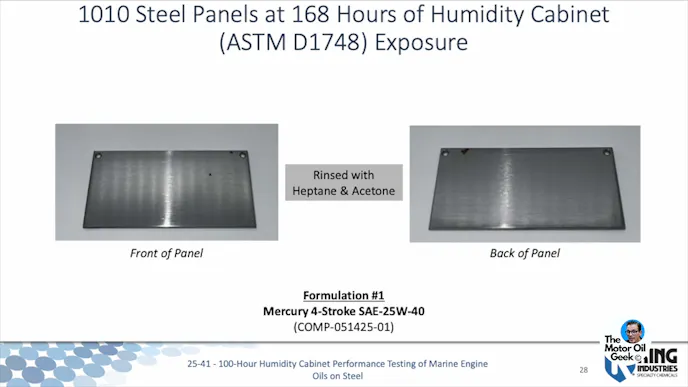
Marine engines often sit unused in humid conditions. That makes corrosion resistance critical, especially during storage. Speed used a humidity cabinet to expose oil-treated steel samples to moisture over time. After 168 hours, five oils showed no rust on either side of the test panels.
By comparison, Rotella T5 showed corrosion on both sides after just 36 hours. This also challenged the assumption that more calcium automatically provides better corrosion protection. However, it was a controlled steel-panel test, not a long-term engine-durability trial. Regardless, once again, it was a check mark for the marine-specific oil formulations.
What Do the Results Mean for Boat Owners?
Speed has previously demonstrated why diesel engine oil can be problematic for gasoline direct-injected engines. We covered those findings in our earlier article, Is diesel oil actually worse for your performance engine?. But what about gasoline engines using port fuel injection? That’s the question this latest comparison seeks to answer.
Marine oils generally performed better in foam testing, an important consideration for high-RPM gasoline engines. However, Rotella T4 delivered impressive oxidation resistance and corrosion protection. Meanwhile, Rotella T5 and T6 produced stable foam, highlighting significant differences even within the same product family.
These findings don’t establish diesel oil as a suitable replacement for marine oil. Instead, they demonstrate why an oil’s formulation matters more than its label. As Speed frequently reminds viewers, “application dictates chemistry.”
Ultimately, choosing the right oil means understanding an engine’s operating conditions and following its manufacturer’s specifications. Laboratory testing helps explain why certain formulas perform better in specific applications, for those of you who need to see to believe.
You might also like
How Material Choice Affects Your Harmonic Damper Choices
The material of your harmonic damper's components plays a huge role in both the performance and longevity of the balancer.