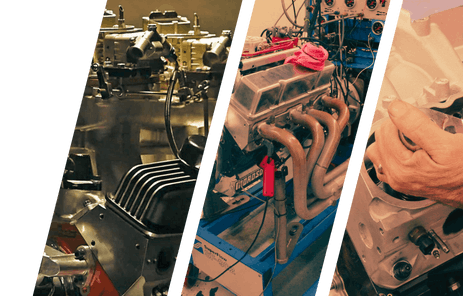



Building is only half the battle when it comes to the 632 cubic-inch big-block Chevrolet engine for the EngineLabs Giveaway presented by Summit Racing. For anyone needing to get caught up, Nick Bacalis of Bullet Racing Engines got most of the bottom-half wrapped up on day one of the PRI Show. The top half of the engine was assembled over days two and three of the PRI Show, with the final bolt torqued about two hours before the end of the PRI show.
However, a storm of the decade blew in on Friday evening, resulting in a large number of attendees bailing prior to the end of the show, trying to beat the storm for those driving, or getting on an earlier flight for those flying. That appeared to be a good move as Saturday was met with significant snowfall and frigid temperatures. That didn’t affect us until Sunday morning, as we loaded the complete engine into our van in -4 degree weather and ankle-deep snow on top of ice on the sidewalk.

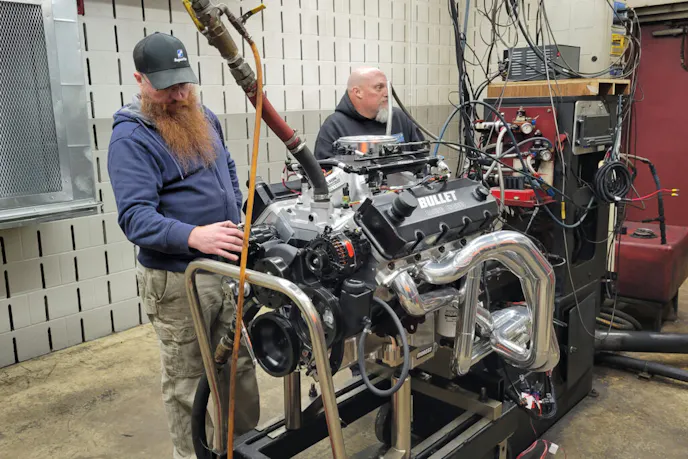
Aside from the treachery of loading and getting out of the Indianapolis metro area in that weather, the three-hour drive to the University of Northwestern Ohio was relatively uneventful. Once we arrived at UNOH, we were greeted by Greg Hill, and treated to a tour of the facility. The UNOH students then unloaded the engine for us, and we got the engine ready on the dyno.
On The UNOH Dyno
With the engine mounted to the SuperFlow dyno, we filled the fuel cell with ETS Racing Fuels‘ 94-octane XS EVO fuel and made all the connections for the Holley EFI Dominator ECU kit (P/N: 550-654). The setup of the ECU was easy thanks to our friend Jimmy Plimpton of Plimpton Innovations, as we were running the relatively new billet 12-1 crank trigger kit for the big-block Chevy (P/N: 556-170). Thanks to the Holley EFI software, accounting for that was as simple as selecting the 12-1 crank trigger in the ignition drop-down menu and choosing the correct firing order in the software. It automatically detected and calibrated all of the sensors we had installed, and we were ready to manually set the mechanical timing.
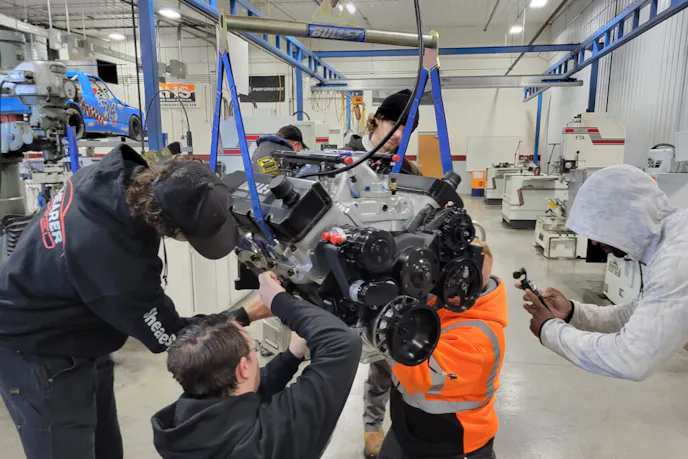
Once mechanical timing was set, we started to break the engine in. However, we started to encounter issues. When we started to make pulls, we ran into a stumbling issue. After a significant amount of troubleshooting, we realized the charge temps were flat out too cold. Even with heaters on in the dyno cell, as soon as outside air was drawn in from the ventilation system, IATs plummeted. We tried a workaround, where the cell was brought up to 68 degrees, and the automatic control of the dyno vents was turned off. While that resulted in the only full pull of the day, the vents did open halfway through the pull, creating a huge dip in the graph.
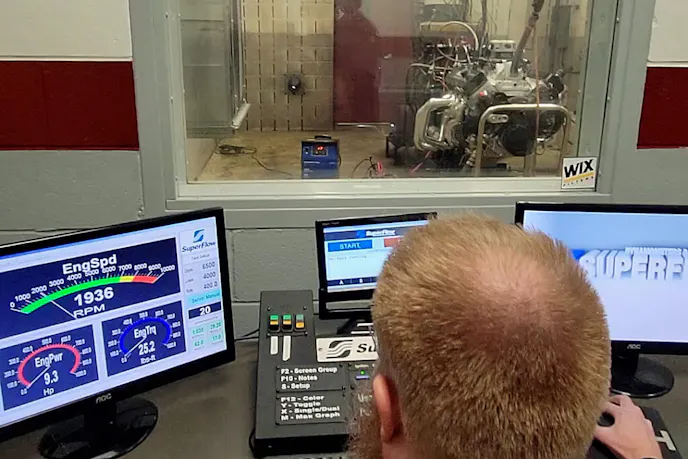
With our window to get back to Indy to catch our flights rapidly closing, we were forced to press pause and pull the engine off the dyno, load up, and head to the airport.
Sunny Skies and Warmer Weather
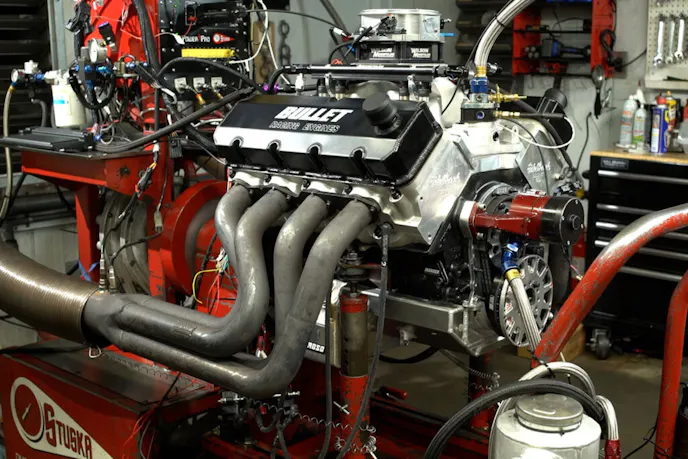
Two months later, when the weather was significantly better, Bacalis loaded the engine back into the van and drove down to Paris, Tennessee, to Cobb Racing Enterprises to give the engine another round on the dyno. This time, with much warmer weather and a correction factor that didn’t take power away from the engine, we planned on a much more fruitful session.
After getting everything warmed up, the first pulls were made, and the engine was firmly in the 950-horsepower range. Several timing and fueling adjustments later, and the engine was… in the 950-horsepower range. Those adjustments ranged from 30 to 38 degrees of timing, and from 12.5:1 to 13.2:1 air-fuel ratios.
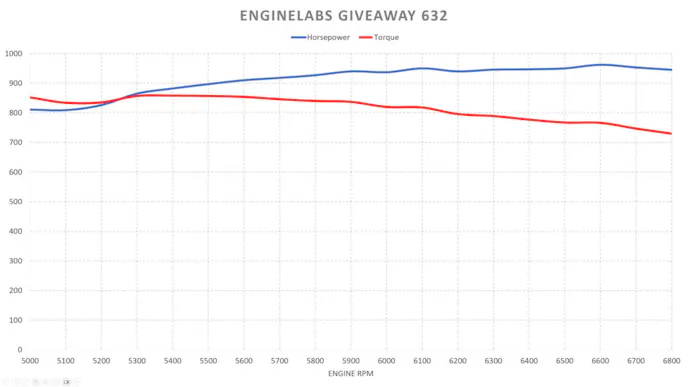
Bacalis went through a painstaking process of troubleshooting, including dumping in some high-octane race gas they had lying around, and the result was still in the 950 horsepower range. Returning to the XS Evo fuel, some final strokes of the keyboard and the Dominator ECU commanding 34.5 degrees of timing and 13.2:1 AFR saw a minor improvement, with the last pull showing 962 horsepower at 6,600 rpm and 858 lb-ft of torque at 5,400 rpm. The real shocker was the average numbers.
Average horsepower across the 5,000 to 6,800 sweep was 911 horsepower, and torque averaged out to 815 pound-feet. As you can see in the graphs, the curves are far flatter than anyone expected. “It seems like we just ran out of camshaft,” says Bacalis. “When an engine flattens out like that and doesn’t respond to any changes, there’s usually a single component that is maxxed out.” As a reminder, the 632 has a .729/.708-inch lift cam with 264/278 duration from Cam Motion, so it’s no slouch. To hit the magical four-digit number, we’d need either a less stingy dyno or a less street-friendly camshaft.
Bacalis is quick to point out that whoever wins the engine will be getting a killer street package. “We’ve proven that it’s not sensitive to the tune-up, so whoever wins it won’t hurt it if they play with the tune-up at all. And with that torque curve, someone is going to have all the power they could ever want on the street, and then some,” says Bacalis.
And that’s really the point of this engine, is to provide a silly amount of power for someone’s street car and provide dozens of smiles per gallon while absolutely annihilating the rear tires at any speed and RPM. “Whoever wins this should probably buy stock in whatever their preferred tire brand is,” Bacalis laughs.
Make sure that if you’re reading this before April 2, 2026, that you head over to www.enginelabsgiveaway.com and get entered. It’s completely free, and there a multiple ways to get multiple entries. The fact is, this engine will be going to someone reading this, and that very well could be you. So what are you waiting for?
The 2026 EngineLabs’ Engine Giveaway is presented by Summit Racing and made possible thanks to partnerships with Bullet Racing Engines, University of Northwestern Ohio, Automotive Racing Products, ATI Performance Parts, Bendpak, Cam Motion, Cometic Gaskets, Edelbrock, ETS Racing Fuels, Ferrea Racing Components, Holley, Jesel, JLine Performance, King Bearings, Klotz, Lemons Headers, Manton, Melling, Moroso, Powermaster, RaceTec Pistons, Total Seal, Williams Performance Products, and Wilson Manifolds.
You might also like
World's First Type Approval For Marine Ammonia Engine
Ammonia combustion engines are becoming more and more of a reality Every day. This engine could revolutionize heavy marine shipping.