


We’ve heard this come up time and time again. Someone is gapping their rings and notices that the oil ring expander is too long for their bore, and it overlaps. Well, it’s usually found while in the process of trimming piston rings to fit, so the first instinct is to cut the expander to fit. But, that is 100-percent the incorrect move.
Total Seal’s Keith Jones gets the question of whether or not to trim a piston ring expander a whole lot more than anyone else. So, to that end, he put together the above video to help educate everyone on the oil ring expander in general. It’s a deceptively simple piece of technology that is critical to keeping our engines from burning oil.
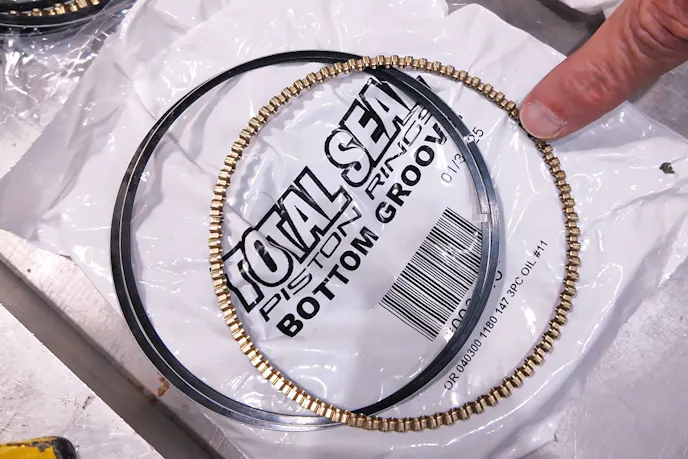
It’s A Spring, Not A Ring
The biggest point to understand, for the proper mindset when thinking about the piston ring expander, is that it is not a piston ring, but a spring for your two oil control rings. The modern expander design comes from Hastings, and Jones explains how that design became the king over its competitors.
“What Hastings figured out was that if they separated the expander from the rings, they could take one expander, and combine it with different rail depths, effective ring tension can be changed,” explains Jones. “Just like a valve spring, the more I compress it, the more pressure it makes. The less I compress it, the less pressure it makes.
The expander doesn’t ever touch the cylinder wall. That is an important fact to remember. “The expander rides on the inside diameter of the oil control rings. The expander only sees that dimension, not the diameter of the bore,” says Jones. “I can take that same expander and combine it with deeper radial depth rails for more compression, or shallower radial depth rails for less compression, all using the same expander.”
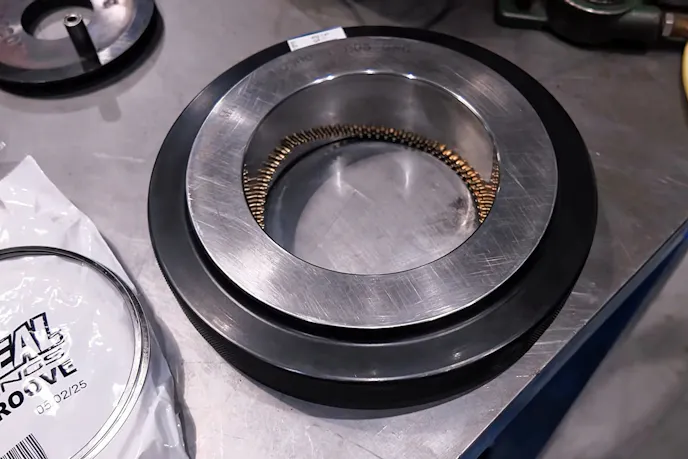
Explanations are good, and all, but Jones then goes through with a practical demonstration with a Mercury gauge, a single oil ring expander, and four sets of oil control rails to highlight how the parts interact with one another. Make sure to watch the video, because you have to see the fact that expanders can run the gamut from a .200-inch gap, to overlapping when checked in the bore, because the bore diameter isn’t what is influencing the expander at all, and the free-gap of the expander in the bore doesn’t affect the ring tension like you might think.
Jones leaves us by cautioning, “It’s almost impossible to read a flex-vent-style expander just by putting the expander in the bore. If you’ve got questions about your piston ring tension, call us. Don’t clip the expanders because you could drop the tension down to nothing because you don’t know what it was to start with.”
You might also like
Opel C20XE: The Awesome Engine GM And Cosworth Teamed Up On
In the 1980s Cosworth partnered with GM Europe to make an incredible performance engine out of a production four-cylinder; the C20XE.