
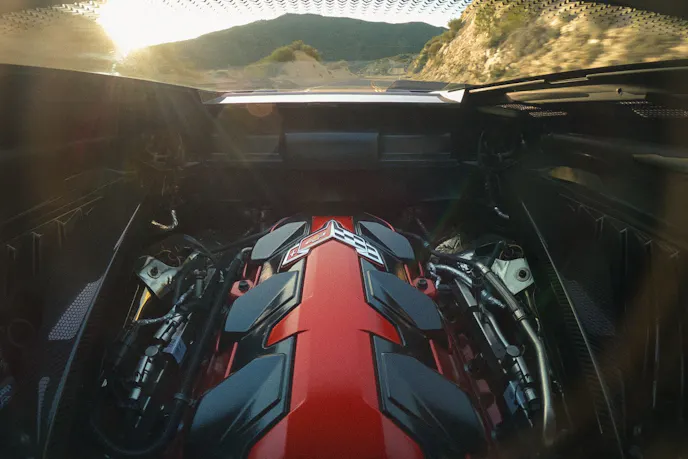
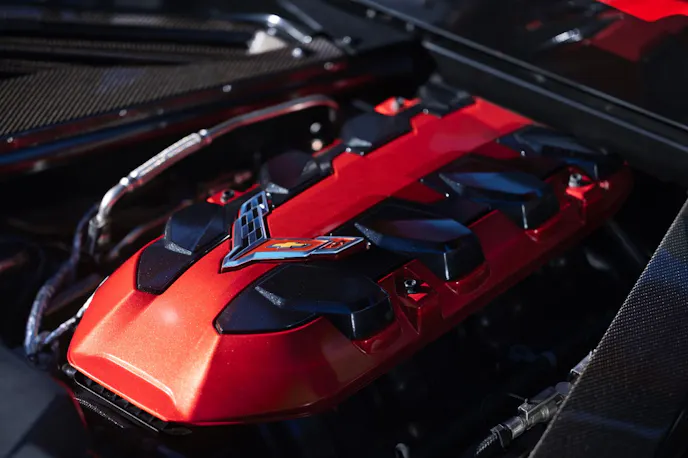
There’s a lot of history all rolled up into the latest V8 engine Chevrolet’s engineers just unveiled to the public. First of all, they dropped the last-generation LT nomenclature and went back to the LS. There’s a lot of weight that comes with the LS name, since it is the LS engine that brought about a revolution when it comes to producing big power reliably and on a budget. And then they stuck the 6 at the end to designate this as the sixth generation of their small block engine. And on top of that, it displaces 409 cubic inches. If you aren’t familiar with why the 409 is critically important in Chevrolet history, we’ll just tell you it’s also called the Mark I big-block and ask you to Google it.
Chevrolet doesn’t just roll out brand new engine designs casually, or often. When word started circulating that the LS6 badge was coming back, many assumed it would follow the same playbook as many other manufacturers dealing with modern problems. Smaller displacement, higher RPM, maybe a little help from boost. That’s not what happened at all.
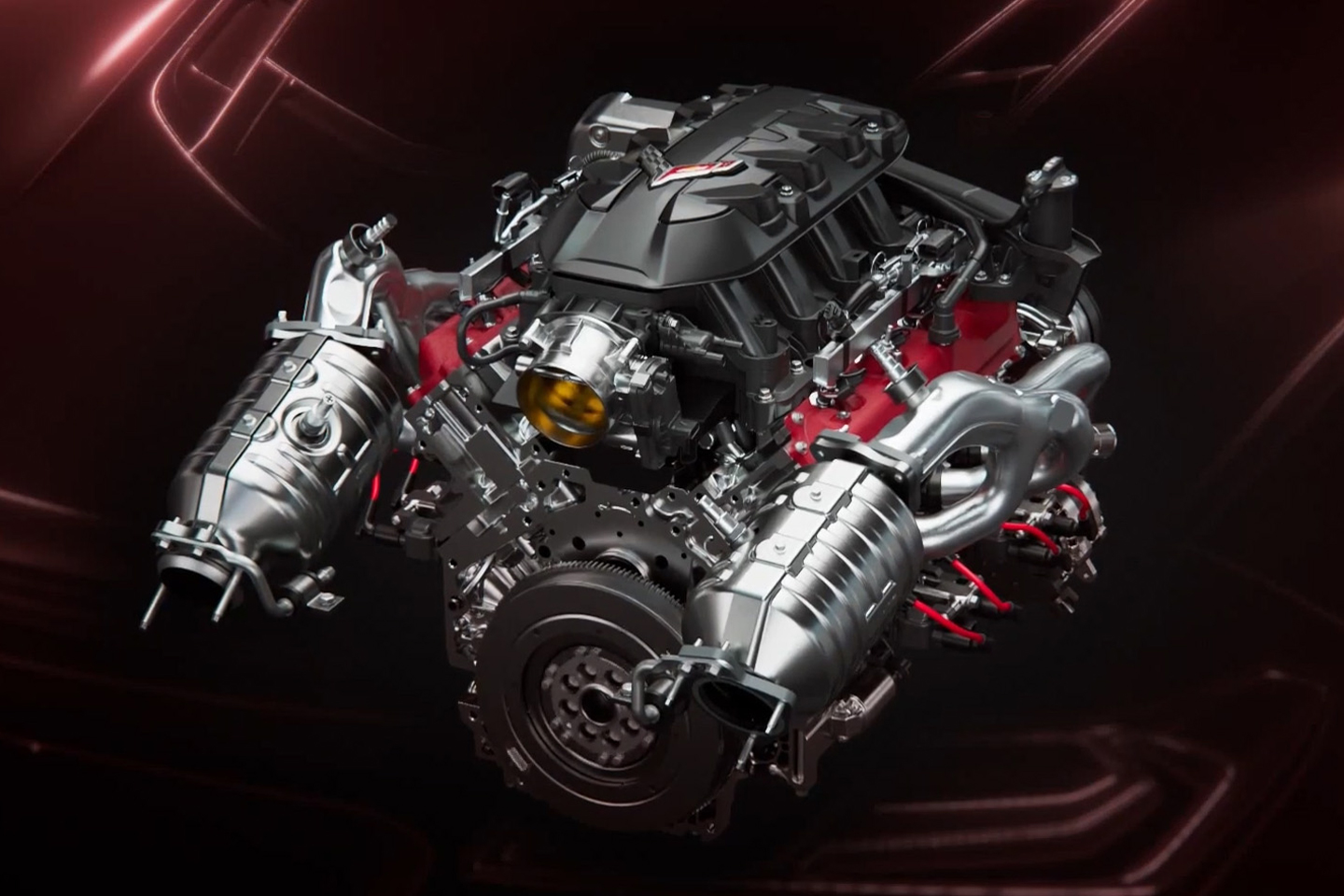
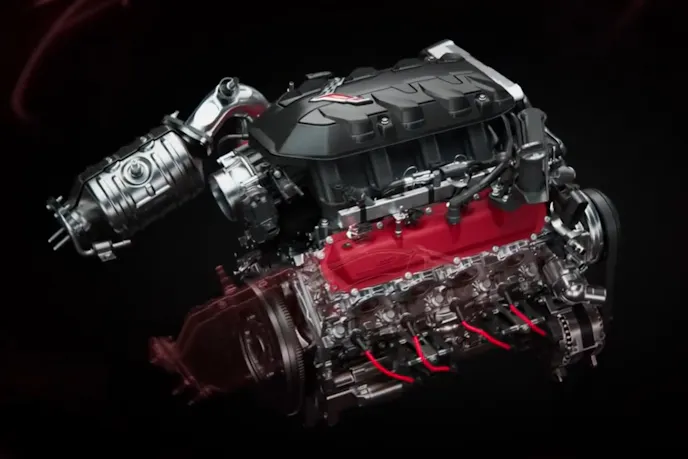
We still haven’t been allowed a deep dive into the new LS6’s architecture, but here’s what we do know. It’s going to be pushing lots of displacement. Chevrolet built a 6.7-liter, naturally aspirated small-block that leans hard into displacement, torque, and drivability. We’re told it’s a big evolutionary step forward on the Gen V architecture, and it will be showing up first in the Corvette Grand Sport. It’s the next chapter in the small-block story, and that’s a big deal for those of us who still appreciate the old-school cam-in-block design.
Big Inches, Real Torque, and No Apologies
Let’s start with the numbers, because they tell you exactly what Chevrolet was aiming for. The new LS6 displaces 6.7 liters, or 409 cubic inches, and produces 535 horsepower at 6,100 rpm and 520 lb-ft of torque at 4,600 rpm.
That torque number matters more than anything else here. Chevrolet is shouting from the rooftops that this engine produces the most torque ever from a naturally aspirated Corvette V8, and it’s not just a sharp peak that falls off a cliff on the dyno chart. The goal was to build an engine with a broad, usable powerband that delivers everywhere in the rev range.
To get there, engineers increased displacement by stretching the stroke from the older LT2 engine from 3.62 inches to 3.94 rather than chasing a bigger bore, staying at 4.065 inches there. That tells you everything you need to know about the philosophy behind this engine. A longer stroke increases piston speed and cylinder pressure at lower RPM, which builds torque early and keeps the engine responsive in real-world driving.
Mike Kociba, the assistant chief engineer for GM’s small-block program, put it pretty plainly. The team wanted to “recreate some of what worked in the muscle-car era” with a wide torque band and strong output across the curve. So the engine is not chasing peak numbers at the top of the tach. It’s designed to hit hard everywhere.
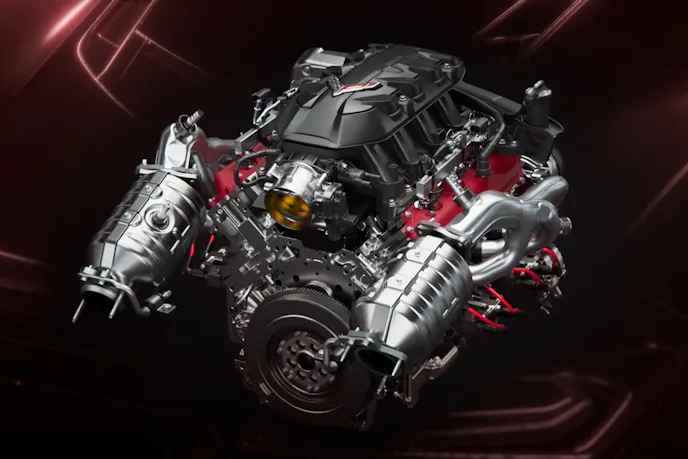
Even though the LS6 leans heavily into displacement and torque, it’s not a throwback design. Under the surface, it’s packed with modern tech that makes those old-school goals possible. One of the biggest changes is the move to a dual fuel system designed to benefit from the best parts of both port and direct injection. GM refers to this as PDI, and it’s a major step forward for the small-block platform.
Direct injection allows for precise fuel control and supports the engine’s high compression ratio, while port injection helps with fuel distribution and limits carbon buildup on the intake valves because it blasts the fuel from the intake port and across the back of the valves. For engine builders, this is the kind of setup that opens doors. It allows for better combustion stability under load, more consistent performance at higher RPM, better engine life and improved drivability across the board.
Airflow is another area where the LS6 takes a noticeable step forward. The engine uses a larger 95mm throttle body paired with a tunnel-ram-style intake designed to increase air velocity into the cylinders. That last part is easy to overlook, but it’s critical. High airflow numbers don’t mean much if the air isn’t moving efficiently. By focusing on velocity as well as volume, Chevrolet is improving cylinder fill throughout the RPM range, not just at peak power.
The result is an engine that shouldn’t feel like it needs to be spun to the moon to make power. It builds it naturally and carries it through the rev range in a way that’s going to feel familiar to anyone who still loves big-inch old-school engines.
One of the more eye-opening specs on the LS6 is its 13.0:1 compression ratio. That’s the highest ever used in a Corvette V8, and it puts this engine firmly into territory that used to be reserved for race builds. Just a few years ago that number would have been unimaginable on anything that even hoped to burn pump gas.
That incredible 13.0:1 ratio becomes possible thanks to the dual-injection system, which gives engineers more control over the fuel curve. Meanwhile, improvements in combustion chamber design and cooling allow the engine to manage heat and avoid detonation. The engine cooling system has been revised to better manage temperature distribution across the heads and cylinders.
This is where you really see how far OEM engine development has come. High compression, large displacement, and street drivability used to be a balancing act requiring compromises all over the place. Now thanks to better controls and smarter design, those compromises are shrinking. And that’s before you even get into the lubrication system, which includes a continuously variable oil pump designed to maintain optimal pressure under a variety of operating conditions.
Corvette Grand Sport and the Bigger Picture
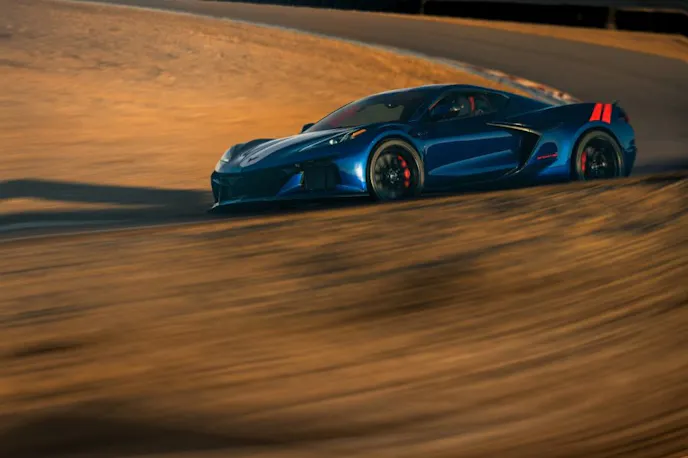
The LS6 makes its debut in the Corvette Grand Sport, and it will also become the base engine in 2027-and-up Corvette Stingrays. The Grand Sport is positioned as a purist’s Corvette, pairing rear-wheel drive with a naturally aspirated V8 and a chassis that’s capable both on the road and track.
It’s available with multiple performance packages, ranging from a more street-focused setup with all-season tires and magnetic ride control, to track-oriented configurations with carbon-ceramic brakes and aggressive rubber.
There’s also going to be a hybrid all-wheel-drive variant, known as the Grand Sport X, which combines the LS6 with an electric front axle to push total output beyond 700 horsepower. So, it’s important to note that even with all that technology available (and turbos becoming more common on OEM engines every day), Chevrolet still chose to center this program around a naturally aspirated V8. That’s not an accident.
Chevrolet recognizes there’s just something about the way a big-inch engine delivers power that’s impossible to replicate. It’s not very scientific, but we’ll just call it “soul.” The sound, the response, the connection between throttle pedal and acceleration. Those are things that don’t show up in spec sheets, but they matter to enthusiasts.
And Chevrolet continues to lean into that idea hard. The LS6 is paired with an available quad center-exit exhaust, designed to amplify what the company calls a “deep, exhilarating” exhaust note. That’s not just marketing language. It’s part of the experience they’re trying to preserve.
The LS6 Means is the Future
If you step back and look at the LS6 in a broader context, it starts to feel like more than just a new engine. It’s a signal. For years, the trend has been toward smaller engines, more boost, and more complexity. That approach works, and it’s not going away. But the LS6 proves there’s still room for a different philosophy.
Displacement still matters. Torque still matters. And drivability still matters. The new LS6 proves you can combine those traditional strengths with modern technology to create something that’s both powerful and efficient. It’s about applying what everyone has learned to make the small-block better than it’s ever been.
For engine builders, we’ve got a few takeaways. Dual injection is likely to become more common as systems become more accessible. Ford is already using a similar system on their V8 Coyote. Higher compression ratios are viable with better fuel control and combustion chamber designs. And we’re just starting to see the potential of these systems.
The LS6 isn’t the highest-horsepower engine Chevrolet has ever built. It’s not trying to be. What it does instead is deliver a combination of torque, response, and character that feels intentional. And in a performance landscape that’s rapidly changing, that might be the most important thing of all.
Because sometimes the best way forward isn’t to chase the next big trend. Sometimes it’s to refine what already works, push it further, and remind people why it mattered in the first place.
You might also like
Converting An LS To A Front Roller Thrust Bearing With Steve Morris
Steve Morris addresses a weak point in the high-horsepower LS/LT drag and drive engine world: beating your thrust bearing.