


Building a performance engine involves deciding where to spend your money most effectively. Pistons are one of those decisions. A forged piston costs more than a cast piston commonly found in production engines. But does every modified engine really need one? The answer depends less on a specific horsepower number and more on what happens inside the cylinder: that is where the real limit shows up, making the switch easier to justify.
Cast pistons have proven themselves in millions of production engines. They can also survive considerably more power than their original application produced. As operating demands increase, however, the advantages of a forged piston become more important.
Different Ways To Make A Piston
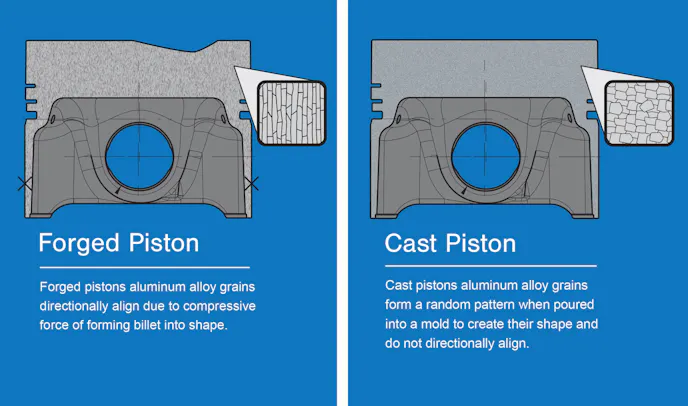
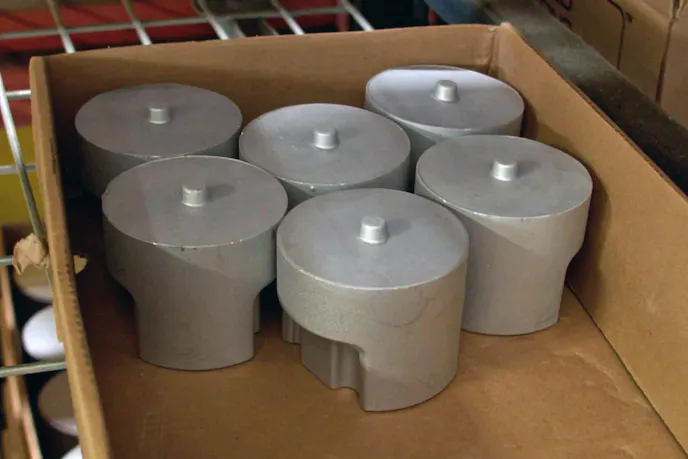
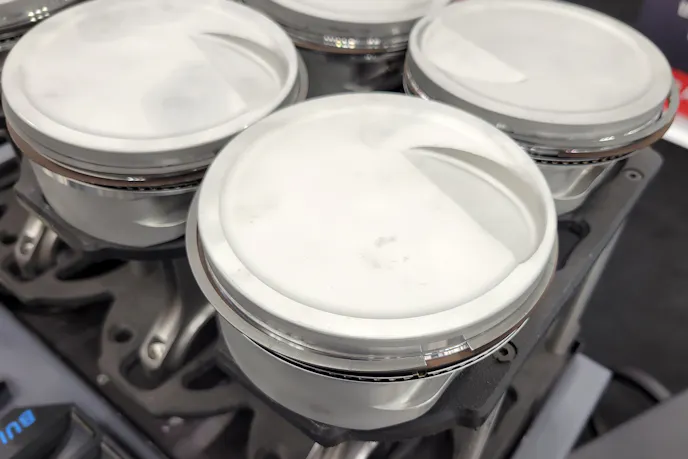
A cast piston begins with aluminum heated into a liquid state and poured into a mold. Once cooled, the casting is machined into the finished piston. Forging takes a different approach. Instead of pouring molten aluminum into a mold, an aluminum slug is formed into a rough piston shape under extreme pressure. The resulting piston forging is then machined into its final dimensions and features.
The manufacturing process changes the physical characteristics of the finished part. A forging generally provides greater strength and toughness. These characteristics make it better suited for demanding performance applications.
In this video discussing cast versus forged pistons, RaceTec Pistons’ Trey McFarland describes cast pistons’ use in original equipment engines. However, using cast pistons doesn’t necessarily limit an engine to its factory horsepower rating. You can make more horsepower on an OE engine than it comes with, McFarland explains.
Cylinder Pressure Changes The Equation
Adding power increases the load placed on the piston. Boost, nitrous, increased compression, and aggressive tuning can all raise cylinder pressure. Abnormal combustion adds another concern; McFarland states that detonation is a piston killer.
Detonation creates pressure loads that can be particularly destructive to pistons. A cast piston is relatively hard, but can’t tolerate severe loading as well as a forged piston can. A forged piston provides additional toughness under these conditions. That extra strength shouldn’t be confused with immunity. Severe or prolonged detonation can also destroy a forged piston. The advantage is an additional operating margin, not an indestructible part.
Horsepower Doesn’t Tell The Whole Story
It would be convenient to establish a horsepower at which every single engine should switch to forged pistons. Unfortunately, engine combinations don’t work that way. Consider two race engines: first, a naturally aspirated circle-track engine might operate near 9,000 rpm for lap after lap. Second, a boosted drag racing engine is only under load for several short bursts per event.
The drag engine may run only a few seconds at full load using substantial boost or nitrous while producing considerably more horsepower than the circle-track engine. However, both engines place significant demands on their pistons in very different ways.
In the video, McFarland emphasizes why piston design should follow the application. A circle-track piston must withstand repeated high-RPM operation and sustained loading. A power adder piston must contend with tremendous cylinder pressure created by forcing additional air and fuel into the cylinders.
This also explains why forged pistons designed for different racing applications aren’t necessarily interchangeable. Sharing the same bore diameter does not mean two pistons were designed for the same job.
Choosing A Forged Piston
Making the decision to move from a cast to forged piston doesn’t end the selection process. The aluminum alloy used for the forging also matters. Two common choices are 4032 and 2618. The greater silicon content of the 4032 reduces its thermal expansion. This allows an engine builder to use tighter piston-to-wall clearances. These characteristics can make 4032 attractive for street and moderate performance applications.
For more severe applications, 2618 offers greater ductility and an ability to tolerate extreme operating conditions. It is commonly chosen for high-output engines using turbochargers, superchargers, or nitrous. That toughness comes from a trade-off. Because 2618 expands more as it reaches operating temperature, the piston generally requires additional cylinder-to-wall clearance, making it noisy on startup. This is another reason the strongest available piston isn’t automatically the best piston for every engine.
When Is It Time To Go Forged?
A mild street engine operating at moderate cylinder pressures may live a long life with cast pistons. Increasing boost, nitrous, compression, RPM, and cylinder pressure makes the additional strength of forging increasingly valuable.
Intended use matters just as much. An engine expected to spend hours cruising has different requirements than one repeatedly subjected to maximum cylinder pressure. There isn’t a universal horsepower number that tells an engine builder when it’s time to go forged. The decision comes from understanding the entire combination. Boost, nitrous, RPM, compression, cylinder pressure, and intended use all matter. Once those demands exceed the capabilities of a cast piston, stepping up to a forged piston becomes inexpensive insurance compared with the cost of a piston failure.
If you’re still unsure which piston best fits your combination, RaceTec’s customer service team can help narrow the choices. You can also browse RaceTec’s available piston options through Summit Racing.
You might also like
Piston Ring Tension: Understanding Force and Friction
Piston ring tension is more than a catalog number. Learn how force, friction, and testing methods affect your ring package.