


There’s no doubt that the name Cosworth carries some incredible weight in the performance engine world. Their decades of experience at the forefront of world motorsports powerplant production have led to some of the best known and most successful projects in the industry.
However, there are also a lot of projects that are much less known. Not because they weren’t successful, but because for one reason or another, the spotlight just didn’t hit them. Mike Fernie got to go inside Cosworth and check out a few of these projects for years past, with Managing Director Bruce Wood as his personal tour guide.
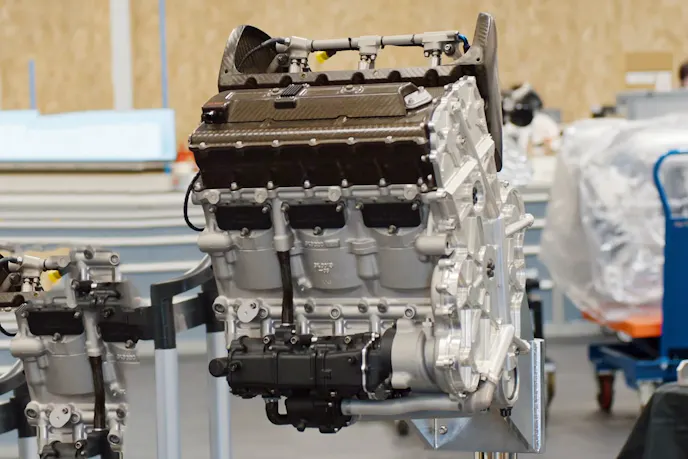
One of the coolest engines to come out of that trip was Cosworth’s three-cylinder Moto GP engine program that was built off of the Formula 1 engine technology of the time. It made 240 horsepower and spun to 16,000 rpm.
Why Only Three Cylinders?
Designed for the 2002 season, this wild engine was designed at the request of the Aprilia MotoGP team. “Aprilia were hugely successful in MotoGP under the 500cc two-stroke rules. But in 2002, the regulations changed and they moved wholeheartedly away from the 500cc two-stroke to just shy of 1,000cc four-stroke engines,” explains Wood.
“Aprilia, for all their success in two-stroke engines, recognized that they weren’t very familiar with four strokes and so they came to us, asking if we could help them.” Of course, Cosworth obliged, but nothing in their current catalog had anything remotely resembling a MotoGP engine.
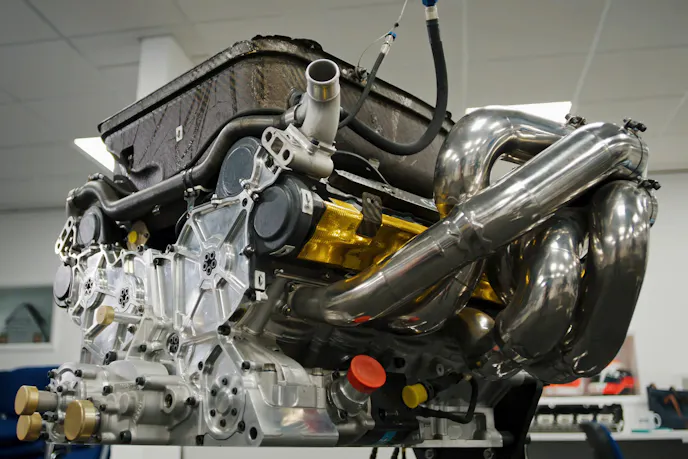
“The time to create a brand new engine from scratch wasn’t really available,” Wood continues. “But, as fortune would have it, we were right in the middle of developing our TJ 3.0-liter V10 Formula One engine. We had the thought, ‘Three cylinders of that would make a pretty ideal MotoGP engine.’ So this is literally three cylinders of the TJ Formula one engine.
Wood also points out that it wasn’t just 3 cylinder’s chopped out of a block, but rather ALL of the technology in the Formula One engine. “It even had the air valve springs in it. I think at the time, that was a first in motorsport.”
More About The Engine Itself
So, we’ve established that it came from Cosworth’s 2002 Formula One engine program. A little background on that powerplant. It powered the Jaguar Racing Formula One team, which featured Eddie Irvine and Pedro de la Rosa as drivers and Niki Lauda as the team principal. It was also the team that would eventually become Red Bull Racing only a few short years later. It powered the Jaguar R3 chassis, and spun to an incredible 19,000 rpm.
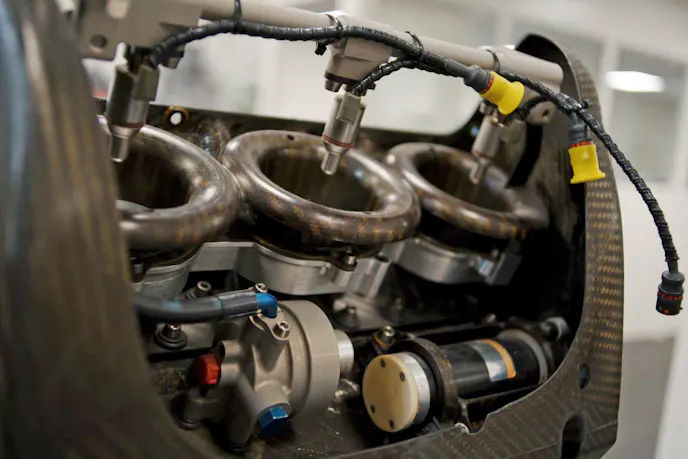
However, while physically capable of those engine speeds, the vehicular dynamics of a MotoGP motorcycle and a Formula One car are completely different. So the three-cylinder MotoGP engine one spun to 16,000 rpm. “It became colloquially known as ‘The Cube’,” Wood recounts. “It really was as much as we could take from the TJ engine and put into a package to run across the frame [of the MotoGP chassis]. For two or three years, it was heralded as the most powerful engine on the grid. The first race of 2002, [Aprilia] had the fastest straight-line times.”
Power Isn’t Everything
While the engine’s 240 horsepower was the king of the field, in a MotoGP application, brute force isn’t everything. “With our experience in auto racing, whenever a driver would ask for better response low out of a corner, and we explained to them that we’d have to give up a little on the top to pick up down low, they would invariably, to a man, not be willing to give up any top end power. They wanted the most power possible and were willing to drive around any problems it gave them,” laughs Wood.
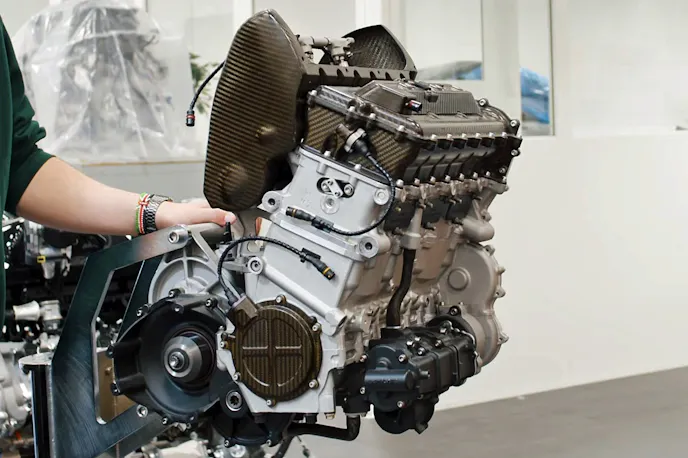
“When we came to [MotoGP] and the riders posed the same question to us, they were willing to take less top-end power. That was a surprise to us, since all of our experience with racing said otherwise.” Cosworth quickly learned the riders knew what they were talking about, and it all comes down to the dynamic of the motorcycle and its small contact patch.
“It took us, perhaps shamefully, a little while to realize that these guys do know what they are talking about. If we had another season or two to develop the engine with Cosworth’s increased understanding of what the riders were telling us and the team was telling us, we could have been more successful,” Wood shares candidly.
Lasting Effects On The Future
While three seasons of powering the Aprilia MotoGP team could be the end of the story, it isn’t. This engine has had a lasting impact on Cosworth’s Research and Development department. The three-cylinder naturally aspirated race engine can be traced directly to the development of the Aston Martin Valkyrie 11,000-rpm, 1,000-horsepower naturally-aspirated production engine (which we covered here).
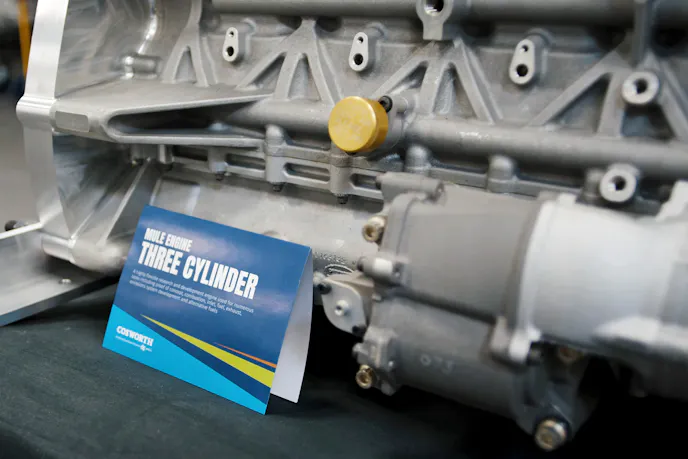
The evolution of those projects, along with several others are covered by Wood in remainder of Mike Fernie’s video above and is absolutely worth a watch, regardless of whether your interest is technical or historical. However sticking to the focus of this article, the little three-cylinder that was a 30-percent slice of a 2002 Formula One engine is an interesting part of history.
As the most powerful engine on the grid, it not only helped Aprilia fight for three seasons, but has helped to shape the development of several other incredible engines from Cosworth since its retirement.
Not a bad resume for a largely unknown-to-the-public three-cylinder naturally aspirated engine that spins to 16K.
You might also like
LT4 Camshaft Shootout: Flag And Griffin Motorsports Dyno Test 7 Cams
7 LT4 cams hit the dyno as Griffin and Flag Motorsports compared horsepower, torque, air Flow, and a final whipple 3.0-L combination