
There are easier ways to make big power with a Ford Coyote than a naturally aspirated setup. Bolt on a supercharger and let boost do the heavy lifting. Same thing with turbos. But Carlos Sobrino has never been particularly interested in the easy way.
Sobrino wanted an all-out, naturally aspirated Coyote to run in a drag racing class that had no limits on displacement or engine speed. He also wanted it built by Chris Smith and the team at Elan Power Products, even though Smith freely admitted he had never built a Coyote before.
That sounds like a leap of faith until you look at their history.
Smith and Sobrino began working together around 2009 or 2010, when Elan built the pushrod small-block Ford that carried Sobrino to two NMRA Factory Stock championships. The 309-cubic-inch engine operated under tight class restrictions yet ran deep into the ten-second zone. So, when Sobrino decided to move to a new class, he called Smith with a much bigger request.
“I wanted to build an all-out NA Coyote,” Sobrino says. “I asked him, ‘You want to do it?’ He goes, ‘Sure. I’ve never seen one, but I’ll do it.’”
That answer makes more sense when you understand Elan. Don Panoz founded Elan Power Products in 1998 to develop and support engines for the Panoz Le Mans Prototype program. Smith joined in 2000, worked in cylinder-head development and assembly, then later assumed a leadership position and eventually purchased the company from the Panoz family in 2020. Elan-powered programs have earned victories and championships in endurance racing, road racing, rally and drag racing, including class wins at Sebring and Le Mans.
Smith may have been new to the Coyote, but four-cam Ford engines were familiar territory. The Coyote simply presented a new set of dimensions to solve.
Starting With A Spreadsheet
The production Coyote is already a serious high-RPM engine. Ford’s current Gen-4 crate version uses an aluminum block, dual overhead cams, four valves per cylinder, and variable intake and exhaust cam timing to produce 480 horsepower at 7,150 rpm. Sobrino’s engine needed to live well beyond those speeds and make substantially more power, so Smith began the way he starts nearly every new engine, with a spreadsheet.
“Every single project starts with a spreadsheet,” Smith explains. “I have individual spreadsheets that I’ve made over the years, probably a hundred of them.” Smith says he uses it to target what airflow numbers he needs to hit the horsepower target, what valve sizes will be required, and so on.
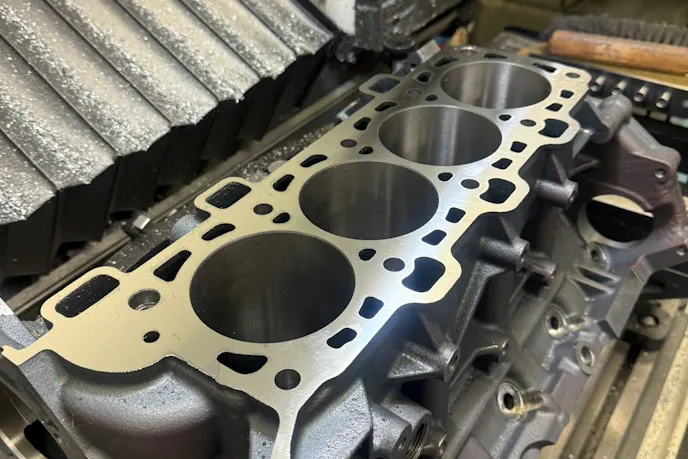
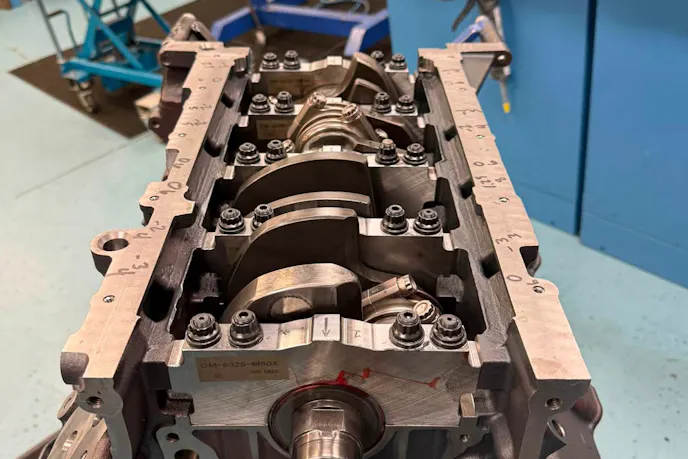
Smith started with the largest practical displacement he could get from the block and then worked the numbers. He considered minimum piston compression height, maximum usable stroke, and the rod length required to connect the two. A crankshaft from another program was offset-ground for a 3.900-inch stroke and paired with 6.125-inch Carrillo rods. With a bore slightly larger than the original 5.2-liter Voodoo dimension, displacement came to 336.01 cubic inches.
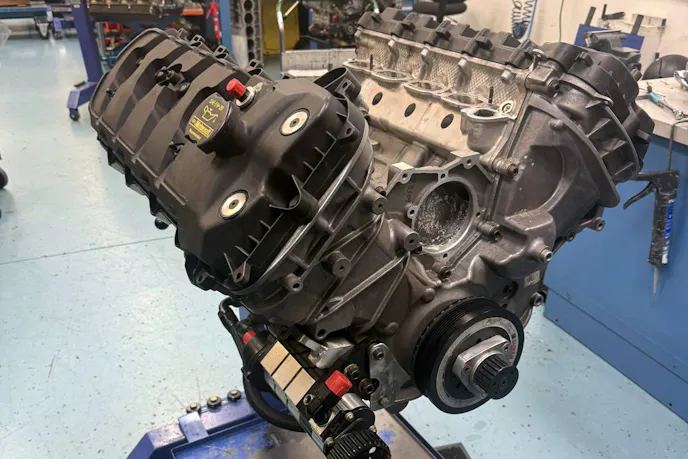
The first version used an aluminum 5.2-liter block. The current engine moves to a Ford Performance cast-iron block bored to 3.705 inches. The iron adds weight, but Smith believes its greater dimensional stability is worth it. Aluminum expands substantially as temperature rises, changing main-bearing clearance and housing-bore dimensions. The iron block should hold those dimensions more consistently, retain more heat in the cylinders and provide a wider safety margin when Sobrino pushes some serious RPM on the track.
Plus, to help make up for the added weight, Sobrino made some changes to the chassis, especially up front, to cut a few pounds off.
Making The Airflow Work
Smith retained the basic Voodoo cylinder-head architecture, including the original valve angle and valve sizes. His focus was making the available port area work efficiently rather than chasing a spectacular flow-bench number.
Smith has spent roughly 35 years developing cylinder heads and says he’s seen plenty of ports that looked impressive on paper but failed to turn airflow into the power it promised. Generally, he says his goal is to establish the bowl as the minimum cross-sectional area, then keep the rest of the intake tract equal to or slightly larger as it moves away from the valve.
“People get carried away with flow,” Smith says. “You’ve got to make sure that everything you do in there is contributing to efficient airflow.”
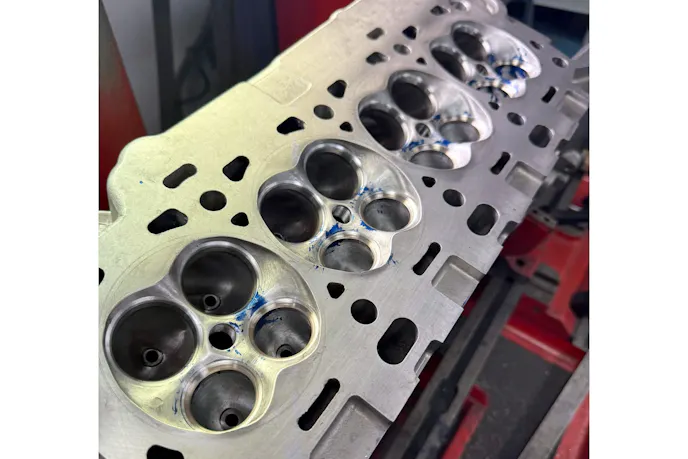
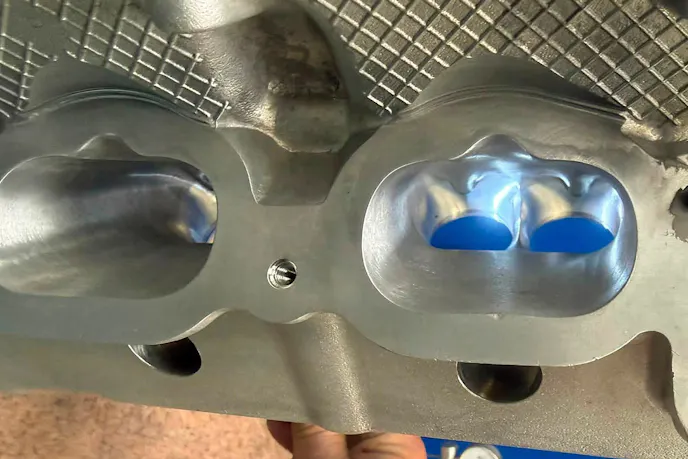
The exhaust side required more attention. Smith compared the stock port to an old Cleveland head, with a steep short side that makes a sharp turn before heading downhill. For the latest version, he lowered the short side, increased the radius, and opened the bowl area. The changes improved high-lift flow and created a smoother path out of the chamber.
Custom 45-degree valve seats are machined with cutters Smith designs himself. Titanium intake valves replace the earlier stainless pieces, and single-groove locks replace the production-style multi-groove arrangement to add more durability. At 10,000 rpm, reducing valvetrain mass and protecting the valve tip are survival measures.
Smith worked with Billy Godbold of Godbold Engineering, who currently consults with several teams, to develop cam lobes specifically for the engine. Existing profiles did not provide the lift and motion the combination needed. So, they came up with something that has roughly 268 degrees of duration on the intakes and 278 on the exhausts at 0.050-inch tappet lift. Smith wants to keep the lift numbers private, so we’ll respect that.
The profiles leave the seats relatively gently, then become far more aggressive once spring load is established. The engine retains a hydraulic arrangement, which is surprising considering the rpm involved, but Smith’s overhead-cam endurance experience gave him confidence in the approach.
The previous combination made peak power in the upper-8,000-to-low-9,000-rpm range and carried it beyond the peak. Sobrino’s problem was how quickly it got there. He repeatedly overshot the shift point and tagged 10,000 rpm.
“When I told Chris about that, he goes, ‘Okay, so I’m going to build you a 10,000-rpm engine,’” he laughs. “‘We can’t fix you, so we’ll fix the engine.’”
Two Rings And Plenty Of Compression
The MAHLE pistons Smith chose use a two-ring package, one compression ring and one oil ring, with no conventional second ring. Smith has used similar packages in endurance engines with good oil control, so this was a calculated omission rather than reckless.
The original version used a 0.7mm Total Seal top ring, but the updated ethanol-fueled engine moves to a slightly thicker 0.8mm ring because the ethanol they’ll be running can be harder on the oil than gasoline.
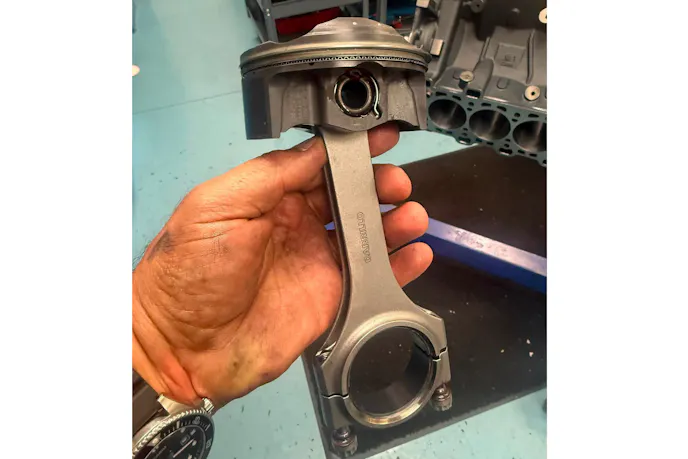
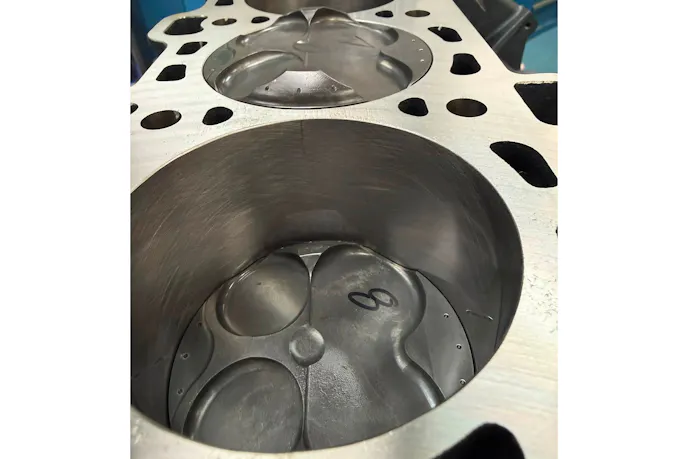
The Mahle pistons use vertical gas ports and sport an interesting dome that’s all about maximizing compression. With the Coyote’s shallow valve angle and large valves, designing the top side of the piston becomes a game of raising every area not occupied by a valve pocket. Piston-to-valve clearance remains in the roughly 0.060-to-0.090-inch range, and Smith did manage to get the dome up to 11cc to bump the compression all the way up to 13.92:1.
Smith says he treats the piston, ring package, chamber, cam timing, and valve motion all as one system. Change just one dimension or timing event, and everything needs to be adjusted to keep the engine operating as efficiently as possible.
A Holley Intake In Name Only
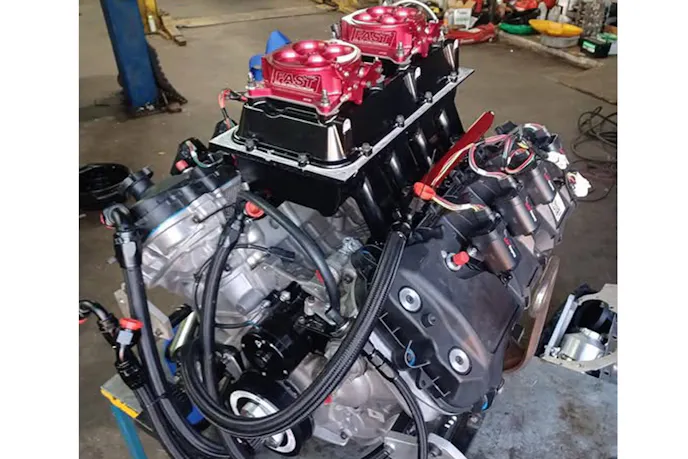
The intake may be the easiest place to see how far Elan was willing to go. It began as a Holley intake, but very little of the original manifold survived.
Smith disliked the injector location and runner geometry, so Elan digitized the flange and mounting angles, machined new flanges, and began cutting. First the manifold came apart near the flange. Then the runners were removed. By the time the design stopped evolving, Elan had created a largely custom sheet-metal intake.
“That thing is a Frankenstein,” Sobrino says. “The only thing that’s left from the Holley are the sides, right above the runners.”
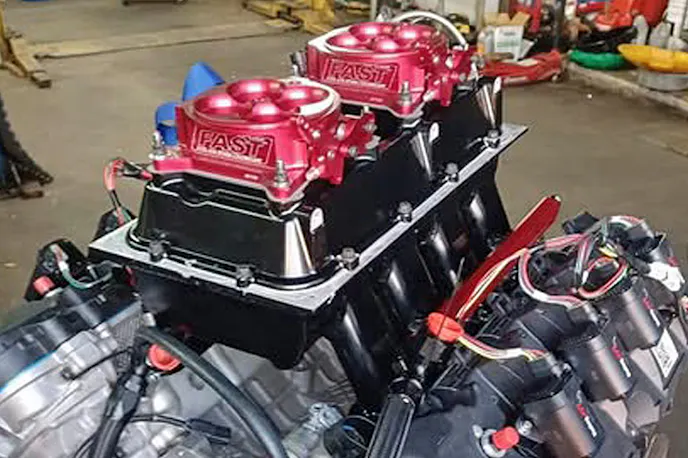
Runner length and taper came from calculations backed by experience. Dual FAST throttle bodies feed the plenum, and the injector location was revised after an early dyno incident damaged the first upper section. The rebuilt arrangement works with a Holley engine-management system because that’s what Sobrino’s tuner prefers.
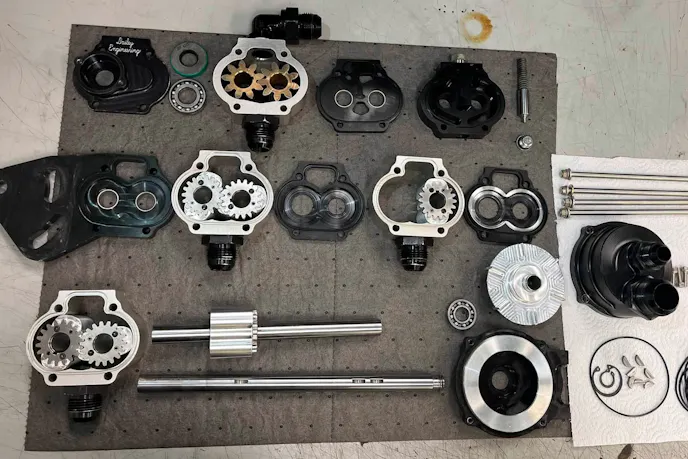
The engine also uses an MMR heavy-duty cam drive, an ATI damper, a modified Armstrong dry-sump pan and a Dailey Engineering pump.
Smith intentionally sizes the oil pump with more capacity than the engine should need. Different gear widths and spacers then allow Elan to reduce pressure or scavenge volume without changing the external package, mounts or oil lines. That lets the team tune oil delivery and crankcase vacuum while the engine remains packaged exactly as it will run in the car.
Eight Hundred Horsepower Was The Starting Point
The first 336-cubic-inch version made 800 horsepower at 8,600 rpm on Q16 during its initial engine-dyno break-in. Sobrino stresses that the session was intended to seat the rings and establish a safe wide-open-throttle tune, not chase a hero number.
Unfortunately, chassis-dyno testing ended early when the dual seven-inch clutch failed. From there, Ken Bjonnes of Palm Beach Dyno refined the Holley calibration using track data. Bjonnes is Palm Beach Dyno’s founder and head tuner, and the company specializes in Ford performance applications.
Based on elapsed times and trap speed, Sobrino estimates the earlier combination made roughly 750 horsepower at the rear wheels. He has posted a best elapsed time of 8.25 seconds despite the learning curve that comes with a naturally aspirated, stick-shift car and all the variables that come with it. (EDITOR’S NOTE: Apparently both Sobrino and Smith were too modest to tell the author that the 8.25-second quarter mile pass is the world-record for a naturally aspirated Coyote engine, making it the quickest and fastest N/A Coyote engine in the world at the time of publication.)
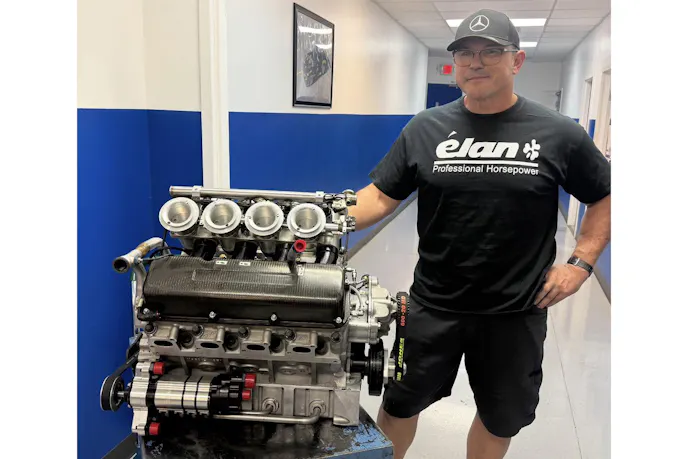
The updated engine is intended to push the program into the seven-second zone. Smith believes that will require something near 1,000 horsepower at the crank, or roughly three horsepower per cubic inch. There is still tuning to be done, so we don’t know if they will be able to hit such an ambitious mark. But the foundation is there thanks to more stable main bores, improved exhaust ports, lighter intake valves, a revised ring package, updated cam timing and an engine prepared for the 10,000-rpm shifts Sobrino seems determined to give it.
The project also demonstrates what Elan Power Products does best. The shop approached the Coyote as a system, drawing on data, machining capability, supplier relationships and lessons gathered from both their drag racing and world-class endurance racing programs.
Smith is careful to spread the credit, pointing to his own crew in the shop as well as Godbold, Mahle, Carrillo, Total Seal and others. “The most important thing you can do in this business is make relationships with people that are great at their job,” Smith said. “There are great people out there. You’ve got to get them on your team. That’s what we do.”
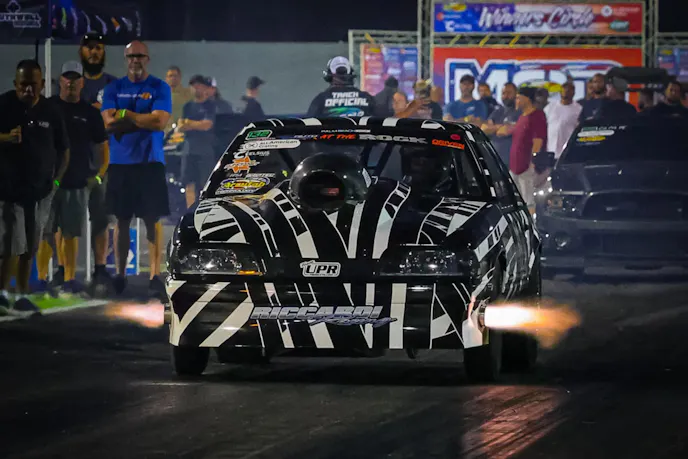
So keep an eye on Carlos Sobrino and his wicked black-and-white striped Mustang at the racetrack. He’s eyeing some really low numbers when it comes to lap times with his car he calls Joker, and we’re betting it won’t be long before he claims a timeslip starting with a seven.
You might also like
Lake Speed, Jr. Puts Zinc Oil Additives And DLC Lifters To The Test
Lake Speed ,Jr. tested ZDDP oil additives and DLC lifters to see how oil chemistry affects flat tappet camshaft wear and engine break-in.