


When it comes to extremely high RPM engine reliability, everyone knows that valvetrain control becomes incredibly important. Besides a simple reduction in power output, losing control of your valvetrain can spell mechanical disaster for your engine. There are a number of ways to increase high RPM valvetrain control within a given system; the two most common are to reduce mass and increase spring pressure.
However, Ducati long ago said, “I have a different idea. Hold my beer…” and rather than running elevated spring pressures, they created an entirely new system, called “Desmodromic,” which did away with valve springs and instead, uses a second cam follower to return the valve to its closed position. It also eschewed modern thinking in that the extra components in the Desmodromic system would, in theory, add mass to the system.
For the full explanation of not only the Desmodromic system, but Ducati’s entire design philosophy in order to efficiently achieve ridiculous RPM, we turn to Engineering Explained’s Jason Fenske. His three-video series on the Ducati engine philosophy not only explains their wild valvetrain, but also the rest of the engineering that goes into building an efficient engine. After all, saying that Ducati’s engines rev so high simply because they have a Desmodromic valvetrain is like saying any motorsports champion stands on the top step simply because they have the fastest vehicle. There is so much more to it.
Desmodromic Operation
In any engine, the timing of the valve opening and closing events is incredibly important. For all traditional engines, that timing is dictated by a camshaft. Whether in the block or overhead, a single camshaft or multiple camshafts, the valve events are commanded by the camshaft.
In a traditional valve arrangement, valve opening force is generated by the camshaft’s rotation and closing force is generated by a spring. Usually that spring is a coil spring, but sometimes can be a pneumatic spring in incredibly specialized racing applications. Either way, their function is the same — to generate enough force on the valve to return it to its closed position and keep it there for the rest of the engine cycle, until it’s commanded to open again.
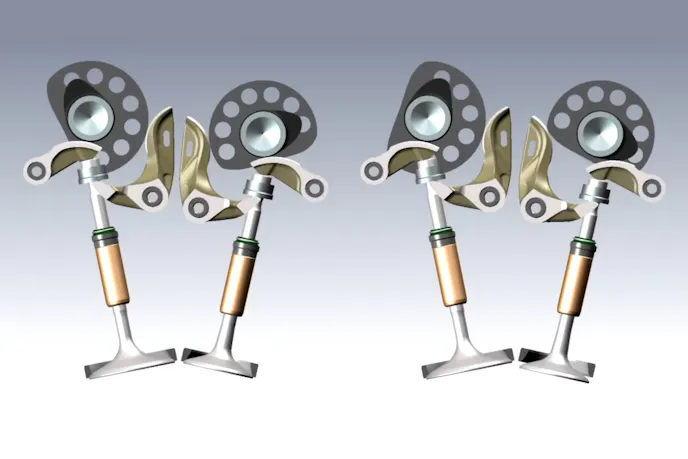
The Desmodromic system does away with springs altogether, and simply controls the valve through its entire range of motion, mechanically. The camshaft lobe is shaped such that one follower applies pressure downward on the valve to open it, and the other follower — controlled by the cam lobe as well — provides upward pressure on the valve to close it. The theory behind this is that there is nothing in the system that will allow a loss of control in the valvetrain, short of a full mechanical failure.
While you might be thinking how complex and heavy a system like that must be, at its core, it’s no more complex than a typical cam and follower valvetrain, and by maintaining positive control, mechanically, of the valve at all times, the extra mass becomes far less of a detriment at high RPM than it would be with a traditional spring-return system. However, this design alone isn’t the reason that Ducati’s engines both live and thrive in the upper stratosphere of engine speeds.
Bank And Crank Angles
In the world of V4 engines, there are a number of configurations that are possible, and will all effectively run. However, Ducati isn’t looking to just run. They are looking for the peak of competitive design. While many people think that an engine’s bank angle has more to do with packaging than performance, the right combination of bank angle and crank journal separation can produce a powerband that is tailored to exactly what their engineers want to see.
According to Fenske, the Ducati secret sauce is the 90-degree bank angle of their V4 engine block, with the 70-degree crank throw separation. This arrangement has benefits for power delivery, exhaust scavenging, and secondary valvetrain forces, specifically valvetrain torque and friction.
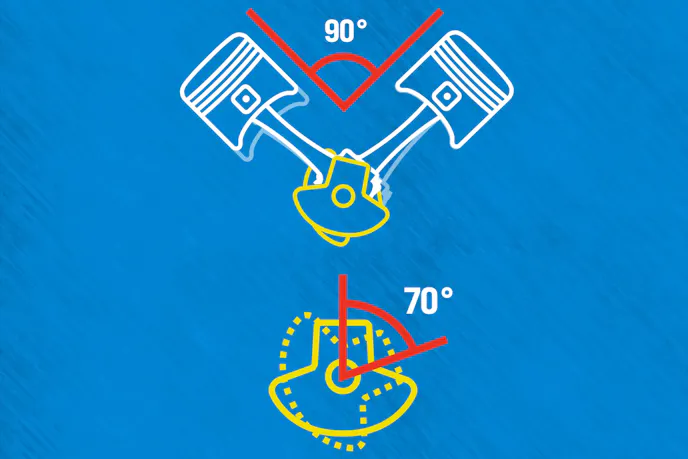
Valvetrain torque is a term you might not be familiar with. We’re going to make it as simple as possible, but if you want the full-on engineering explanation, that’s why Fenske’s videos are here. Like every mechanical object that is driven by or drives another component, there is an amount of torque being applied. In a Desmodromic system, torque is applied twice per valve event — once to open the valve and once to close the valve. Now, factor in that each camshaft controls two cylinders, and it doubles those torque events per camshaft.
If phased properly, “the negative torque” of closing the valve can aid in the “positive torque” needed to open the other valves. For a given engine configuration — a 90-degree V4 in this case — these torque values can not only be calculated across multiple different crankshaft angles, but plotted against one another for an easy comparison of efficiencies.
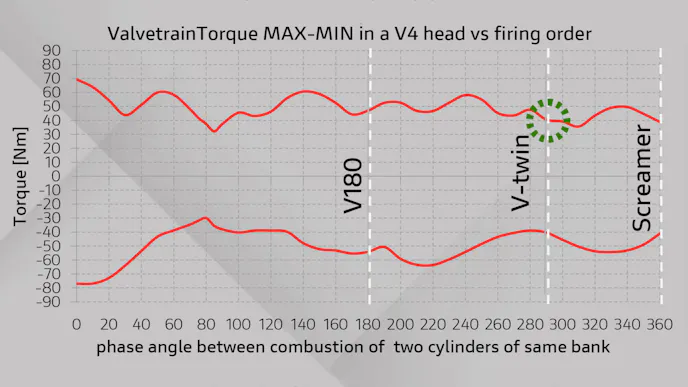
Based on Ducati’s math, the most efficient configuration would be what’s referred to as a screamer engine, where each cylinder in a given bank fires 360 degrees apart. However, that is only a single factor in engine performance, and there are other considerations when deciding on a configuration. But, what we can see in the charts, is that Ducati’s 70-degree bank separation offers an incredibly efficient arrangement, more so than a 90-degree or 180-degree arrangement. Not only does it make for a more efficient arrangement, but it also reduces valvetrain oscillation, which can be a stability concern in a Desmodromic valvetrain arrangement.
Valvetrain Friction
Another consideration when comparing crank throw separation angle is the friction generated in the system. Obviously, if you were to overlay the friction graph with the torque value graph, you’ll notice that the results coincide with each other. It makes sense that an arrangement that takes less torque to operate will do so in part due to having less system friction.
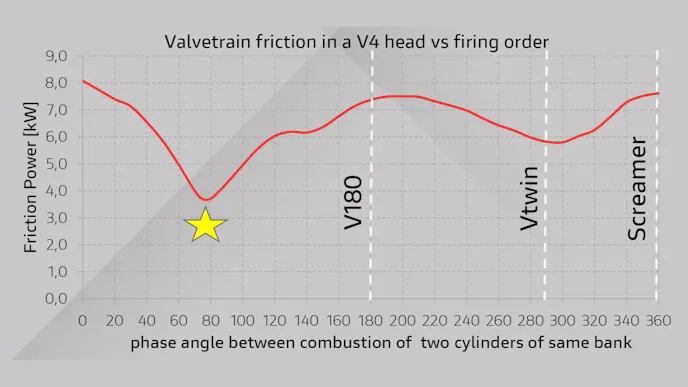
What that all comes down to, is explaining that Ducati’s amazing high-RPM performance is so much more than just a novel valvetrain arrangement that doesn’t use valve springs. It goes deep into engine design factors that the average enthusiast probably doesn’t even know exist, let alone considers when seeing an incredible performance from an engine design. Now, thanks to Engineering Explained and Jason Fenske, you know why it’s not just Ducati’s Desmodromic valvetrain that lets its V4 engines spin to the moon.
You might also like
Do Hub Dynos Actually Record Higher Numbers? Big 3 Racing Plays "Mythbusters"
It is commonly believed that hub dynamometers make more power than a roller dyno, but less than an engine dyno. Is this right, though?