
For decades, building custom components for a performance engine followed one of two paths. You’re either busting out the cutting wheel, sheet metal brake, and welder, or loading up raw material into the milling machine. Whether it was an intake manifold, an oil pan, a set of turbo headers or an intercooler, there was almost always a skilled fabricator standing behind every masterpiece. But now, there’s also 3D printing.
There will always be value in old-school fabrication skills. But there’s a new tool sitting between the TIG welder and CNC machine that’s pushing the envelope when it comes to creating one-of-a-kind components to help bring your horsepower dreams to life. That’s metal 3D printing.
3D printing with plastics is common these days, but additive manufacturing with high-strength metals is still widely considered the domain of NASA and billion-dollar rockets. However, innovative engine shops, like Nelson Racing Engines (NRE), are already proving otherwise. In fact, owner Tom Nelson is currently integrating 3D printing (the proper name is metal additive manufacturing) into some of the wildest street engines on the planet. The technology doesn’t replace old-school craftsmanship, but it does allow experienced builders to create components that simply couldn’t exist using conventional fabrication methods.
Few projects demonstrate that better than the twin-turbo V8 Nelson is building to power the SSC North America Tuatara hypercar. The engine is a 5.9-liter, twin-turbocharged V8 with a flat-plane-crank, which is engineered and assembled in collaboration with SSC North America and NRE. Previous versions are rated at up to 1,750 horsepower on E85 while remaining completely streetable, but NRE is still updating designs to help make even more power while still maintaining the same cooling and reliability within the limited real estate of the supercar.
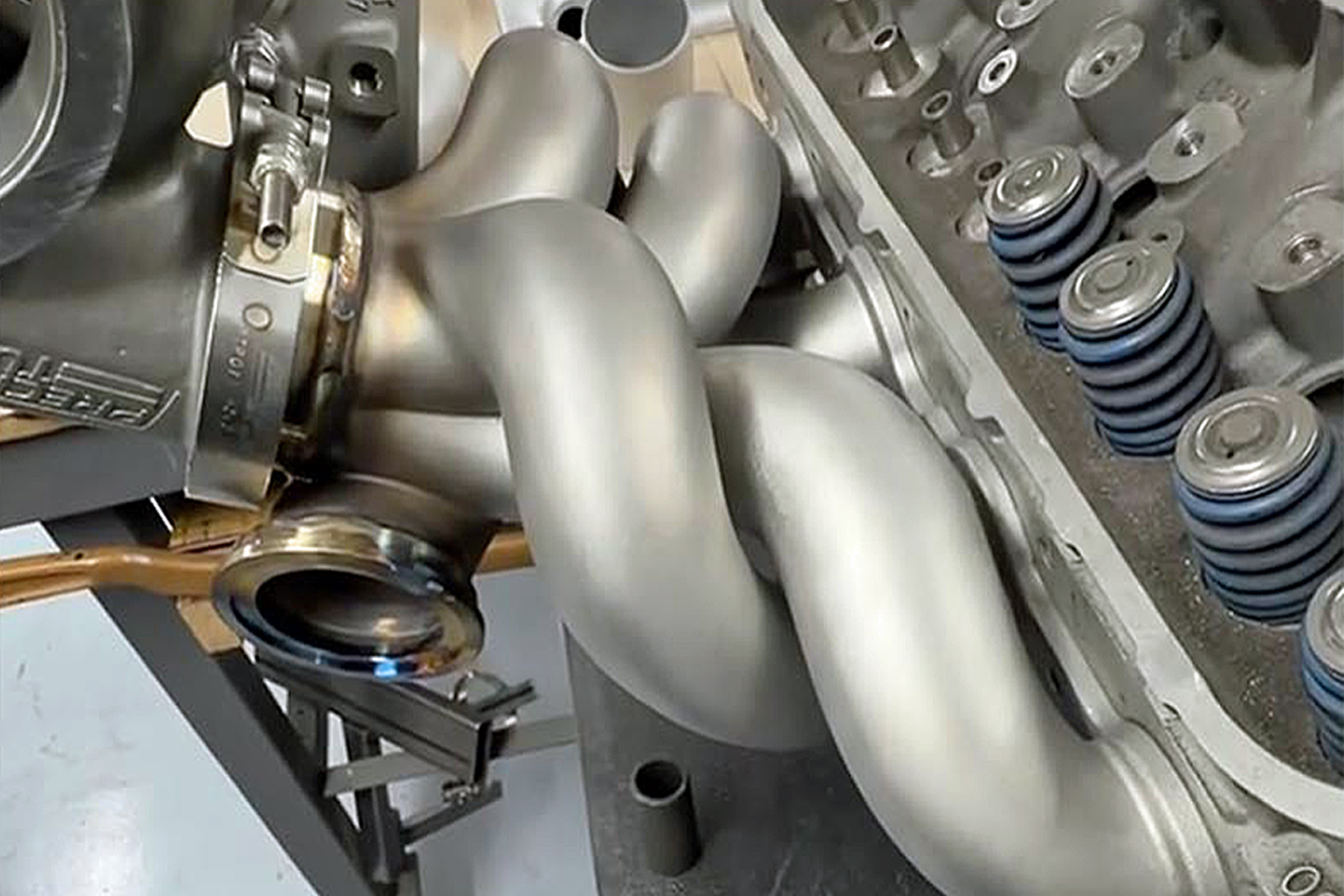
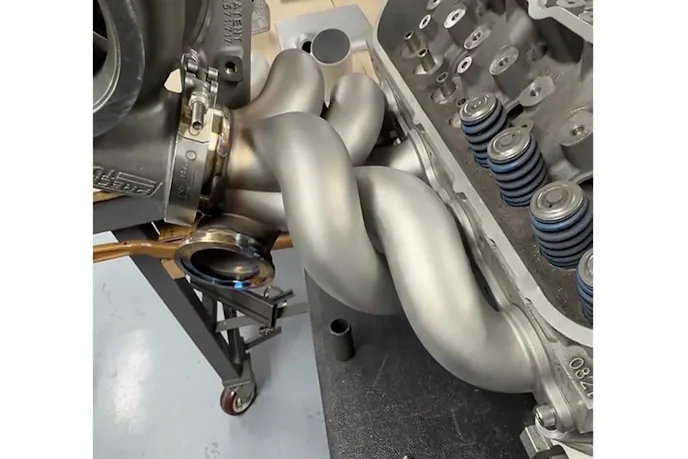
That’s exactly the kind of problem where additive manufacturing begins making a lot of sense. “We’ve been using 3D printing for a few years now,” Nelson explains. “We’ve been finding more and more places we can use it. We first started trying Inconel collectors, probably five years ago, and it’s worked well. The 3D-printed Inconel can stand up to the heat, and we haven’t really had any problems with it.”
That’s pretty impressive because exhaust collectors are abused with intense heat and pretty strong vibrations every time the engine is fired. If a printed Inconel piece can survive there, it opens up an entire world of possibilities, so Nelson and his team kept expanding their list of printed components.
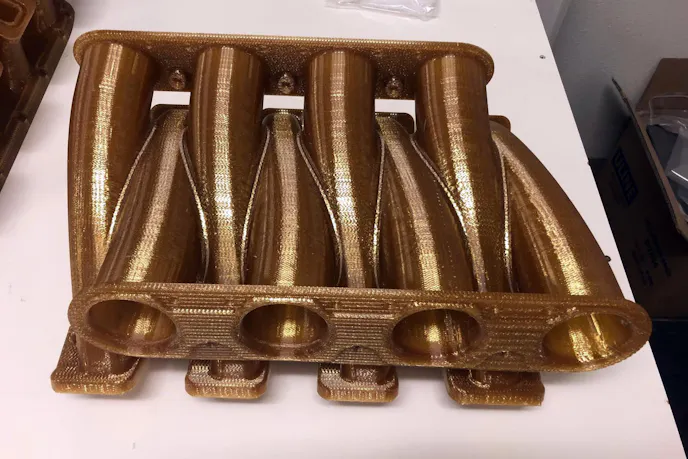
“On some of our builds, we will do air intake pipes and carb hats, even pressurized carb hats, and that’s out of [printed] aluminum,” Nelson says.
Pushing Limits with the Tuatara
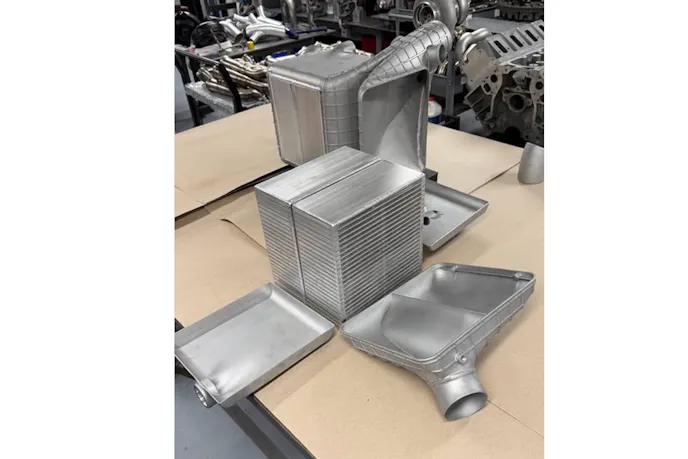
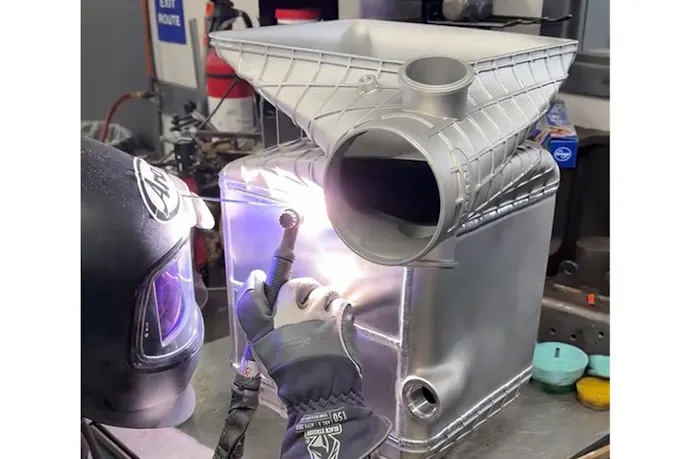
Instead of limiting additive manufacturing to individual components when it came to the high-stakes engine build for the Tuatara, which is sure to receive tons of media attention, NRE saw it as an opportunity to come up with an incredibly complex water-to-air intercooler that’s mostly 3D printed.
That’s because one of the biggest advantages of metal printing is the complete freedom of design. Traditional fabrication has limits. Every bend, weld, and flange must be physically accessible to the fabricator. Internal passages are constrained by what tools can reach. Piping with exceptionally complex curves can require dozens of individual pieces to be welded together. That makes more opportunities for mistakes and also lots of time spent at the fabrication table.
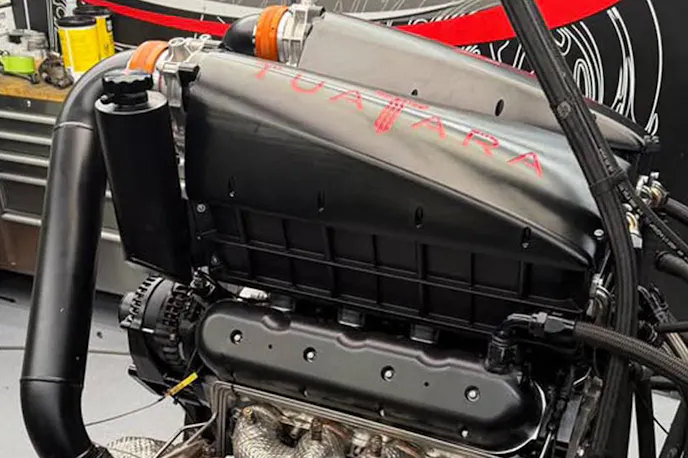
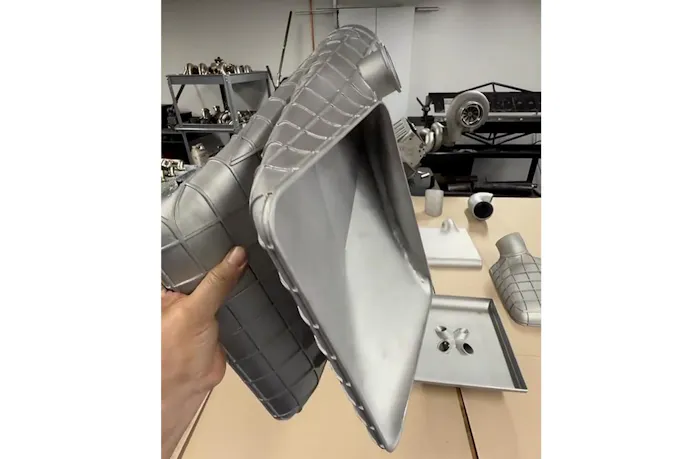
This intercooler was designed in sections, and once complete, it was welded together with the traditionally manufactured heat exchanger secured inside. In many cases, additive manufacturing doesn’t care about traditional fabrication limitations. If you can design it in CAD software, there’s a good chance it can be printed.
For the Tuatara, that flexibility was critical because the car was being built overseas, with no physical prototype available for the NRE shop. “That car is being built in Europe,” Nelson explains. “So we had them scan the engine bay, and then we built everything in CAD. Rather than trying to fabricate it, we just printed it. And everything we built was based on the scan. As long as the scan is good, we know it will work.”
Thanks to advancements in modern CAD programs, engineers can perform airflow simulations, evaluate structural strength, predict pressure distribution, and even identify weak spots before a single pound of metal powder enters a printer.

“The CAD part of it is wild,” Nelson says. “You can do CFD (Computational Fluid Dynamics) testing, so you can do airflow analysis on it all in the computer before you ever print it. That’s going to change the game for sure.”
The Tuatara’s printed intercooler isn’t just visually impressive with its ribbed outer shell and organic-looking structure. Every contour serves a purpose. Areas that require additional strength can be thickened. Ribs can be strategically added where computer simulations predict flexing. Curves can be altered to improve both airflow and structural rigidity.
“The stuff that we’re doing is probably stronger than cast, but not as strong as forged,” Nelson admits. “You can put that into a pressure program and measure deflection, then modify the CAD design where it’s flexing to put ribs or curves or even thicken up the part in areas that look weak.”
Some of that can be done with traditional fabrication techniques, but every added step adds time — and we all know time is money. With 3D printing, you can make the design as complex as you like, then hit the print button to start the process and turn your attention to something else while the printer does its thing.
3D Printing Integration
Instead of welding together dozens of individual pieces, mounting bosses, pressure ports, blow-off valve provisions, and O-ring sealing flanges can all become part of a single printed assembly. “It’s got tapped intercooler mounts. We’ve got pressure ports built in (to the intercooler). We’ve got blow-off mounts built into it. It’s got a flange built into it for an O-ring seal to the throttle body,” Nelson says. “It’s wild.”
Fewer welds generally mean fewer potential leak points, improved material consistency, and often a lighter finished component. And the same thing applies to exhaust systems. “We’ve got a motor on the dyno that’s making, like, 2,500 horsepower right now with a set of printed headers, and they’re doing just fine,” Nelson says. As far as durability tests go, that’s about as good a recommendation as you can get.
Of course, none of this comes cheap. Although Nelson says they are coming down in price, industrial metal printers remain a serious investment. “We don’t have one in the shop yet because they’re just too expensive,” he says. “The machine that produces our parts is like a million dollars. I’ve heard they’ve come down, with options for about $300,000, but it’s still out there.”
NRE has no plans to abandon traditional fabrication. Old-school cutting and welding will always have a place in a quality engine shop. But combining decades of hands-on experience with digital engineering tools certainly expands what’s possible.
Nelson even sees additive manufacturing influencing more conventional manufacturing methods in the future. “I want to start looking into it for casting,” he says. “You can 3D print patterns and then use those patterns for castings.”
CNC machining was once considered exotic. Laser cutting seemed futuristic. CAD itself was once reserved for large corporations with massive engineering budgets. Today, those technologies are commonplace throughout the performance aftermarket.
Metal additive manufacturing appears to be following that same path. And for companies like Nelson Racing Engines, the future has already arrived. When you’re building engines capable of 2,500 horsepower and eyeing 3,500 to 4,000 horsepower combinations for the very near future, every advantage matters.
And as for proof? The 3D-printed intercooler went on an engine that just made 2,565 horsepower on what Nelson describes as low boost, with even more power on tap.
It’s always nice to have a new tool in the toolbox.
You might also like
Do Hub Dynos Make More Power? Big 3 Racing Plays "Mythbusters"
It is commonly believed that hub dynamometers make more power than a roller dyno, but less than an engine dyno. Is this right, though?