
You can’t ride a spec sheet. Many die-hard enthusiasts will tell you that few experiences in life come as close to engine bliss as rolling on the throttle of a Harley-Davidson motorcycle. The feel, the sound, and the ground-pounding torque. Alas, still some may wish there was a little more power to be had. It’s a natural reaction for anyone into engine performance, be it on two wheels or four. Fortunately, boost isn’t just for car folks. In this article, we’re going to show you one of the quickest and easiest ways to achieve big power gains on a V-twin engine. Welcome to the ProCharger centrifugal supercharger upgrade.
“If you’re a gearhead, you’re a gearhead, right?” Walt Sipp, Director of Powersports at ProCharger, remarks. Growing up around racing, classic cars, and motorcycles, he’s been around Harley-Davidson motorcycles nearly his entire adult life. “If it’s got wheels, I talk,” jokes Sipp. That passion grew into engineering, and he spent nine years working in new product development at Harley-Davidson Motor Company. He also gained 20 years of track experience racing V-twins. That gearhead attitude and high horsepower experience also earned Sipp double-duty as Director of Service Motorsports at ProCharger, too.
V-Twin Perspective: Turbo vs. Centrifugal Supercharger
While engine architecture and technology have become more advanced in recent years, a traditional Harley-Davidson V-Twin differs significantly from our familiar automotive V8 engines. A massive flywheel with a common crankpin, firing at 315 and 405 degrees apart in a 45-degree bank-angle, all while air-cooled. Oil takes the burden of dissipating heat with the help of iconic cooling fins. Especially in the V-twin world, oil becomes the lifeblood of the engine.
A turbo uses hot exhaust gas to drive the compressor and build boost. While efficient, turbo performance suffers from throttle lag. This becomes exponentially more annoying in situations prevalent to motorcycling. Plus, the turbo needs to be lubricated, and that requires plumbing oil lines from the engine. “The same oil circulating through the engine is also going through high-speed, very hot turbo bearings. That’s not good for either piece,” Sipp explains.
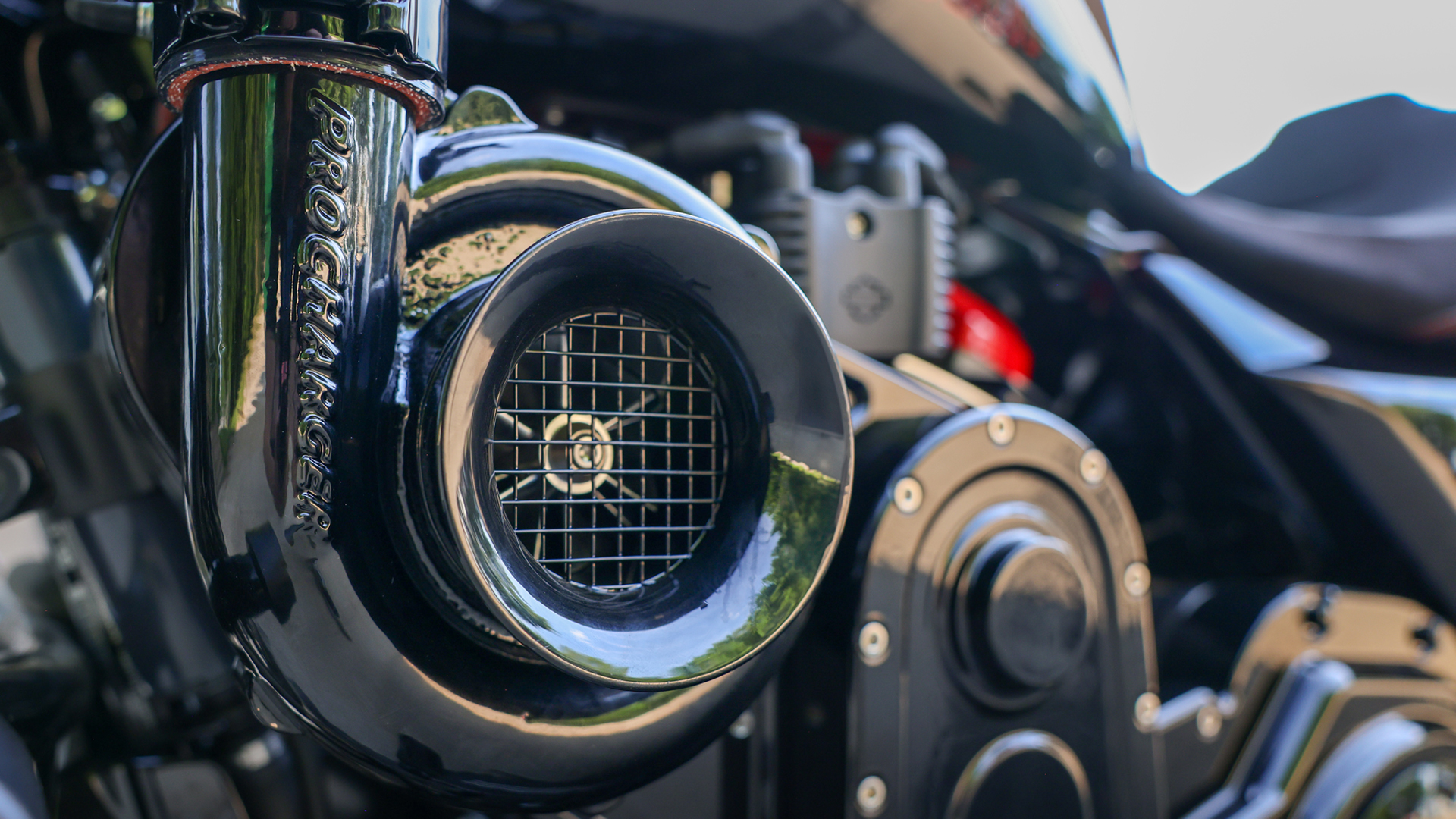
A centrifugal supercharger, like the ProCharger unit combines the best of both worlds. It mechanically drives the impeller off the crankshaft to create boost rather than relying on a burst of exhaust gas. The benefit is instant power with predictably smooth linear delivery, plus the lightweight efficiency of a turbo.
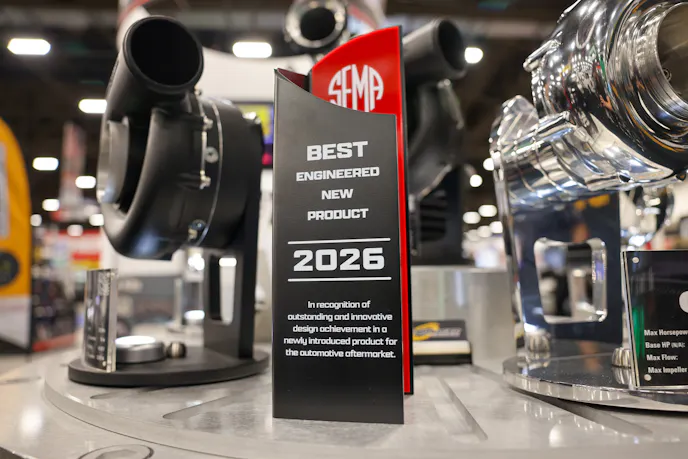
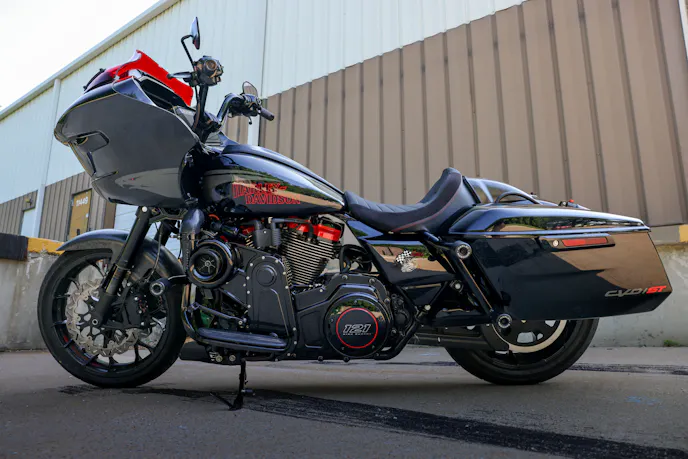
ProCharger has earned its reputation over years in both the automotive and motorcycle industries. At the 2025 SEMA Show, their new supercharger kit for the 2024-2025 Harley-Davidson Milwaukee-Eight (M8) took home the SEMA Best Engineered New Product award.
The PTO Advantage: How a Primary-Drive Supercharger Works
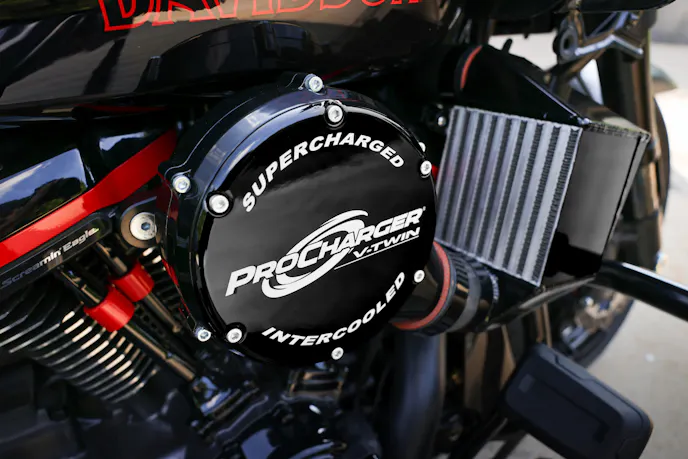
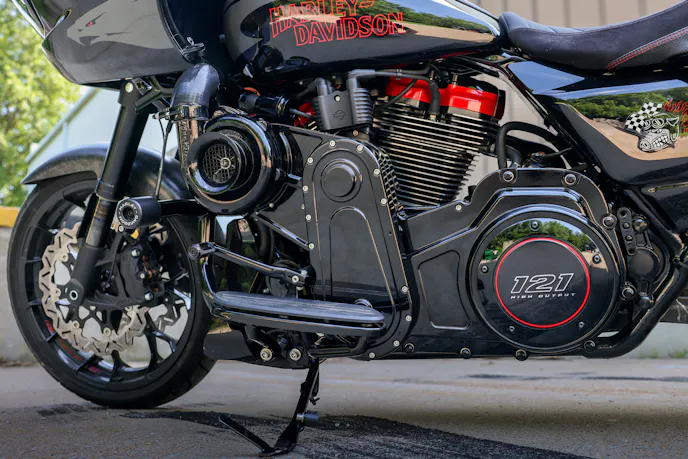
In perspective, a Harley-Davidson V-twin is known for ground-pounding torque and not bouncing the tach needle in high-RPM territory commonly associated with sportbikes, or even late-model muscle cars. To achieve proper supercharger RPM and build boost, ProCharger utilizes the more robust primary side of the engine to create a belt-driven system. “We replace the outer primary cover from the stock Harley with our proprietary PTO (power take-off) drive assembly,” Sipp explains. “This uses a series of pulleys and belts to achieve the necessary impeller speed, despite the engine’s lower RPM limit.”
Supercharging inherently raises intake air temperature due to the physics of compression. To maintain ideal air density and prevent detonation, ProCharger includes an air-to-air intercooler in all its kits. Sipp elaborates that, “there’s no oil lines to worry about. We’re not blocking anything substantially around the fins or anything else with that cylinder head.”
The next components include a manifold bonnet to replace the factory air cleaner. Then, larger fuel injectors for EFI models. “What we’re adding is all bolt-ons from the outside. You don’t have to tear into the engine at all,” Sipp concludes.
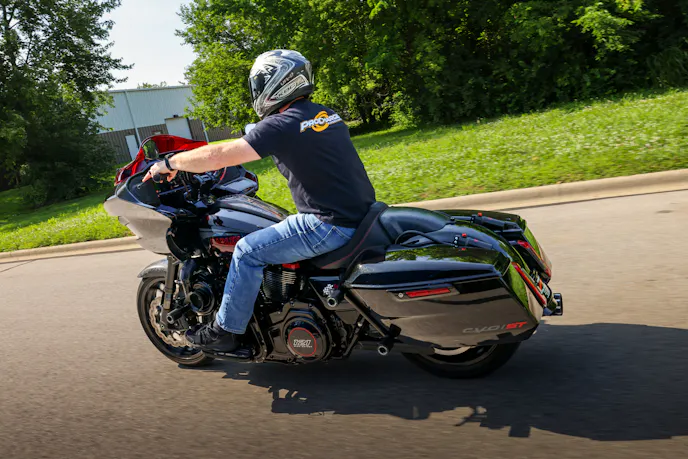
Depending on the model, boost created is 8 psi to 12 psi. On a typical Harley-Davidson M8 or Twin Cam engine with proper tuning, this can generate in the ballpark of an additional 60 to 65 horsepower at the rear wheel. That’s a significant improvement over the stock V-Twin’s output, and combined with the weight advantage of a motorcycle, is plenty for most street applications to scoot quick with the crack of the throttle. “Most of those 110 cubic-inch Twin Cam and modified M8 bikes, it’ll take them close to 200 horsepower with a stock build with some boost and a tune,” Sipp says with a smile. Now, considering the popular Harley-Davidson CVO Street Glide weighs in around 865 pounds, it equates to a respectable 0.23 power-to-weight ratio. That’s quicker than most stock late-model Detroit muscle.
Precision Tuning: Mapping EFI for High-Output Motorcycles
Calculating performance gains and achieving them are two different things. When you jump into modified, high-horsepower territory, the difference lies in plotting the correct air-fuel ratio curve across the RPM range for optimum performance. In this instance, the owner is likely also running a different cam profile and cylinder heads. “In the car world, the EFI systems are more advanced. You can put a canned tune in one of those, and it’s going to be pretty close. Motorcycles are like snowflakes,” Sipp jokes. “There’s definitely no two alike. I don’t care if you use the same cylinder heads, same cam, same exhaust, they’re not going to be the same when they’re all done.”
Installing a ProCharger tuner kit does not include injectors or an ECU update, and requires an aftermarket EFI system and a professional tune. Popular systems on the market include those from Dynojet Power Vision, Thundermax, or Impact Wiring Solutions.
ProCharger even offers centrifugal superchargers for select carbureted Harley-Davidson models. Even for the venturi purists, a tray of assorted main jets and a professional tune on the dyno is necessary to avoid running too lean.
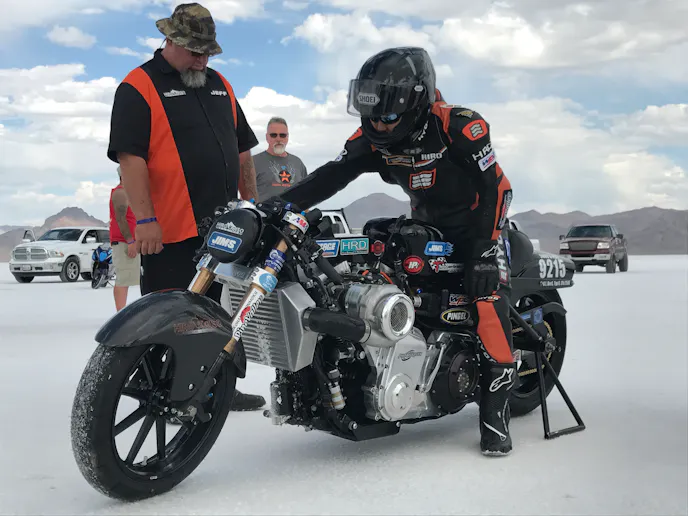
Breaking 260 MPH: The Physics of a 400-Horsepower Land Speed V-Twin
The majority of ProCharger supercharger kits are installed on baggers for added passing power, or Dyna and Softail models for street performance. Then there are proving grounds when it becomes a foundational power building in professional motorsports.
Hiro Koiso started land speed racing at Bonneville in 2008 and has since set 15 AMA National and 8 FIM world land speed records on the same 400-horsepower 2006 Harley-Davidson Dyna Super Glide motorcycle. Koiso’s 249.443 mph FIM and 260.804 mph one-way top speeds are known as the fastest sit-on V-twin in history. He’s been using a B1 or C1-R ProCharger since 2010. “They are always there, being professional and helpful,” He remarks. “Quality of the components are top notch.”
What makes the centrifugal supercharger effective in land-speed racing is its predictable linear power delivery. As Koiso explains, “Racing at Bonneville is traction-limited. The natural salt surface is about half the grip of a paved surface on a good day. Sudden bursts of torque do not translate well to building up speed, and even become dangerous at times. ProCharger’s linear power output gives us smooth acceleration and traction advantages over turbos.”

V-Twins
Adding boost to a V-Twin is just as effective as it is in a larger engine. A ProCharger centrifugal supercharger provides the same smooth linear power, without the need for plumbing oil lines or creating excessive heat. Plus, they are highly reliable. As in any build, it’s important to set your goals and be realistic in your plans and in what you own. Adding power puts additional stress on other stock components, and they have their limits. “A person that’s got that much power is typically going to ride it a little bit harder,” Sipp has observed through decades of experience. “What are your goals? Then we try to steer them towards what they need.”
You might also like
LT4 Camshaft Shootout: Flag And Griffin Motorsports Dyno Test 7 Cams
7 LT4 cams hit the dyno as Griffin and Flag Motorsports compared horsepower, torque, air Flow, and a final whipple 3.0-L combination