



In the last EngineLabs Giveaway engine build article, we covered the bottom half of the engine coming together with all the parts from Summit Racing and our partners. Now, we’re going to take a look at the amazing top half of the engine. But first, have you entered to win this badass 632-cube big-block (or the nine other awesome prizes from Summit) yet? If not, click over to EngineLabsGiveaway.com right now and get entered. It’s totally free and only takes a few seconds; we’ll wait.
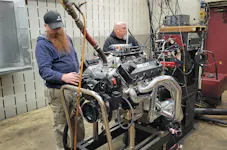
All entered? Good. The top half of this amazing engine was assembled live on the show floor over days two and three of the PRI show. If you haven’t readthe bottom-half build article, you really should. It’s an amazing tall-deck, 632 cubic-inch big-block Chevy engine, assembled by Nick Bacalis of Bullet Racing Engines. It uses a forged rotating assembly from SCAT, with RaceTec forged 2618 pistons, sitting inside of a new iron JLine Performance block. The top end needs to be pretty awesome to do the short-block justice, and I think it accomplishes that superbly.
Sealing Up The Short-Block
With a goal of 1,000 naturally aspirated horsepower from this build (and likely more than that on the dyno), being able to seal the cylinder heads to the block in the face of significant cylinder pressure is incredibly important. Being able to do it in varying conditions, and for an extended period (this is a street engine, after all) makes the job even more challenging. That’s why we turned to Cometic’s MLS head gaskets. They just flat out work in all conditions and should provide a extended service life, even at 1,000-plus horsepower.
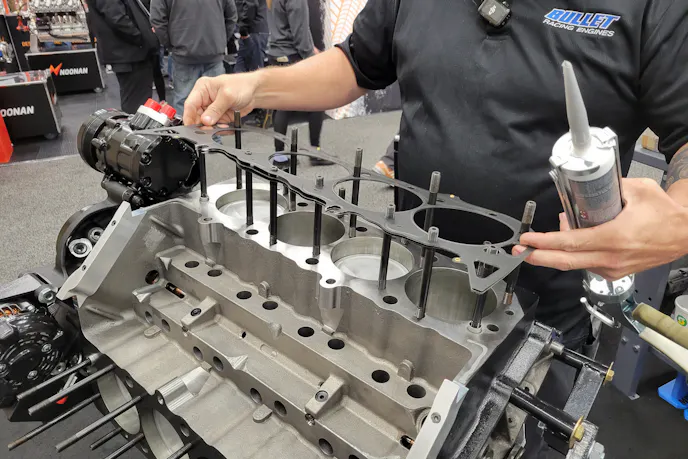
For this build, we used P/N: C5331-051 – a multi-layer steel gasket, manufactured from stainless steel layers embossed with load-control geometry to increase sealing with less physical clamp load required. In order to eliminate the need for external sealants, Cometic coats the outside layers of the gasket with Viton rubber coating along with a PTFE top coat.
To provide the necessary clamp load, we, of course, used ARP head studs. Specifically, P/N: 235-4329, ARP’s Pro Series cylinder head stud kit. Designed specifically for Edelbrock Big Victor cylinder heads, the studs utilize 8740 chromoly material, with rolled threads for maximum thread strength. Hardened 12-point nuts and washers provide extra load dispersion, and the use of ARP Ultra Torque lube results in accurate torque readings. Also, because the brand new DR-17 cylinder heads have a slightly deeper bolt hole, Bacalis dug into the bag of engine builder tricks, and dropped stainless-steel ball bearings into the blind bolt holes in the block to effectively lengthen the studs a little bit.
A Whole New Head: The DR-17
In order to make 1,000-plus horsepower, naturally aspirated, you have to have a pair of incredible cylinder heads. So for that, we went to Edelbrock. Not only are these DR-17 cylinder heads (P/N: 615468) amazing, but they are brand new to the market. In fact, they are so new, that we were down to the wire as Pat Musi finalized the CNC port designs right before sending them to Bullet Racing Engines.
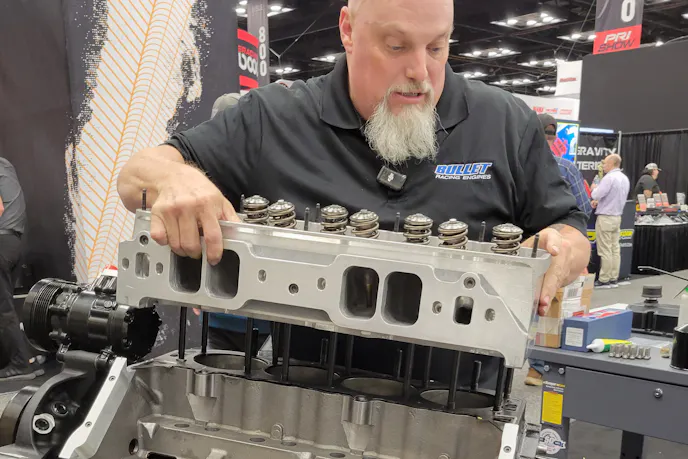
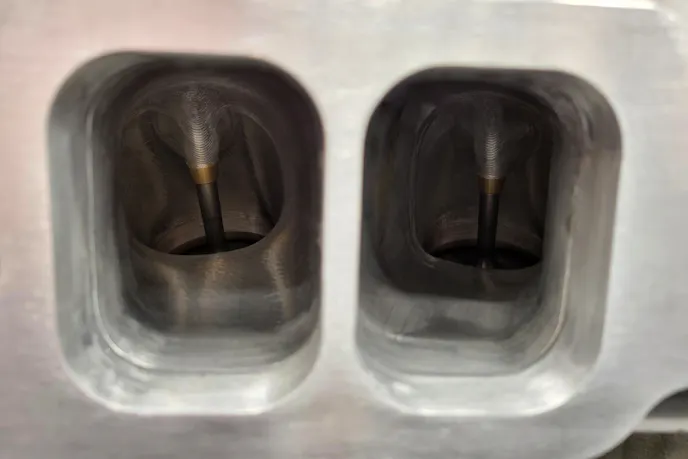
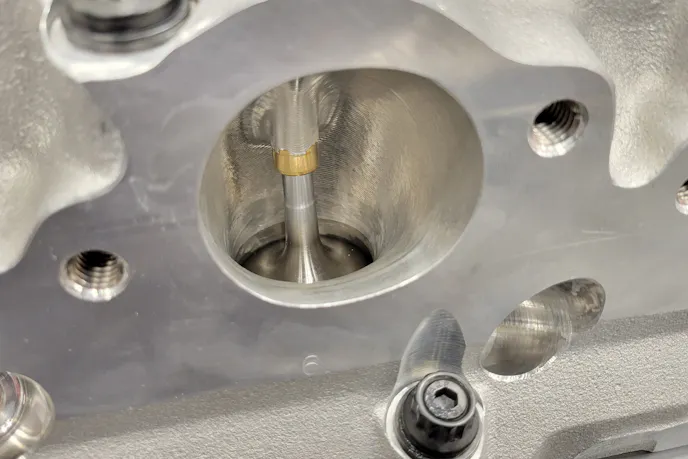
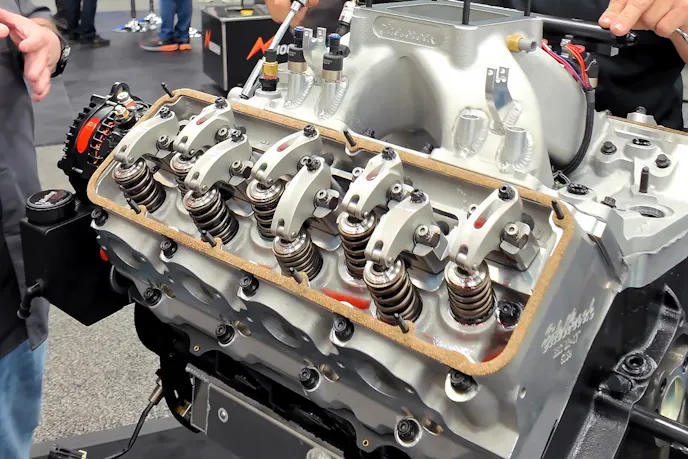
As the name suggests, these aluminum big-block Chevy cylinder heads have a 17-degree valve angle for incredible port flow. The massive intake ports measure 425cc of volume, and our chambers came in at 100.4cc, making for a pump-gas-friendly 10.7:1 compression ratio. While the heads come “bare,” they do have provisions out of the box for 2.450-inch intake and 1.850-inch exhaust valves, with a 55-degree valve seat angle. Between the huge valves and Musi’s port design work, these heads are set up to flow plenty of air.
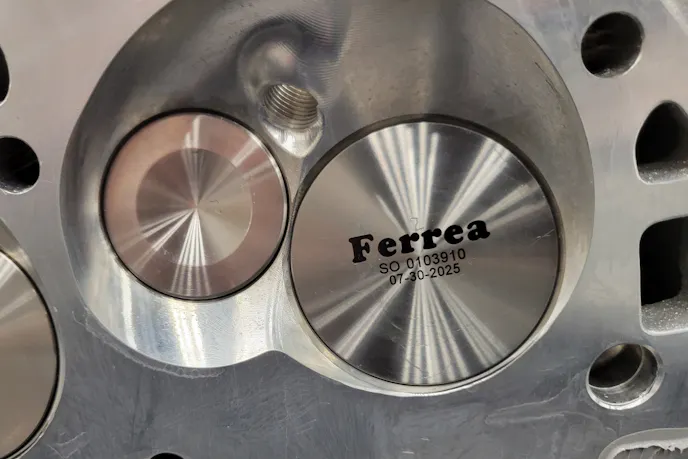
Since the heads come bare, we were able to get creative with our valve selection. Working with Ferrea Racing Components, we decided on 11/32-inch stem, 2.450-inch-diameter titanium intake valves, with a host of small details built into them. Bacalis specified every measurement, including the radius, margin, and back cut angles. For the exhaust valves, Ferrea and Bacalis decided on Inconel valves. Slightly heavier than titanium, but far more heat resistant, the superalloy valves have the same 11/32-inch stem diameter, but a 1.850-inch diameter valve head. The Inconel valves will hold up incredibly well in all conditions, while this engine is making over 1,000 horsepower.
A Killer Valvetrain To Control the Killer Valves
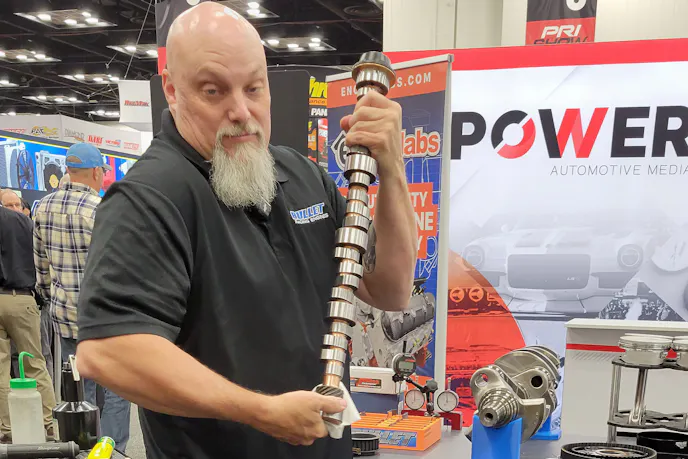
The main controller of the valves is, of course, the camshaft. And, like everything else in this build, the camshaft is something special. Cam Motion started with a 55mm cam core, and Bacalis fit roller cam bearings into the cam tunnel. Working together, Cam Motion and Bacalis picked out some fairly aggressive hydraulic roller lobe designs for the engine. Gross lift at the valve ends up at .729 inch on the intake valves, and .708 inch on the exhaust. The duration at .050-inch of lift numbers seem huge, until you remember there are 632 cubic inches of displacement. With 264 degrees of intake duration, 278 degrees of exhaust duration, and a 113-degree lobe-separation angle, this engine will have a nice balance of street manners and brute power.
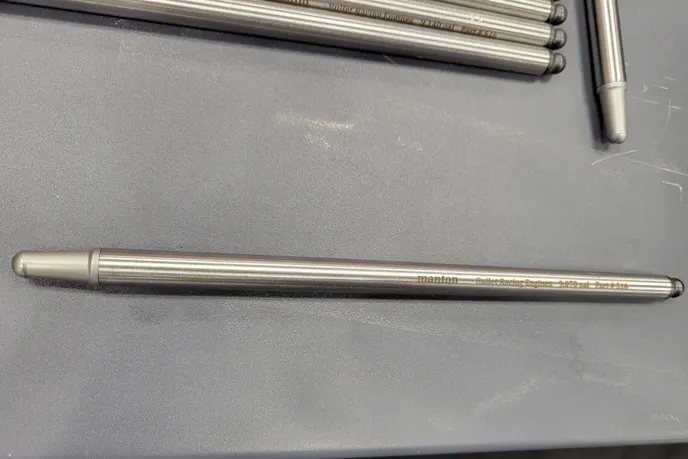
Riding on the lobes of the camshaft are a .903-inch-diameter hydraulic-roller lifters. These units are Johnson short-travel pieces that will handle serious RPM — far more than we are planning on turning this engine. Riding on top of those lifters are some seriously impressive pushrods from Manton. They are a multiple-taper design that tapers from 7/16 inch to 3/8 inch in diameter, with extended 5/16-inch ball tips on either end. Manton’s design is more than just for clearance, as they say the taper design makes the pushrod stiffer than a straight-wall design of the same size.
Translating the camshaft’s motion into valve motion are some of the nicest rocker arms in the industry: Jesel Pro Series aluminum shaft rockers (P/N: KPS-507214). Made with the solid body option, these rocker arms are made from 7000-series aluminum, use an enlarged shaft bearing to help reduce deflection, and have stands mounted to the heads with 7/16-inch ARP fasteners for the ultimate in strength. The rocker arms also have the needle-bearing roller tip upgrade to reduce friction and increase longevity.
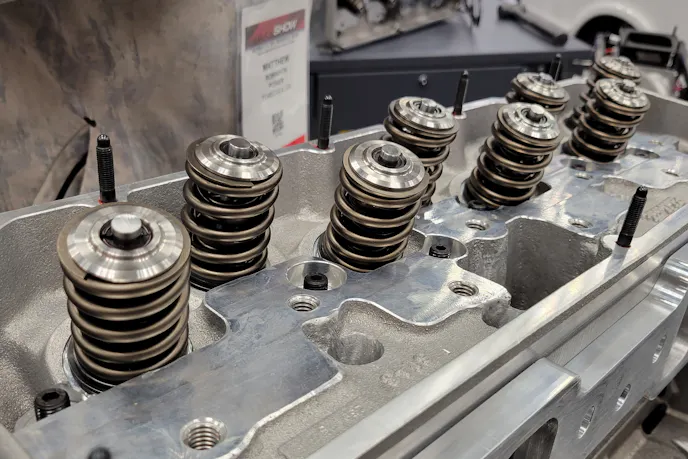
Controlling the valves’ motion are COMP Cams’ Elite Race dual valve springs (P/N: 26097-16). This spring set is designed to handle up to .800 inch of valve lift and a 2.000-inch installed height. That provides 200 pounds of seat pressure and 500 pounds of open pressure through a progressive-rate spring, so the valves will remain under control even at elevated RPM. COMP steel Super Locks and tool-steel retainers round out the killer valvetrain.
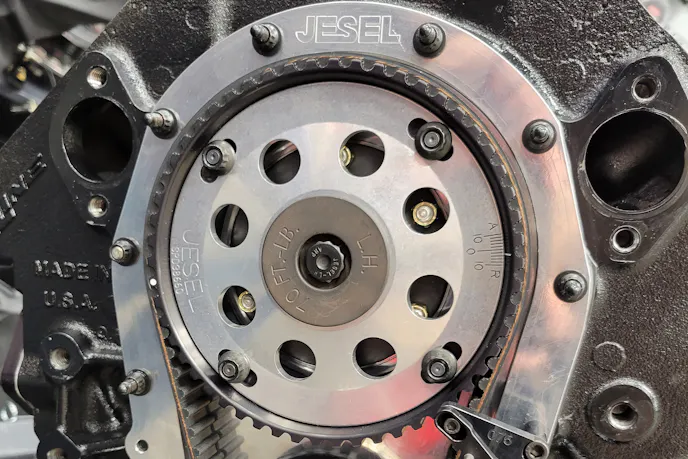
In order to keep the camshaft in sync with the crankshaft, we used a Jesel belt-drive timing set (P/N: KBD-35500). Designed for a raised-cam big-block Chevy application, the Jesel belt-drive uses a billet aluminum 2024-T6 spider, heat-treated steel crank pulley, and Grade-8 hardware throughout. The PTFE cam and crank seals are designed for high-vacuum applications, and have the patented Jesel HTD belt design to reduce the harmonics of the crankshaft being transferred to the cam. Additionally, the external cam timing adjustment allows for 10 degrees of adjustment in either direction.
Induction Worthy Of Kings
In a naturally aspirated application, the intake manifold and induction system as a whole is a lot more critical than in a boosted application, as boost can hide a lot of sins. So, in order to build the best combination possible, we started with an Edelbrock Super Victor II intake manifold for tall-deck big-block Chevrolets (P/N: 2897). This single-pane aluminum intake manifold comes with a 4500-pattern carb pad out of the box, and massive runners designed for big-power big-block builds. However, we went a step further.
We then sent the manifold to Keith Wilson at Wilson Manifolds. Wilson gave the manifold the full treatment, including matching the ports exactly to our cylinder heads. Keep in mind that, at this point, no one outside of Musi’s team had seen the ports on our DR-17 heads before. As was pointed out by Wilson, you need to start with a good manifold as a base in order to be able to make it better. And, what shipped from Wilson Manifolds was a cast intake manifold that rivals the nicest fabricated manifold on the market.
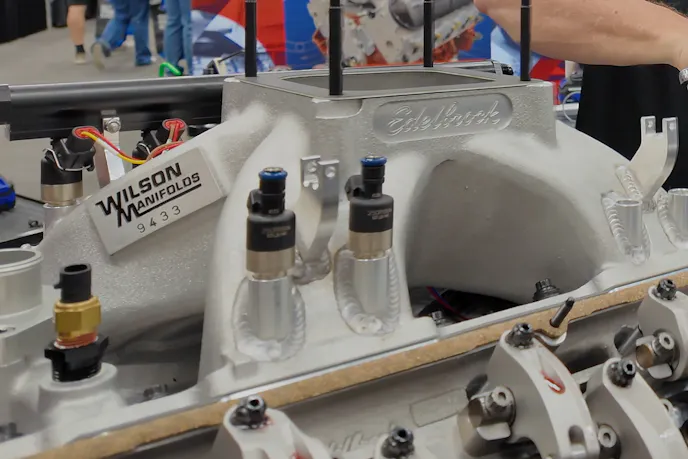
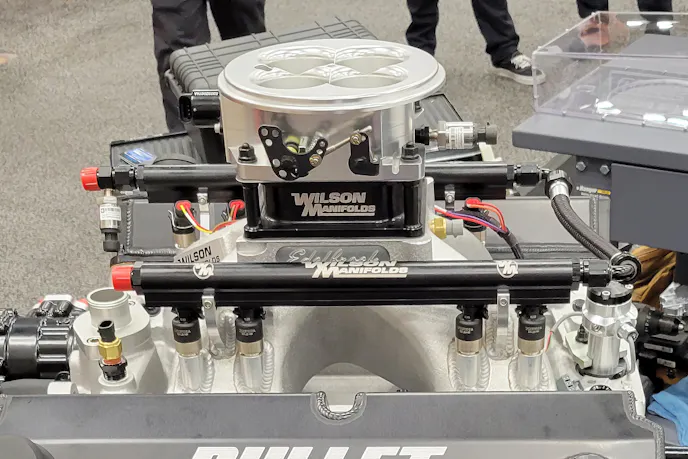
Sitting atop the carb pad is a 2-inch open spacer from Wilson. The idea being that any increase in plenum volume in an EFI application is a positive. Sitting atop that spacer is a Holley 2,000 cfm four-barrel throttle body. CNC-machined from billet aluminum, the 4500-pattern throttle body features four 2.25-inch throttle bores with a progressive linkage. That means that it will not only drive better on the street, but also offer all the airflow the engine can handle at wide-open throttle.
Gimme Fuel, Gimme Fire
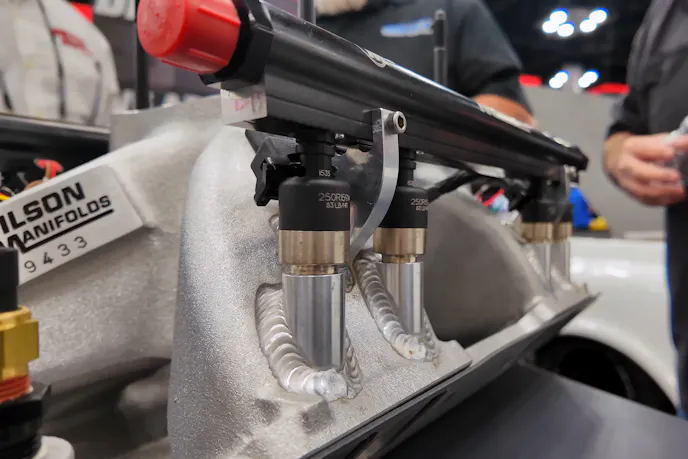
A set of Holley EFI 83-pound-per-hour EV1-style low-impedance injectors (P/N: 522-838) provides fuel to the combination. Rated at a maximum horsepower of 1,325, these injectors will handle the street as well as the track. Besides reliable flow and operation, the Holley EFI injectors feature a “tri-cone” spray pattern for even delivery of fuel into the engine. The 83 lb/hr injectors are housed in a set of Wilson fuel rails mounted to the manifold as part of the EFI conversion from Wilson.
For spark, we went with a coil-near-plug Smart Coil kit from Holley EFI (P/N: 556-127). This replaces the traditional big-block ignition system with a modern eight-coil system like you would find on an LS engine. Adding to the modernization, the distributor is replaced by a cam sync plug, designed specifically for tall-deck big-blocks (P/N: 85142).
To control the fuel and spark, we opted for a universal Holley EFI Dominator system (P/N: 550-654). Rather than being application-specific, this kit is designed to use an EV1 injector harness and attach to the Holley coil-per-plug harness. The Dominator system will allow the winner to get as deep into tuning as they like, while also having the ability to self-learn and be simple to operate, if the winner doesn’t want to get into the nitty-gritty of EFI tuning.
The final piece of the puzzle on the PRI Show floor was the headers. These absolute works of art from Lemons Headers (P/N: BBR-545) are a 4-into-1 design, with 2-3/8-inch diameter individual primary tubes, connecting to a 4-inch diameter collector, and are secured via a bolted solid tab. Designed to fit a stock chassis application of the 1968-’72 Chevelle, the clearance in that application was of the utmost design importance. Lemons then sent the headers out to be ceramic coated, to give the winner the absolute best set of headers possible.
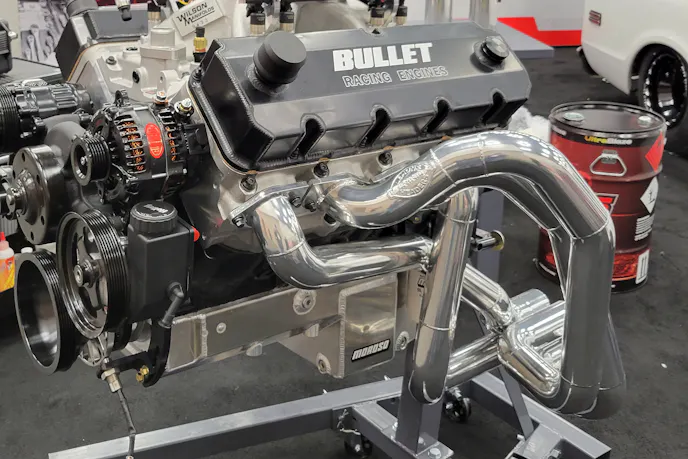
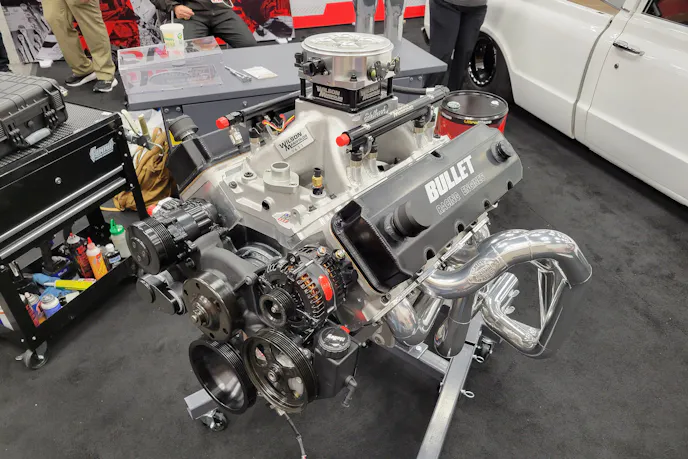
With the engine wrapped up by 1:00pm on Day 3 of the show, it was time to sit back and take in the fruits of the whole EngineLabs Giveaway team’s labor. However the respite was relatively short lived as Bacalis soon prepared the engine for transport, so that we could load it into the truck during an extreme cold weather system, and drive it down to the University of Northwestern Ohio the following day to put this beast on the dyno and see what it does.
The 2026 EngineLabs’ Engine Giveaway is presented by Summit Racing and made possible thanks to partnerships with Bullet Racing Engines, University of Northwestern Ohio, Automotive Racing Products, ATI Performance Parts, Bendpak, Cam Motion, Cometic Gaskets, Edelbrock, ETS Racing Fuels, Ferrea Racing Components, Holley, Jesel, JLine Performance, King Bearings, Klotz, Lemons Headers, Manton, Melling, Moroso, Powermaster, RaceTec Pistons, Total Seal, Williams Performance Products, and Wilson Manifolds.
You might also like
L8T vs. Godzilla Clash In Horsepower Wars Season 5
The new Horsepower Wars Season 5 lineup features a brutal naturally aspirated battle between the Chevy L8T and Ford Godzilla.