
Whether you’re a weekend warrior or a seasoned engine builder, staying current with technology is essential for improving performance. Dimpling cylinder head ports has become a hot topic, with strong opinions on both sides. While some see the practice as promising, others remain skeptical. Many porters continually experiment, striving to discover if dimpled designs can truly boost airflow and enhance engine output.
Principles of Airflow
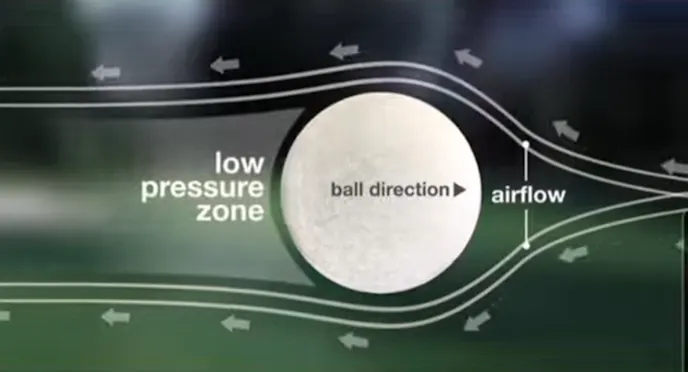
Dimpling a surface to manipulate airflow itself isn’t a new concept. If you have ever been to the driving range, you know where I’m going with this. The process of dimpling a golf ball has proven to reduce drag, improving its airflow characteristics. By reducing the drag behind the golf ball, it will fly further. While the principle may seem the same, the shape of a runner is vastly different from that of a golf ball.
So, how does all this translate into the possibility of improving the airflow of a cylinder head? Sit back, and we’ll take a look at some information behind it all, learning whether this is a worthwhile concept for your next build.
It’s crucial to understand how airflow affects engine performance. Ports and runners act as conduits, directing air (and fuel in a carbureted or port-injected engine) into the combustion chamber. Air encounters less resistance with a streamlined flow, resulting in higher volumetric efficiency and ultimately increased horsepower and torque.
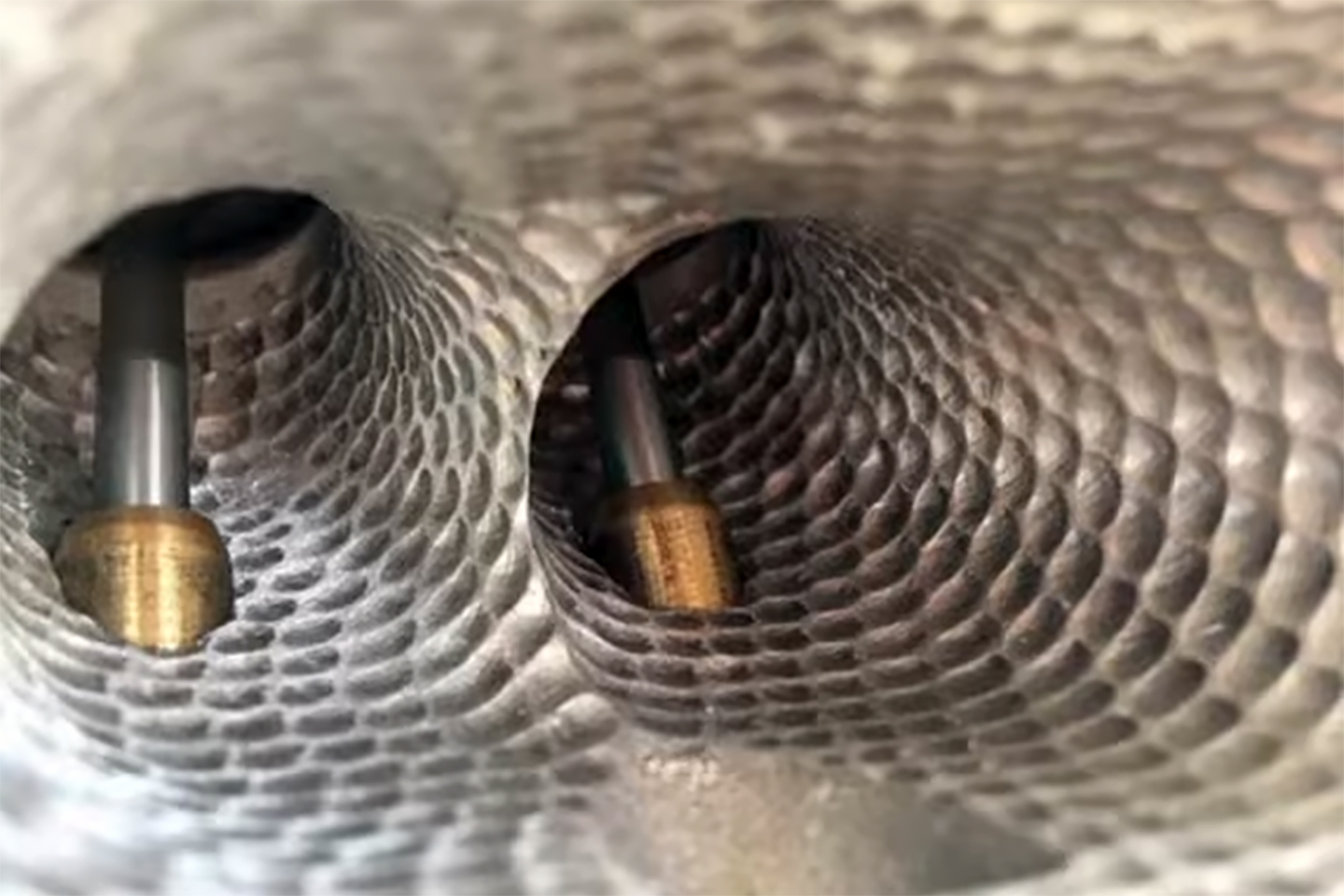
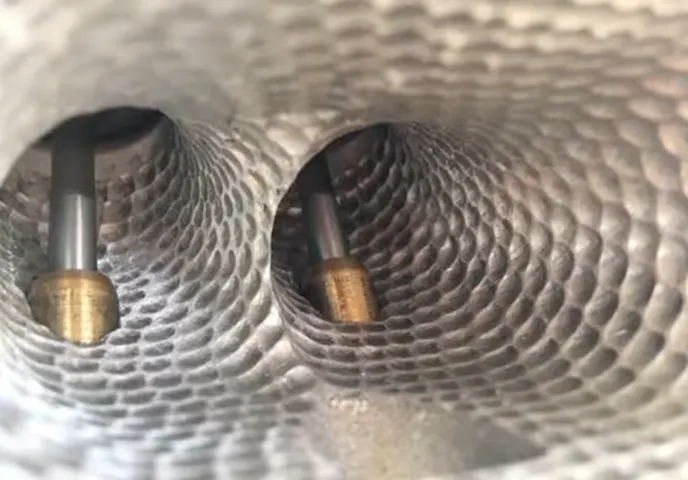
Most engine builders focus on porting and then polishing to texture and reshape the runners, manipulating the air direction, and maximizing airflow. The thought behind dimpling suggests that it may enhance airflow by utilizing boundary layer dynamics. In fluid dynamics, dimples upset the boundary layer. This is the thin layer of fluid (yes, air is considered a fluid) in direct contact with a surface, causing it to become turbulent. This turbulent boundary layer adheres the passing air to the surface for a longer period, thereby reducing the size of the low-pressure area behind the object and decreasing overall drag. When we apply this texture to ports and runners, we’re trying to create a similar effect.
Dimpling Pros
Instead of air flowing over a smooth surface and potentially separating when it changes direction, the dimples create tiny disruptions (turbulence) that keep the air attached to the surface. The goal would be to direct the air where we want it to go, possibly managing dead zones, while providing a higher volume of air entering the cylinder, and maximizing power. The thought is that by encouraging a turbulent boundary layer, dimpling may help air follow the port and reduce flow separation. The turbulence generated by dimpling may also improve fuel atomization, mainly in carbureted and port-injected engines. This facilitates better combustion, translating into increased power, efficiency, and lower emissions. While results will vary, the potential improvements are alluring for those wanting to utilize all the available power in the engine. Some localized basic dimpling can often be done with a ball burr and grinder, making it a cost-effective way to experiment with enhancing performance.
Dimpling Cons
There is always the possibility that we create too much turbulence. (Wait, didn’t we just say we wanted turbulence?) Turbulence needs to be controlled to be beneficial. Finding the right balance is tricky; features like maintaining the proper port velocity, dimple size, depth, and placement are the bare minimum to be considered. Too much turbulence from incorrectly placed and/or sized dimples will disrupt this flow, effectively restricting it and reducing port velocity, thereby diminishing performance.
If an engine runs, and it runs down the racetrack, that doesn’t mean it’s optimal.
Jake Bain — Bain Racing
Dimpling depends on specific engine design, port geometry, RPM, and the application, each with a different degree of effectiveness. What works well for one engine may provide negligible or even detrimental results in another. Getting it wrong will be a costly mistake in more ways than one. Once you dimple your ports and/or runners, there is no going back; you’d better get it right the first time. Trying to repair or fix an incorrectly dimpled head by returning it to a smooth or textured state will likely enlarge the runner, in most cases, destroy port velocity in the desired power range.
This makes dimpling a relatively permanent modification. There also seems to be a lack of large-scale research on the effects of dimpling. This leaves a giant gap in reliable information (keywords) on the effects that dimpling will have on your specific engine. Keep in mind that dimpling is permanent; due diligence is a must before you ever plug in a grinder.
In Conclusion
Dimpling ports and runners in performance cylinder heads is a controversial topic that challenges conventional wisdom about airflow. By drawing on the principles of fluid dynamics and aerodynamics, dimpling possibly offers the potential for improved flow, better fuel atomization, and increased engine efficiency. However, it is not without risks, and the results can be inconsistent. Understanding airflow, engine type, RPM, application, and the ability to accurately verify the modifications are all things to consider before dimpling your heads.
Consulting more than one experienced head porter would also be a worthwhile investment. As with all modifications, experimentation and accurate documentation of the results are key. For this, you will need Flowbench access to evaluate the changes being made. If you are willing to invest considerably more effort, time, and money, dimpling may give you the advantage you’re looking for. Otherwise, normal texturing, porting, and polishing might be your preferred finish choice.
In the long run, your decision should be based on understanding any performance goals and the capabilities of your engine. In addition, do we honestly possess the required skills to bring dimpling to reality? When incorrectly done along with any porting, it often causes more harm than good; consistency and attention to detail are critical.
Having so many videos available, you may be headed down the rabbit hole. It’s worth researching different viewpoints to see if this is the correct modification for you. Jake at Bain Racing is just one of many who have a solid understanding of airflow, and his opinions are just one side of the coin.
You might also like
Inside Ford Racing’s Return To Formula 1 Engines With EPARTRADE
EPARTRADE dives into Ford Racing's return to Formula 1 as an engine supplier, along with their numerous other engine development programs.