
Is hydrogen the fuel of the future? Some very intelligent people have been researching the possibilities. Their work continues to push hydrogen technology closer to practical, real-world applications.
One such group is SwRI (Southwest Research Institute). Founded in 1947 by Thomas Baker Slick, Jr., an adventurer, philanthropist, and oilman. SwRI is headquartered in San Antonio, Texas. It has locations across the US. The organization currently operates several technical divisions and employs about 3,200 people.
Its research operation is no small undertaking. The headquarters encompasses roughly 1,500 acres and contains more than 2.4 million square feet of laboratories, test facilities, workshops, and offices.
Hydrogen Research
Hydrogen engine research is by no means its only business. SwRI works with vehicle and engine systems, automotive fuels and lubricants, communication systems, software development, electronics, and avionics. Its work also includes geosciences, materials engineering, chemistry, environmental science, space science, industrial engineering, modeling, and simulation. This broad range of expertise makes the Institute well qualified for the task at hand.
“Southwest Research Institute likes to say that its work ranges from Deep Sea to Deep Space and everywhere in between,” shared Jesús Chávez, a Sr. Specialist with SwRI’s Corporate Communications Office. “The Institute is an independent, nonprofit research and development organization, and its work serves both industry and government clientele in a variety of market segments and research areas.”
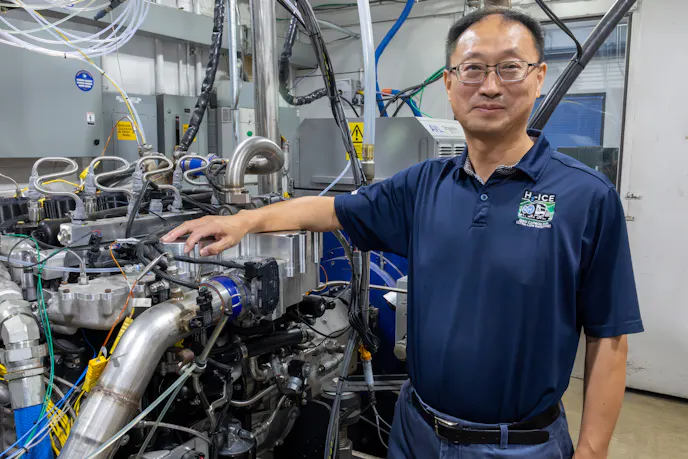
SwRI has extensive experience in developing and testing H₂-ICEs — A.K.A. hydrogen internal combustion engines. Not just passenger car engines, but also decades of experience with medium- and heavy-duty engine development. The current medium-duty Hydrogen-combustion engine project was a two-year development program.
Engine Modification
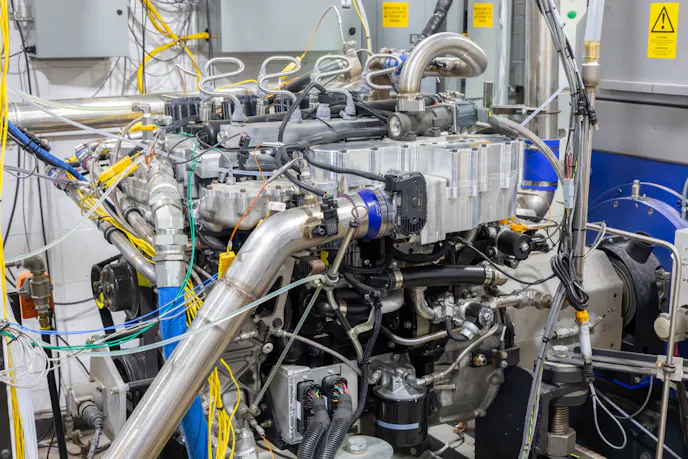
SwRI describes this engine as an optimized, spark-ignited hydrogen ICE (internal combustion engine) specifically designed for medium-duty commercial vehicles. Qilong Lu, a Program Manager with SwRI’s Powertrain System Engineering Department, explains, “We began at the single cylinder level, focusing on optimizing combustion and injection strategies.” From there, SwRI developed the full multi-cylinder engine and addressed pre-ignition, combustion, and system integration.
Here’s where things start to get particularly interesting from an engine-building standpoint. The engine features a pent-roof-style combustion chamber, designed and optimized by SwRI to burn hydrogen. Southwest Research Institute says that the resulting engine demonstrates diesel-like torque characteristics and performance.
Several specific hardware changes are:
- Modified intake port geometry, improving airflow and making it better suited to hydrogen’s faster combustion speeds.
- Larger intake valves to improve volumetric efficiency.
- Hydrogen-specific fuel injectors.
- Variable geometry turbocharger.
- SwRI designed and calibrated engine control system.
Hydrogen Emissions
According to reports, the engine produces near-zero tailpipe CO₂ emissions. Burning hydrogen doesn’t introduce carbon through the fuel itself, but a hydrogen ICE can still produce other emissions, particularly NOx. Hydrogen combustion produces NOx when combustion temperatures are high enough for nitrogen and oxygen in the intake air to react.
Some basic Hydrogen emission chemistry:
- Water Vapor (H₂O): the primary combustion product from Hydrogen.
- Nitrogen (N₂): Most of the nitrogen entering with the intake air passes through the engine unchanged.
- Oxygen (O₂): Some oxygen can remain in the exhaust, especially when the engine operates very lean.
- Nitrogen Oxides (NOx): High combustion temperatures can cause nitrogen and oxygen from the intake air to form NOx.
- Carbon Dioxide (CO₂): Ideal hydrogen combustion produces no CO₂. Lubricating-oil consumption can produce trace amounts.
- Carbon Monoxide (CO) and Unburnt Hydrocarbons: Hydrogen combustion itself does not produce them. Trace amounts can result from lubricating oil consumption.
The ideal chemical reaction is:
2H₂ + O₂ → 2H₂O
This reaction explains how hydrogen combustion produces water. Hydrogen combines with oxygen during combustion to ideally form water. Oxygen is a reactant, not a combustion product. These engines have the potential to operate with near-zero carbon dioxide emissions at the tailpipe.
Engine Design
Southwest Research Institute has already demonstrated that hydrogen can power a heavy-duty internal combustion engine. Now, their researchers are examining how the technology can translate to a smaller engine platform while retaining the durability expected from a diesel.
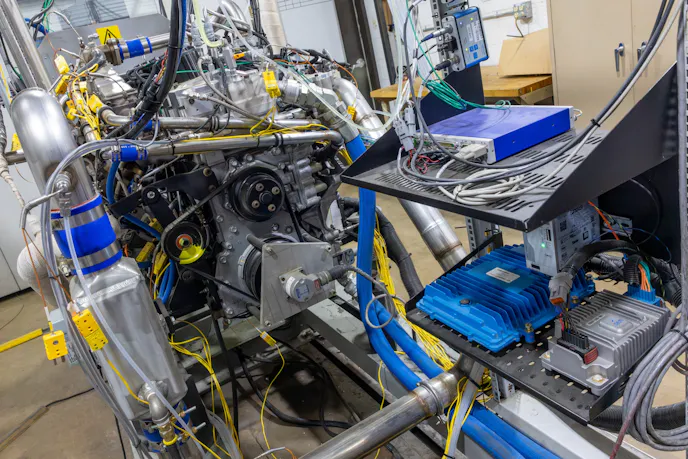
Their latest work starts with a 5.0-liter production diesel engine architecture. Rather than designing an entirely new engine, SwRI retained much of the diesel’s basic mechanical foundation and redesigned the components necessary for spark-ignited operations, as opposed to the base engine’s compression-ignition archetecture.
Ryan Williams, a Manager-Engine Systems R&I with SwRI explained that the project did not begin as a direct diesel-to-hydrogen conversion. Researchers had previously used the platform for gasoline and natural-gas development. Those earlier programs provided a foundation for the latest hydrogen work.
The approach also reflects a broader trend in engine development. A shared engine architecture can support several fuels while retaining many of the same major components. They were able to utilize most of the diesel short block, Williams explained. That includes the block, crankshaft, and connecting rods. Retaining those components preserves much of the rugged mechanical foundation associated with a diesel engine. The upper portion of the engine, however, is considerably different.
Building A Hydrogen Combustion Engine
Converting the engine to hydrogen required SwRI to completely redesign the cylinder head, piston, and combustion chamber. Hydrogen engines are predominantly spark-ignited, and the original diesel combustion chamber was not suitable for the new application.
A traditional diesel cylinder head is essentially flat across the combustion face. SwRI instead developed a pent-roof combustion chamber similar to those found in modern gasoline engines. The new cylinder head retains four valves per cylinder, but their angles changed. That required new camshafts, rocker arms, and other valvetrain components. The piston crown also changed significantly. SwRI ultimately settled near a 12:1 compression ratio for the 5.0-liter hydrogen engine.
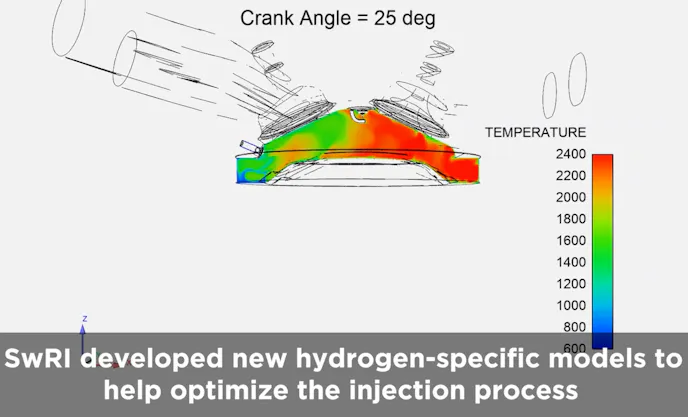
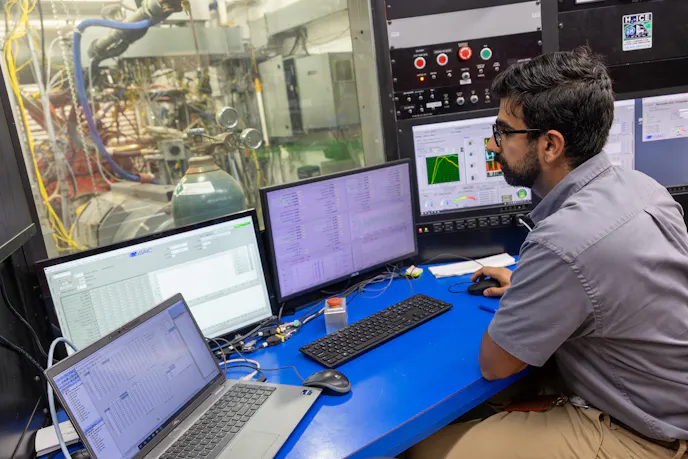
Before committing to the complete multi-cylinder engine, researchers developed the combustion system using a single-cylinder research engine. SwRI used computational fluid dynamics, or CFD, to study airflow and combustion before producing physical components. Researchers evaluated multiple compression ratios, piston crown designs, and intake-port geometries before moving to the full engine. That development process was particularly important because hydrogen presents combustion challenges that differ significantly from gasoline and diesel.
Hydrogen Needs Air — A Lot Of It
One of the biggest differences between a Hydrogen combustion engine and its gas or diesel counterparts is the amount of air flowing through the engine. Williams said hydrogen’s stoichiometric air-fuel ratio is approximately 34:1. However, SwRI isn’t operating the engine at stoichiometry. This hydrogen engine typically operates at approximately 2 to 2.5 times the stoichiometric airflow. The additional air helps control combustion temperatures and reduces the likelihood of pre-ignition. Getting that much air into a 5.0-liter engine isn’t easy.
The experimental engine also uses a single variable-geometry turbocharger. Williams estimated boost during testing at above 2.5 bar and reaching as high as 3.5 bar, depending on the operating condition. SwRI has also investigated cooled exhaust gas recirculation as another way to control combustion while reducing demands on the boosting system. Charge-air temperature is managed with a water-to-air cooler, an arrangement already common in medium- and heavy-duty diesel applications.
Port Injection Vs. Direct Injection
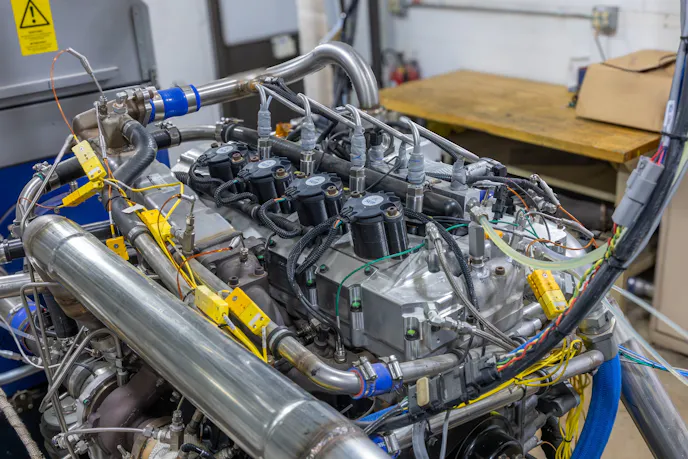
Fuel delivery was another major part of the program. SwRI designed the engine so researchers could investigate both port and direct hydrogen injection. Each approach has advantages. Port injection gives hydrogen more time to mix with the incoming air. Airflow and turbulence through the intake valves also help create a more homogeneous mixture.
There is also a significant disadvantage. Hydrogen has extremely low density, so delivering enough fuel requires a considerable volume og gas. When hydrogen is introduced through the intake port, it occupies space that could otherwise contain air. That becomes particularly troublesome for an engine already requiring enormous airflow.
Direct Injection avoids some of that competition for space. Hydrogen can be injected after the intake valves close, improving volumetric efficiency and easing some of the demands on the turbocharger. The tradeoff is achieving proper air-fuel mixing inside the cylinder. Hydrogen gas doesn’t have the mass and momentum of a liquid gasoline spray. SwRI found that direct-injected hydrogen requires substantial in-cylinder motion to produce a homogeneous air-fuel mixture.
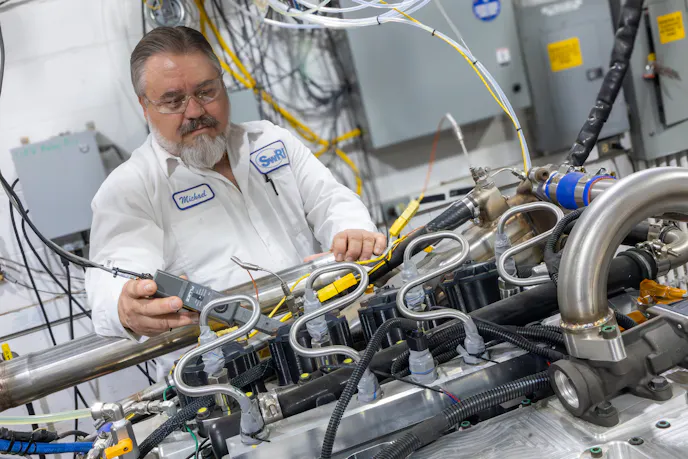
That requirement provided another reason for developing the pent-roof combustion chamber and its associated charge motion. Direct injection also offers an advantage in controlling knock and pre-ignition because the hydrogen spends less time exposed to high cylinder temperatures before combustion.
Unlike gasoline engines, however, hydrogen doesn’t provide significant charge cooling. Gasoline absorbs heat as the liquid fuel evaporates. The hydrogen entering this engine is already gaseous, eliminating that phase-change cooling effect.
The Strange Problem Of A “Ghost Spark”
Hydrogen’s low ignition-energy requirement makes it relatively easy to ignite with a conventional spark plug. It can also create an unusual ignition-system problem. Williams described a phenomenon called “ghost spark.” With a traditional inductive ignition coil, some electrical energy can remain after the intended spark event. That residual energy may survive until the following cycle.
Under certain conditions, enough energy can remain to produce an unintended spark while fresh air and hydrogen are entering the cylinder. That can cause a backfire, particularly with port injection because a combustible mixture is already present upstream of the intake valve. To rectify this, SwRI has investigated ways to bleed the residual electrical charge from conventional coils. Researchers have also experimented with capacitive-discharge ignition, which drains its stored energy each cycle and avoids the same residual-charge behavior.
Controlling NOx Without Carbon At The Tailpipe
Burning hydrogen eliminates fuel-derived carbon dioxide because hydrogen contains no carbon. However, it doesn’t eliminate every regulated emission. Nitrogen Oxides, (NOx) can still form when nitrogen and oxygen in the intake air are exposed to sufficiently high combustion temperatures. SwRI’s extremely lean combustion strategy helps address that problem. The lean mixture also plays an important role in controlling cylinder temperature and preventing pre-ignition, making airflow management critical to both emissions and engine durability.
According to Williams, engine-out NOx concentration from the experimental hydrogen engine is approximately 10 times lower than the diesel baseline. Significantly lower NOx emissions also simplify the required aftertreatment system. Continuing to use these systems will reduce those emissions even further. The reduction in system complexity and size can also reduce the production cost while requiring less space in the vehicle.
Matching The Diesel Output
For this project, SwRI wasn’t attempting to produce a spectacular horsepower number. Researchers wanted the hydrogen engine to provide performance equivalent to the diesel engine on which it was based, and they achieved that target. Williams cited published output for the original diesel engine of approximately 215 horsepower and 450 lb-ft of torque. The hydrogen version reached the project’s equivalent-performance goal while retaining the robust diesel-based mechanical foundation.
For a medium-duty application, that torque output matters considerably more than a high-RPM horsepower figure. The project also demonstrates something larger than one hydrogen engine. Williams emphasized that SwRI’s broader objective is exploring multiple paths toward decarbonization rather than selecting a single technology as the solution for every application.
Once a durable diesel-based platform has been converted into an optimized spark-ignited architecture, hydrogen isn’t necessarily the only fuel that could be used. A similar architecture could potentially accommodate natural gas and fuels such as methanol or ethanol, which can be produced from renewable sources.
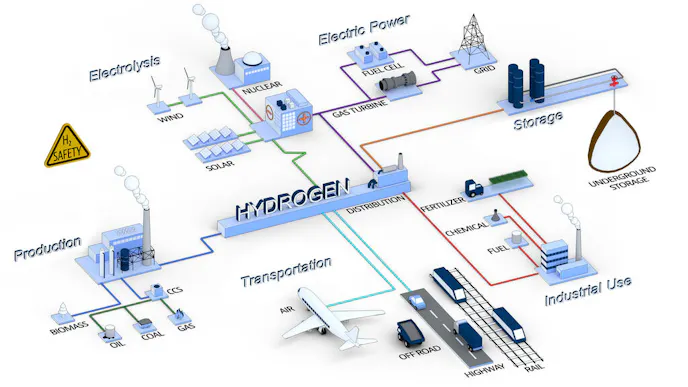
Hydrogen represents the extreme case because the fuel itself contains no carbon, eliminating fuel-derived CO₂ at the tailpipe. However, hydrogen currently has infrastructure challenges. Production, distribution, storage, and dispensing must develop alongside the engines that consume it. For SwRI, that makes the 5.0-liter medium-duty project about more than replacing diesel fuel with hydrogen.
It’s an exercise in creating a flexible engine architecture capable of taking advantage of different low- and zero-carbon fuels without abandoning the manufacturing base, durability, and infrastructure developed around the internal combustion engine. As Williams put it, the objective isn’t to prove that hydrogen will become the single answer. It’s to demonstrate that “engines aren’t the enemy.” The real target is reducing fossil-based CO₂, and hydrogen provides one more pathway for reducing it.
You might also like
Do Hub Dynos Actually Record Higher Numbers? Big 3 Racing Plays "Mythbusters"
It is commonly believed that hub dynamometers make more power than a roller dyno, but less than an engine dyno. Is this right, though?