


It’s no surprise that Ford has been working very hard on its return to Formula 1 as a power unit partner with Red Bull Racing and its junior team, Racing Bulls. At the recent EPARTRADE Race Industry Week, familiar EPARTRADE host Brad Gillie sat down with Mark Rushbrook, Global Director of Ford Racing, to discuss Ford Racing’s big move back into the powerplants of Formula 1, as well as LeMans Hypercar.
“We’ve grown very much as a team here at Ford Racing; the number of people and the number of programs,” Rushbrook shares. With the sheer size of the move to get into and back into several of the major categories that Ford Racing is getting into in 2026, Rushbrook assures that they aren’t abandoning any of the existing programs within Ford Racing, formerly Ford Performance.
The racing and the performance vehicles are linked together. It is a true two-way transfer from the racing to the road vehicles, and the road vehicles to the racing. — Mark Rushbrook, Global Director of Ford Racing
“Our biggest challenge has been Formula 1. After all, it is the pinnacle of motorsport. It is so fast-paced and has so much attention to detail,” says Rushbrook. “We’ve been working on that for three years now with Red Bull. We have great people working on it, great designs, great testing, and everything looks good on the dyno.” Obviously, all of that work played out well for the teams during recent pre-season testing, even earning compliments from rival teams.
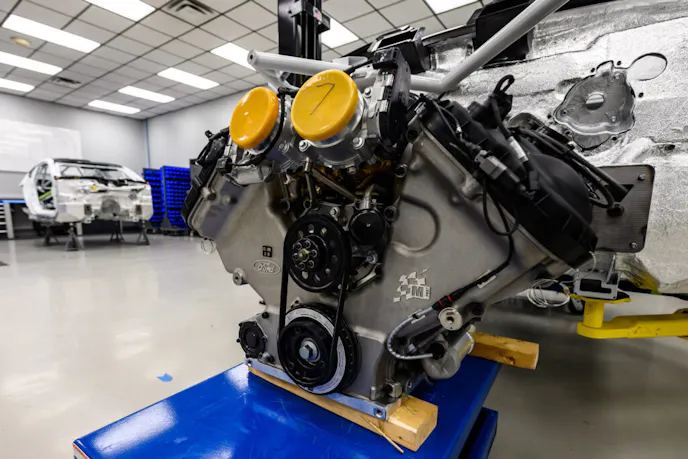
A Lot Has Changed, Technologically Since The Last F1 Effort
Ford’s last effort as a Formula 1 engine supplier was more than two decades ago. But, that doesn’t mean the Blue Oval is behind the curve. “There are a lot of parallels between our development in motorsports and racing and the development of our road vehicles. It used to be a lot of trial and error. But, today, as we develop in racing and road vehicles, there is so much work that can be done on computers.”
There is no doubt that the computer-based tools available today compared to twenty-plus years ago are a chasm larger than the Grand Canyon. However, it’s not like Ford hasn’t been using all of those tools in its day-to-day operations. Now, they are able to simply refocus those tools into the F1 arena. “Design and simulation really allow us to understand what the performance is. Those analytical tools have become so much stronger for us. And then also, the bench testing, the dyno testing, the lab testing — either as a single component or a set of components or a system — has so much fidelity in those machines, we can really understand what is going on at a component or system level,” Rushbrook explains.
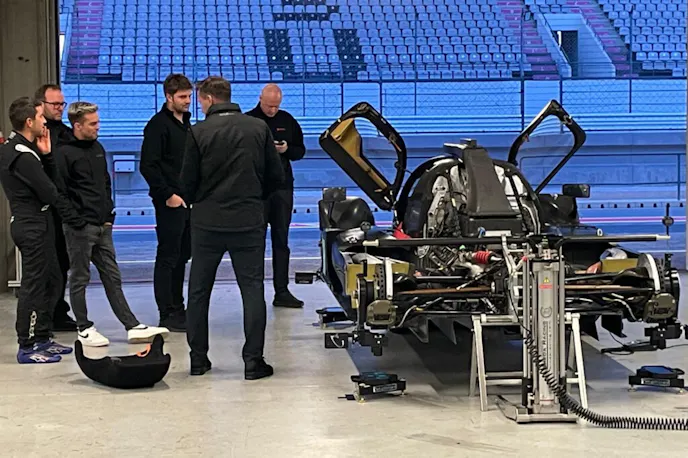
Another difference for Ford from their last round of Formula 1 efforts, is that the power units are now hybridized. “Our dynos, we have engine dynos, and in the case of F1, they are hybrid dynos, for the electric motor and the internal combustion engine. We also have driveline dynos that we can use for that, so we can put most of the components on for a full simulation of a lap, but it’s sitting stationary in a room,” reveals Rushbrook.
“We’ve got a lot of confidence from that, but until the vehicle comes together as a whole, and actually gets on the track, you don’t know everything, and you’ll find things that surprise you. I think that’s going to be the key for all of our programs,” concludes Rushbrook of simulation testing. “We will learn something on track that we did not see in the computer or in the laboratory.
What is clear in the interview is that this is a large step for Ford Racing, and they are taking it extremely seriously, not simply as a side project. Ford as a whole believes deeply in racing’s importance to the brand and is devoting considerable resources to not only being involved but being at the top of the ladder.
This is only part of what Gillie and Rushbrook discussed in the interview, so be sure to watch the above interview in its entirety — it’s well worth the half an hour to listen to.
You might also like
Finding The Limit: Exploring A Blown-Up VK56 Engine
There's been a lot of hype around the Nissan VK56 engine as of late, but someone found the limit, and in spectacular fashion.