


The Ducati Desmosedici Stradale V4R engine represents one of the most extreme examples of naturally aspirated performance ever put into a street-legal motorcycle, combining MotoGP-derived design, extreme engine speed, and uncompromising engineering. Jason Fenske of Engineering Explained recently showcased this amazing engine and broke it down in his signature fashion.
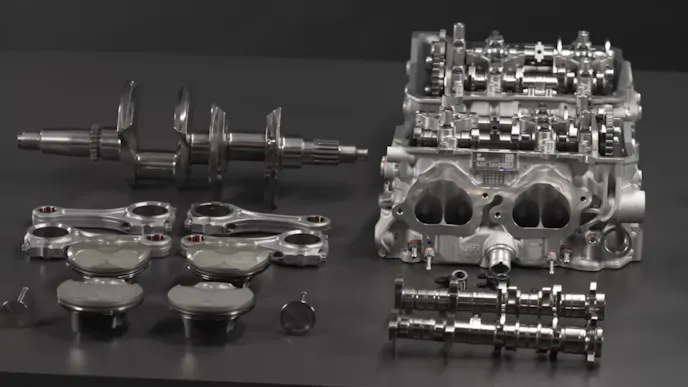
Inside the Ducati Desmosedici Stradale V4R Engine Design
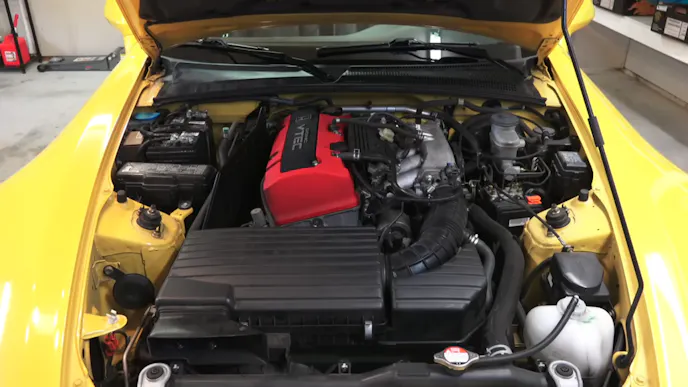
When the Honda S2000 debuted in 1999, its F20C inline-4 engine set a new benchmark for performance. The naturally aspirated two-liter inline-four produced 240 horsepower. At the time, 120 horsepower per liter was an unmatched figure in a production car. Fast forward to today, and Ducati’s one-liter V4R, in race trim, produces nearly the same total output as the F20C while using half the displacement. Even the street-legal version delivers an astounding 218 horsepower while also meeting emissions and durability requirements.
The easiest way to increase engine power is to increase its size; unfortunately, this also adds weight, which is not ideal for a high-performance motorcycle. Instead of increasing engine size, Ducati pursued the more challenging path for boosting power: increasing engine speed. To achieve this, the V4R includes a unique blend of mechanical design choices that favor a high-rev range, balance, and durability.
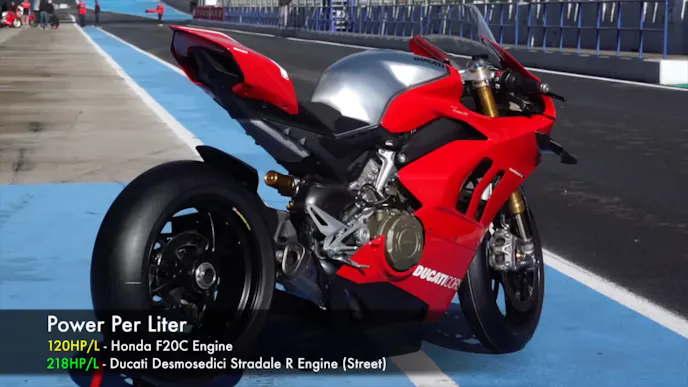
Comparing the high efficiency of the Ducati V4R engine to other high-performance naturally aspirated engines, such as the 4.0-liter V12 in the Gordon Murray T50, we can see just how impressive these numbers are. The T50 engine produces 661 horsepower or roughly 165 horsepower per liter, one of the highest figures ever seen for a naturally aspirated engine in a production car.
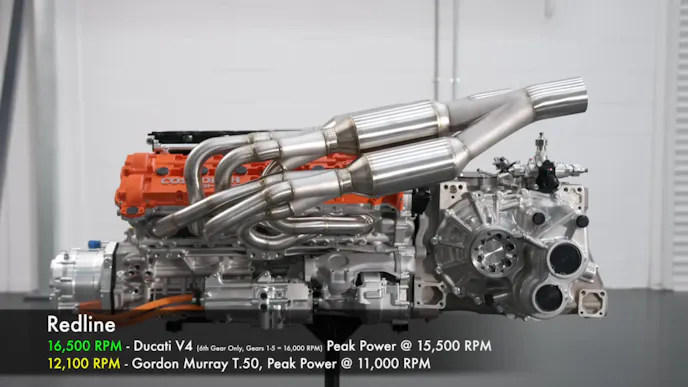
Even so, Ducati’s V4R produces more power per liter by a significant margin. The difference comes down to engine speed. The T50 reaches an extraordinary 12,100 rpm, an almost unheard-of number in the automotive world, while Ducati pushes the V4R to roughly 16,500 rpm. Higher RPM directly translates into more power strokes, increasing total power output. The challenge is building an engine that does not destroy itself at such speeds. Every internal component faces higher heat, greater stress, and stronger acceleration forces. Valve springs lose authority, piston speeds approach critical limits, and the entire mechanical assembly must resist extreme pressures. Ducati’s engineering is centered on solving these issues.
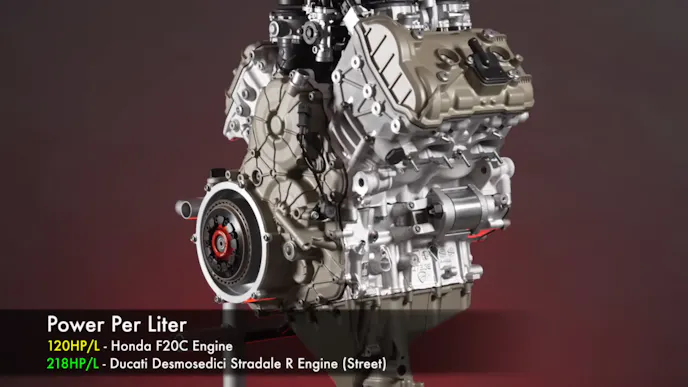
For decades, Ducati built its reputation on V-Twin engines. That architecture offered strong torque characteristics but limited potential for extreme engine speeds. For the V4R to reach the high RPM needed for the desired output, Ducati needed smaller valves, a shorter stroke, and lower reciprocating mass. A V2 cannot achieve a power increase without dramatically increasing bore size, which increases valve diameter and valvetrain mass. The V4 solves this by splitting the displacement among four smaller cylinders rather than two large ones. This means a smaller, lighter valvetrain that is easier to control and less prone to instability at high RPM.
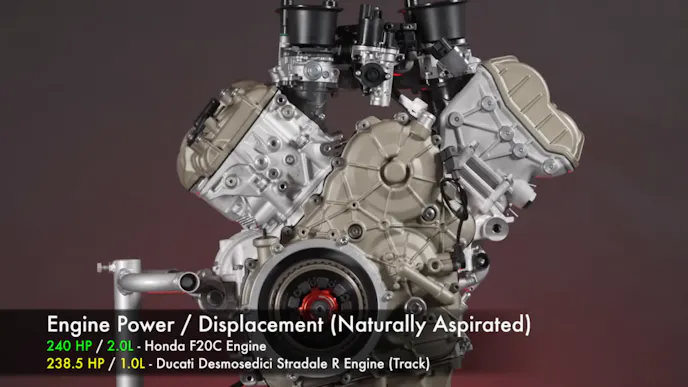
Another concern is that at extreme RPM, traditional metal coil springs cannot reliably close the valves. They lose the ability to track the cam’s motion, which can lead to valve float. An option to avoid this is pneumatic air-controlled valve systems, but they are complex and require constant maintenance, making them unsuitable for a street bike.
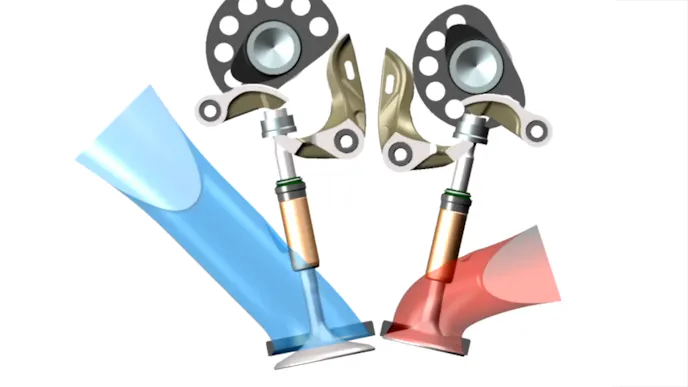
To address this problem, Ducati’s patented Desmodromic valve system eliminates the need for valve springs entirely. One cam lobe opens the valve, and another cam lobe closes it, using rocker arms to precisely translate each motion. This removes the unpredictability of springs and gives precise control of valve movement at any engine speed. This valvetrain system is a defining feature and a key factor in the Ducati V4R’s ability to operate at such an extreme RPM.
The Ducati V4R’s packaging advantages also improve the motorcycle’s overall performance. An inline-four engine, often used in motorcycles, has a large frontal area, which increases aerodynamic drag and limits the lean angle clearance needed for aggressive riding. The Ducati V4R solves this issue by dividing the cylinders into two narrow banks, creating a much slimmer profile with better aerodynamics. The engine can also be positioned lower in the chassis, in turn lowering the center of gravity. Ducati also cleverly uses the rear cylinder bank as a stressed structural member, increasing chassis rigidity without additional frame material.
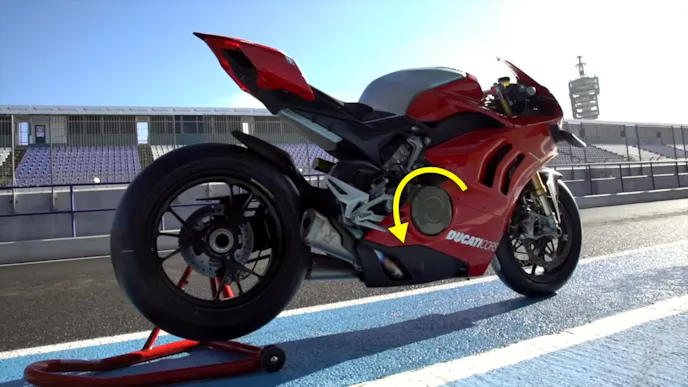
Another way Ducati pushes overall performance even further is by applying the same philosophy, that extra complexity is acceptable if it delivers results, to crankshaft rotation. Although common in MotoGP, Ducati is one of the few manufacturers to use a counter-rotating crankshaft in a street-legal motorcycle. Most street bikes have the crankshaft and wheels spinning in the same direction. For the Ducati V4R, the crankshaft’s rotation is reversed relative to the wheels. This creates several performance benefits. It reduces front-wheel lift during acceleration and rear-wheel lift during deceleration. As well as reducing the overall gyroscopic resistance acting on the motorcycle. With less gyroscopic force, the bike transitions more easily from side to side and feels more agile during rapid direction changes.
The Ducati V4R is an excellent reminder that internal combustion engines still have room for improvement. The power number is impressive, but it is the underlying engineering that really stands out. Ducati has produced a one-liter engine with power density comparable to multi-million-dollar hypercars while remaining accessible. The V4R shows just how far engineering can be pushed when performance is the primary objective and complexity is treated as an acceptable cost.
You might also like
Back Cut Valves: Why Intake Valve Geometry Matters More Than You Think
Eric Weingartner just released Part One of a two-part test where he compared cylinder head flow of various intake valve back cuts.