


Everyone has heard the argument that flow bench numbers don’t translate to actual engine power. While airflow numbers are useful, they’re only meaningful if they help explain what ultimately happens on the dyno. Eric Weingartner of Weingartner Racing is looking to do exactly that. He just released Part One of a two-part test comparing back cut valves with intake valves without back cuts. Part One focuses on flow bench data. Part Two will determine how those differences translate into real power on the engine dyno.
The Test Plan
For the dyno portion of the test, Weingartner will use a 408 cubic-inch LS engine, the same engine he has relied on for numerous prior projects, including his LS cam challenge. Weingartner plans to compare three different cams with varying durations to determine if the camshaft duration has an effect when combined with the valve back cut.
Proven Heads, Now CNC-Ported
For the cylinder heads, Weingartner chose to use a pair of ProMaxx small-bore LS3 heads, a set he has already dyno tested extensively. In previous testing, these heads produced 685 horsepower with a Texas Speed Stage 2 camshaft. These results outperformed every other head tested with the same camshaft.
Following that testing, Weingartner has developed a CNC port program specifically for these small-bore LS3 heads. The intake runner volume has been increased from approximately 250cc stock to 265cc after CNC porting. Since they’re designed for small-bore applications, these heads use smaller valves than traditionally found on LS3 heads. Instead, they have a 2.08-inch intake valve and a 1.600-inch exhaust valve.
What Are Back Cut Valves and Why Test Them?
A back cut is a secondary angle machined into the underside of the valve head, just above the primary seat angle. In this test, all valves and seats use a 45-degree seat angle, isolating the back cut as the variable. The back cut alters how air turns around the valve as it enters the cylinder.
To exaggerate the effect and make the differences easy to see, Victory 1 Performance supplied custom titanium intake valves featuring a large back cut of around 30 degrees. The goal of this initial test was to determine whether the back cut valves have a significant effect on airflow.
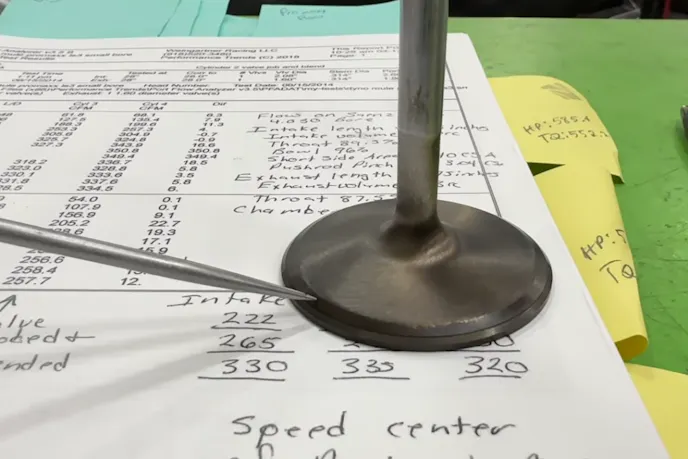
Flow Bench Results: Low-Lift Flow Dominates The Conversation on Back Cut Valves
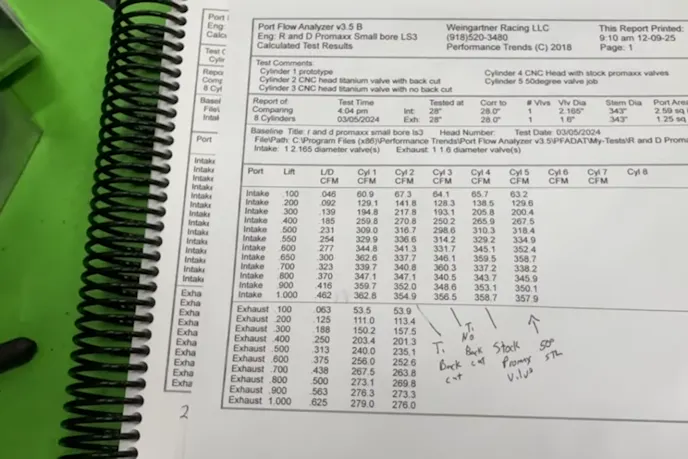
Immediately, there was an answer to the initial question. Comparing the large titanium back cut valves to a titanium valve with no back cut showed major losses in low and mid-lift airflow when the back cut was removed.
Results at key lifts:
- 0.300 lift: airflow increased from 193 cfm to218 cfm, a 25 cfm gain with back cut valves
- 0.400 lift: airflow increased from 250 cfm to 271 cfm, a 21 cfm gain with back cut valves
- 0.500 lift: airflow increased from 299 cfm to 316 cfm, a 17 cfm gain with back cut valves
At higher lifts, the results began to change. At 0.650–0.700 lift, the no-back-cut valve actually out-flowed the heavly back cut valve. These data points amplify the main question of this experiment: Is low-lift airflow more valuable than high-lift airflow when it comes to making power?
The Stock ProMaxx Valve: A Useful Middle Ground
Weingartner also reflowed the stock ProMaxx steel intake valve featuring a modest back cut. The testing results landed squarely between the two extremes. With its more modest back cut, it consistently outperformed the no-back-cut titanium valve at low and mid lifts, while trailing the aggressively back-cut titanium valve by a smaller margin. This placed the stock ProMaxx valve in a practical middle ground: not optimized for maximum low-lift flow, but far better than a valve with no back cut at all. When compared to the no back cut titanium, the stock ProMax valve flowed better everywhere except at .700 lift, where it flowed 337 cfm compared to 360.3 cfm. This value, ironically, ended up being the maximum flow of all the testing.
This data reinforces a key takeaway that applies to many different aspects of engine building. While peak flow numbers are easy to chase, improving airflow where the valve actually spends most of its time open often delivers the biggest real-world gains. Whether that advantage carries through to horsepower and torque will ultimately be decided on the dyno.
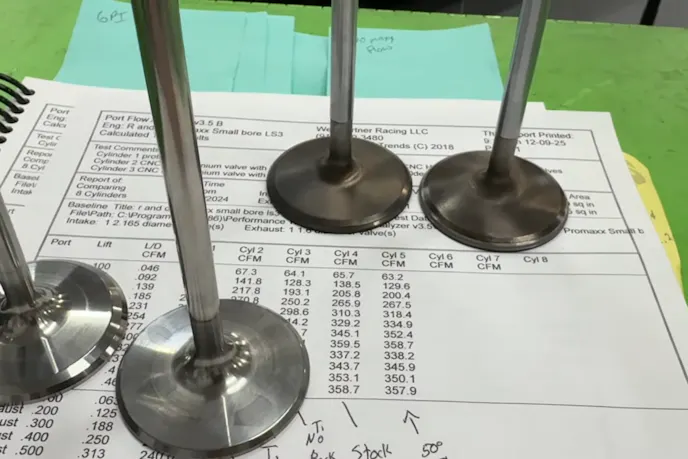
Seat Angle Experiment: 45 vs. 50 Degrees
Curiosity led Weingartner one step further. Based on previous R&D with small-block Chevy heads, he reworked the stock ProMaxx valve and seat from 45 degrees to 50 degrees while leaving everything else unchanged.
The results were once again thought-provoking:
- At 0.500 lift, the 50-degree seat produced the best result at 318.4 cfm
- At 0.600 lift, it again led the group with 352.4 cfm
Weingartner notes that repeating this experiment with the Victory titanium valves would not be cost-effective, as coated titanium hardware is rather expensive.
The Takeaway So Far on Back Cut Valves
Part One of the test makes one thing clear: valve and seat geometry can produce airflow gains that rival or exceed traditional porting, especially at low lift. Whether those gains translate into more torque and horsepower across different camshafts will be determined in Part Two on the dyno. This comparison reinforces one of Weingartner’s most consistent messages: many enthusiasts spend hours grinding on ports and are lucky to gain 10 cfm if they never touch the valve. His experiment showed that back-cut changes alone delivered more than double that improvement at certain lifts. As Weingartner puts it, you can grind on a cylinder head all you want, but the biggest changes often happen where the air meets the valve.
You might also like
Inside Ford Racing’s Return To Formula 1 Engines With EPARTRADE
EPARTRADE dives into Ford Racing's return to Formula 1 as an engine supplier, along with their numerous other engine development programs.