
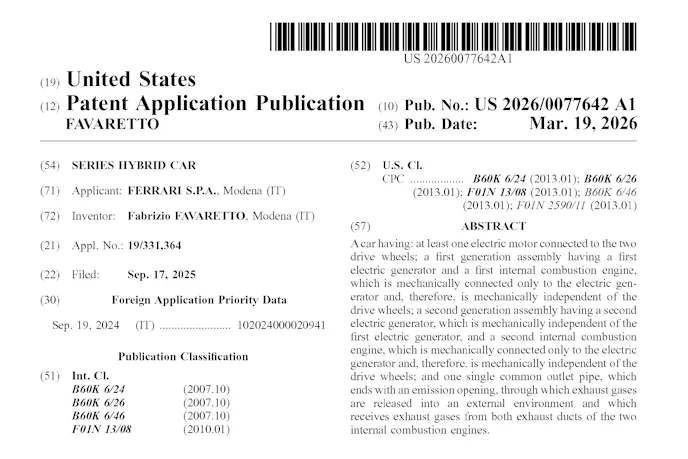
A recently published patent application from the US Patent and Trademark Office (US 2026/0077642 A1) shows an insa… err… unique engine arrangement being investigated by Ferrari. Like most modern OEM filings, it’s equal parts fascinating and tough to fully decode unless you’re living deep in powertrain engineering every day.
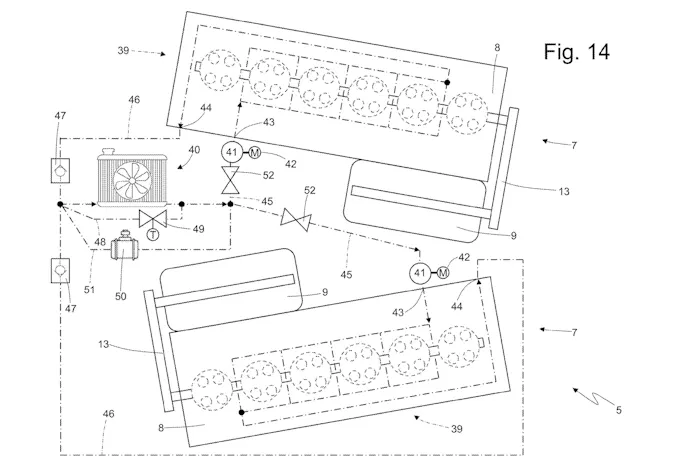
What it outlines is a 12-cylinder arrangement, but not like anything you’ve ever seen before. There’s a lot going on here, and while the intent is clear in places, the full execution is anything but simple. There are two inline-six engines arranged in a V configuration… but not like you’re thinking. The V arrangement is from above, forming a shape that points towards the rear of the vehicle.
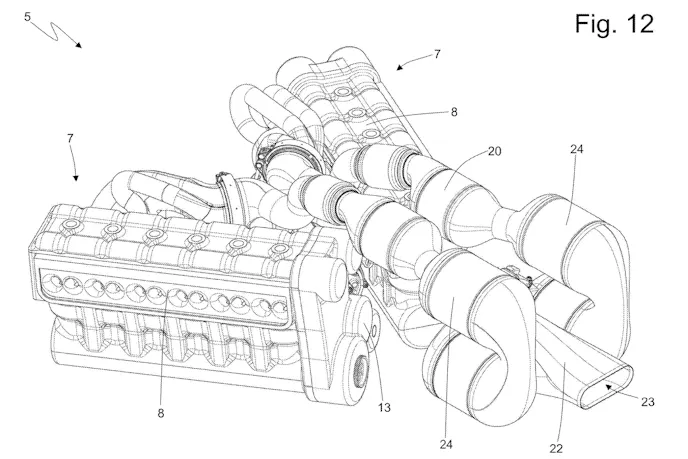
Before you break your brain trying to figure out driveline angles, the arrangement works because the two inline-six-cylinder engines don’t actually drive the wheels. Instead, they act as full-time generators for the electric motor attached to each engine. Those motors are what actually power the wheels. If we’re reading the patent correctly, a maximum combustion engine crank speed of 15,000-18,000 rpm, with the generators reaching speeds in the 25,000-28,000 rpm range.
Where things get a little interesting, as if this idea wasn’t “interesting” enough already, is that both independent six-cylinder engines will share an exhaust. While each engine will have its own exhaust manifold, apparently of the 6-into-1 configuration, they will feed into a common chamber before exiting the rear of the vehicle. That screams one thing to us: sound. Ferrari is aiming to have this “hybrid” configuration maintain the soul of a Ferrari 12-cylinder sports car — the sound.
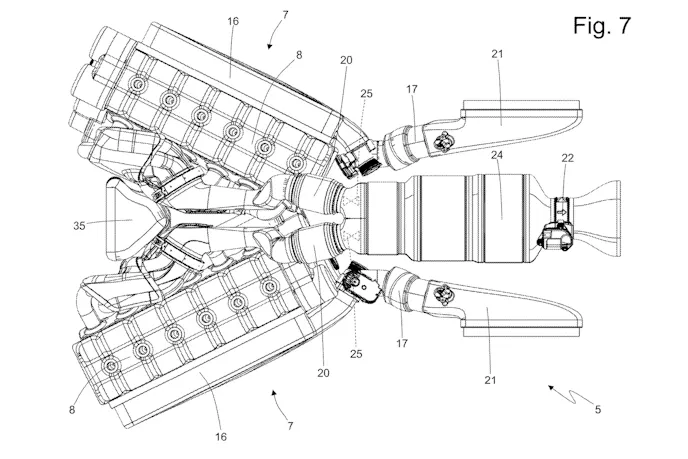
This assumption is further supported in the patent, as there are 13 references to the sounds produced by the internal combustion engines. Specifically, the ability to control and alter the timing of the exhaust pulses of each engine in relation to one another, bringing them into and out of sync for different acoustic effects.
A side thought, is, what is a Ferrari inline-six going to look like? If this engine package makes it off the drawing board and into production, could we see “junkyard” Ferrari straight-six swaps? Surely, even on its own, the “generator unit” will be an impressive engine.
Now, before anyone gets overly worked up about this, just because a patent has been filed doesn’t mean that it will ever come to life. But, it does raise an interesting philosophical question. If it makes all the right noises, but the internal combustion engine doesn’t actually power the car, does it really have the same soul? It’s sure better than the speaker-based system on the Dodge Charger, though, isn’t it?
You might also like
Valve Spring Retainers: Discussing Durability Vs. Mass With Melling
Valve spring retainer material choice is a balance of durability, weight, and fitment based on application and use.