

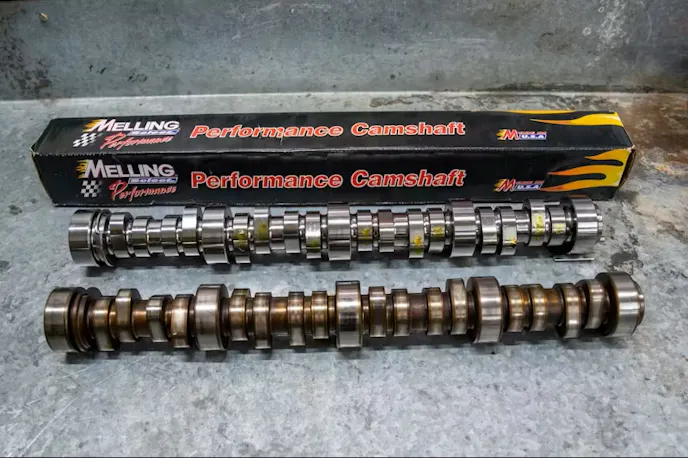
Melling has earned a reputation over the years as an engineering, product development, and distribution powerhouse in replacement parts, aftermarket performance, and professional motorsports. In the past few years, Melling has jumped hard into the camshafts market, and we caught up with Cale Risinger, Technical Director at Melling, for a closer look goes into the development of a Melling camshaft.
According to company sources, Melling was founded in 1946 and today is headquartered in Jackson, Michigan. It operates seven facilities; five in North America, one in Mexico, and one in Europe. Two of the divisions, Melling Engine Parts and Melling Performance, combined product offerings serve over 1.3 million vehicle applications from Ford, GM, Stellantis, Toyota, Honda, and more over their 75-plus-year history.
First Determining Application and Use
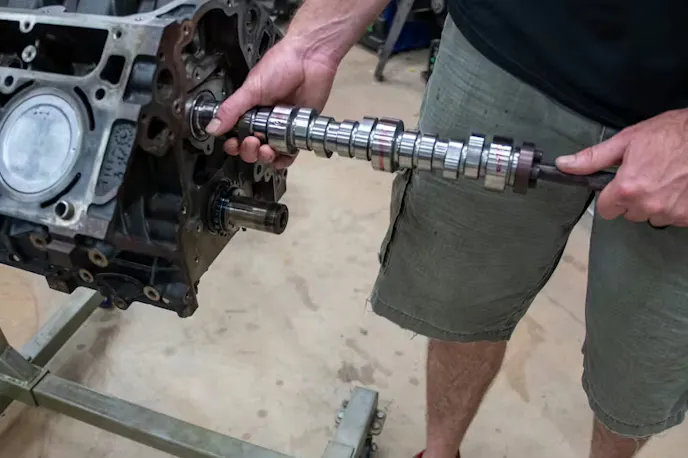
With Melling having hundreds, if not thousands, of performance vehicle applications in their system, we wondered where they even begin with so many vehicle applications. “We have an extensive line of stock replacement camshafts. For those, the focus is on vehicles in operation (VIO) numbers,” explains Risinger. “Our goal is to feed the masses.” Ok, that seems simple enough. The higher the VIO number, the higher the priority.
Risinger continues to elaborate on their depth of applications, “Aftermarket performance ranges from the traditional torque cams (RV, trucks) to midrange performance. Our primary focus is the Big Three (GM, Ford, Stellantis [formerly Chrysler]), and we have coverage from back in the muscle car era to current late-model V8 engines. For higher-end performance and racing applications, we take a lot of feedback from trade shows and events that we attend, as well as builders we work with. What the current and upcoming performance engines are, what power levels builders are looking for, and what induction systems are being used. These can all give us a road map when developing new cam profiles.”
Camshaft Selection and Specifications
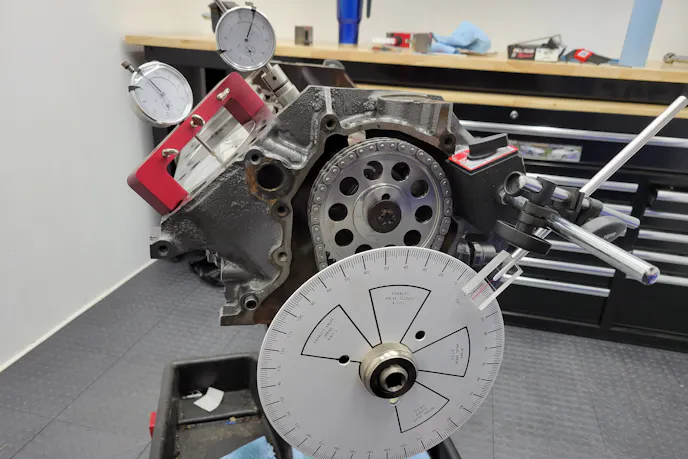
Once an application is determined, Melling’s next step is understanding how the engine will be used. A V8 in drag racing has a different cam profile than one used in circle track. “We need to understand what the goal of the engine is,” says Risinger. “A drag race engine that needs to make maximum power at high RPM for a very short time will be designed differently than a circle track engine that needs to make maximum power over an extended period. The drag race application might have a higher ramp speed to open the valves as fast as possible, whereas the circle track engine will have a profile that is easier on the valvetrain.”
The team at Melling goes deeper than application and use. Researching factors such as power goals for the engine, displacement, induction, and sanctioning body class rules is also necessary. “Melling still offers quite a few of the older cast iron cams, as well as new billet steel,” remarks Risinger. “We take great pride in providing the customer with what they want and need for their build.”
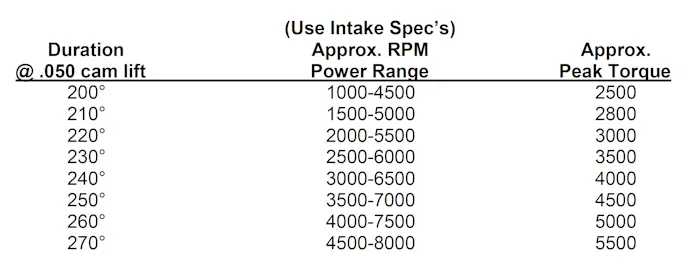
Melling segments their Select Performance camshafts into categories based on duration at .050” lift. General guidelines from Melling are as follows:
CLASS I (200° – 215° duration): Good idle quality. These cams will have low-RPM torque and mid-range performance. They will work with stock or slightly modified engines and manual or automatic transmissions.
CLASS II (215° – 230° duration): Fair idle quality. Good low- to mid-range torque and horsepower. They will work with stock or modified engines and manual or automatic transmissions. A class II cam will possibly generate lower vacuum than stock.
CLASS III (230° – 245°duration): Rough idle quality. Good mid- to high-RPM torque and horsepower. Class III will need a manual or high-stall auto transmission and will likely need an improved carb, exhaust, and ignition systems. Designed to strike a balance of street and drag, the class III will have lower vacuum than stock.
CLASS IV (245° and greater duration)? Rough idle quality. Mid- to high-RPM torque and horsepower. For serious racing. You will need a proper selection of rear axle ratio and improvements in carburation and exhaust systems. The high-RPM nature of Class IV cams means they are for manual transmissions or automatics with a very-high-stall converter and will not have enough vacuum for power accessories.
Beyond The Specs: Engineering and Manufacturing
With the performance targets defined, Melling’s attention turns to engineering work that brings a camshaft from concept to production. They take it to the drawing board once the application and intended performance use are known. While Melling doesn’t disclose proprietary information regarding its camshaft engineering and manufacturing process, we can, however, take a look at industry practices.
Engineers typically begin by modelling the camshaft in computer-aided drafting (CAD) software. Here, the cam lobe profiles can be digitally adjusted for lift, duration, lobe separation angle, and ramp speed. Software then allows the engineers to predict how the valvetrain will behave across the RPM range.
Once the lobe profile is set, the next step is selecting the right material to manufacture a camshaft from. This is based on a number of factors for the intended application and use. These include compatibility with the engine block it will be installed in, stability under the spring loading, and durability for a long lifecycle. A stock replacement camshaft for older engines may use cast-iron, while a late-model racing engine could use billet steel for high strength and fatigue resistance.
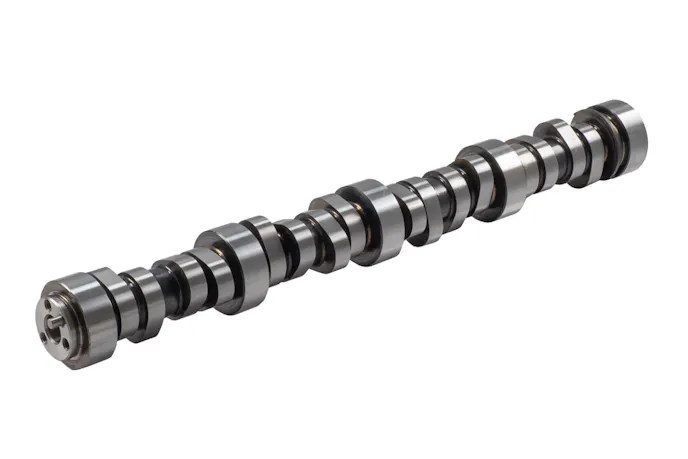
Manufacturers use cast cores to keep costs down, while billet cores serve high-performance applications that demand superior material quality. Either way, the manufacturing process involves precision grinding with the use of computer numerical control (CNC) machines. The CNC process allows for precise control and repeatability across production runs. CNC grinders can achieve tolerances in the ten-thousandths of an inch, ensuring lobe lift and timing accuracy. Surface finish is a critical step for long-term reliability, and each camshaft lobe is then polished to maintain proper contact between the cam and lifters. Depending on the material and application, the cam may also undergo heat treatment or nitriding to further harden the lobe surface.
Quality control plays a major role throughout manufacturing production. Many manufacturers use a coordinate measuring machine (CMM) to check several critical dimensions. An inspection routine can verify runout, journal diameters, and lobe taper for correct geometry. Surface hardness is another critical measurement. These quality checks are vital to ensure each camshaft coming through the process meets drivability and longevity expectations.
Final Testing and Quality Assurance
Melling camshafts are tested throughout the manufacturing process for hardness, straightness, and all other dimensional aspects. From there, they take it further to verify modeling against real-world production use. “We utilize both Spintron and dynamometer testing. We also use a third party for our valve spring development, which also gives us the opportunity to look at and fine-tune our cam lobes if needed,” explains Risinger.
A Spintron is a high-speed valvetrain analysis system used in research and development. It consists of a large electric motor unit that attaches to the crankshaft and is capable of spinning the engine anywhere from 500 rpm to 20,000 rpm. A laser camera and computer are then used to record valve bounce, lofting, spring harmonics, and pushrod deflection based on RPM.
Risinger states that, “All of our performance camshafts are manufactured in the USA from American materials. Melling has always been an industry leader in quality.” Proof is in their IATF 16949:2016 and ISO 14001:2015 certifications. IATF 16949 signals OEM precision quality assurance through manufacturing, and ISO 14001 demonstrates environmental sustainability. Both are often required when supplying the automotive industry.
Sophisticated product development testing combined with OEM-level standards makes for some pretty solid camshaft designs from Melling.
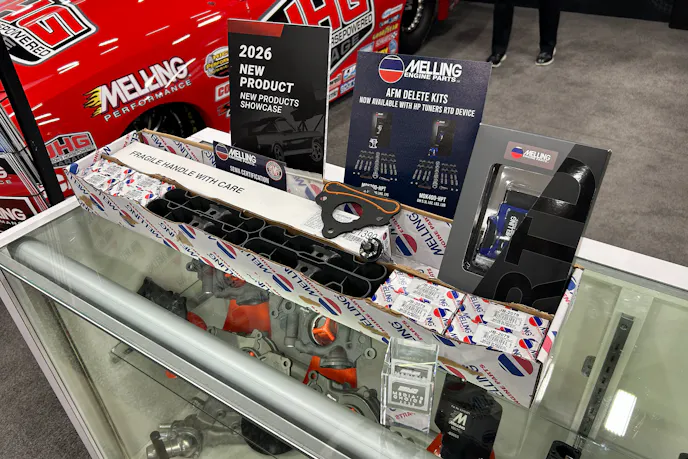
Getting The Right Grind For Your Project
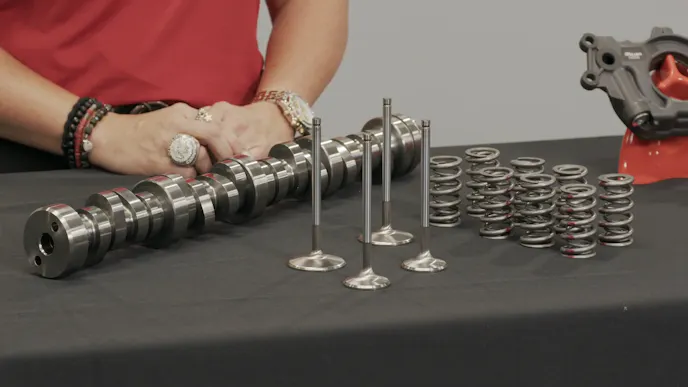
Melling provides numerous resources to help customers learn and choose which camshaft is best for them. “We have an extensive YouTube channel, technical information on our website, as well as one of, if not the best, technical service departments in the industry,” concludes Risinger. The website features both OEM part number lookup and year/make/model vehicle lookup. In addition, select camshafts such as those found in the GM LS Performance Camshaft Kits come complete with necessary installation parts. These include a thrust plate and seal, valve locks, valve stem seals, chrome-moly pushrods, valve springs, and retainers.
Each application brings its own set of priorities. A camshaft for a daily driver is different than one designed for all-out racing. For Melling, that means knowing what’s on the road today for replacement parts and also closely listening to motorsports teams and engine builders for high-performance applications.
Strict certified quality controls, American materials, and extensive testing assure high standards. It all comes full circle to the customer, with the tools to find the right camshaft for their specific application, and if needed, a call with their outstanding technical support staff.
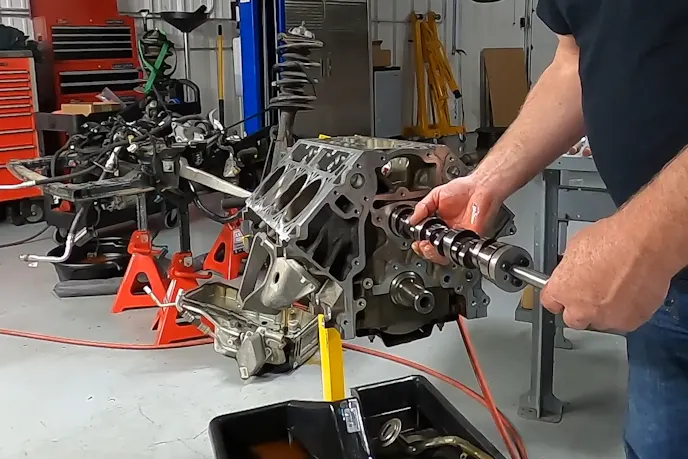
You might also like
Inside Ford Racing’s Return To Formula 1 Engines With EPARTRADE
EPARTRADE dives into Ford Racing's return to Formula 1 as an engine supplier, along with their numerous other engine development programs.