

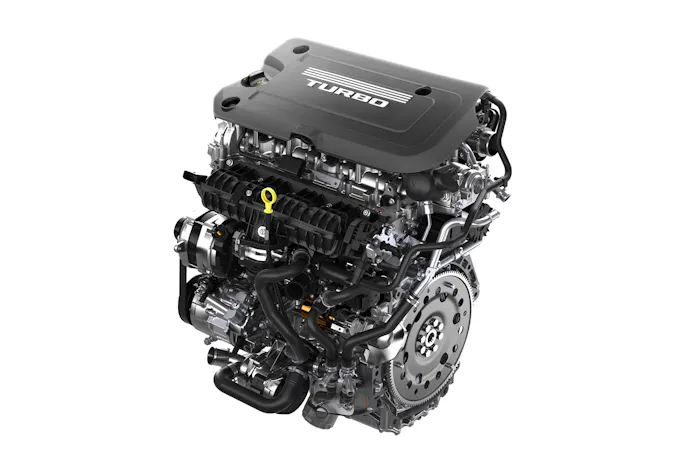
A little over three years ago, there was widespread discussion about the General Motors LSY 2.0-liter turbo engine running hot. That issue was largely believed to be due to a faulty engine coolant temperature sensor, and not an actual overheating issue. Bad sensor or not, it was a black eye for the small, turbocharged engine that powers some of the General’s higher-end vehicles.
Now, that black eye is back, possibly including a split lip, as this time, the issue can’t be traced back to a faulty sensor reading. This time it’s an audible engine tick. While the aftermarket makes jokes about lifter tick in various models, when a customer drops the cash for a Cadillac CT4, CT5, XT4, XT5, or XT6, they expect a smooth, quiet engine and are much less forgiving of any kind of engine NVH.
Looking over GM Service Bulletin PIP6101A, the ticking coming from the engine isn’t just poorly suppressed NVH, but rather is caused by, “Valve rocker arm debris, getting inside the hydraulic valve lash adjuster and not allowing it to pump up with oil, resulting in a soft hydraulic valve lash adjuster,” per the bulletin. Not exactly what you want to hear when you buy a brand new car.
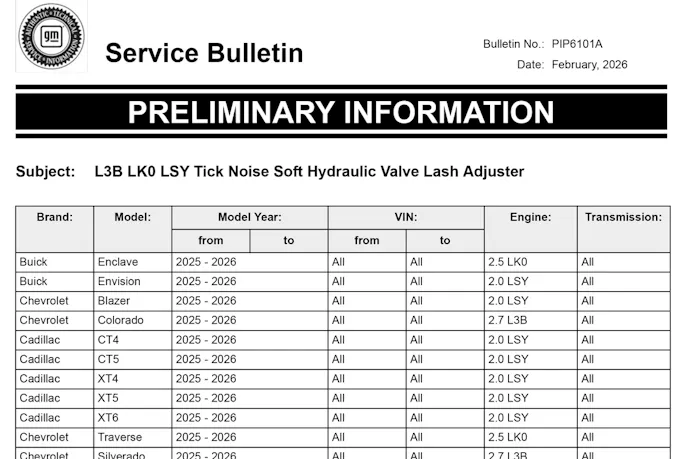
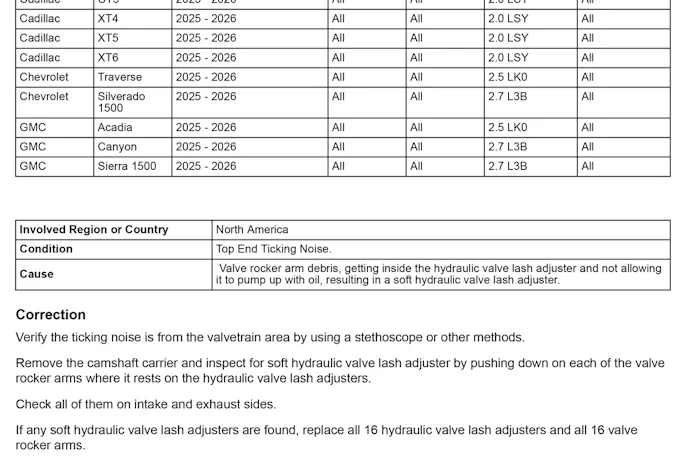
The stated correction is to pull the camshafts and the camshaft carrier out, and to check each of the hydraulic lash adjusters for signs of failure. If any lash adjusters are found to be soft, all 16 are to be replaced, along with 16 new rocker arms. So, not an inexpensive proposition, by any means, with parts coming in at about $225, and 16 to 17 hours of labor according to one source we found.
This issue isn’t new, as PIP6101A is an addendum to a previous service bulletin that addressed the same noise and the same cause in the 2.5-liter LK0 and 2.7-liter L3B engines, indicating this is a wider-spread issue than previously known. Interestingly, the initial service bulletin, PIP6101, the cause was listed as: “Manufacturing debris inside the Stationary Hydraulic Lash Adjuster (SHLA) and not allowing it to pump up with oil, resulting in a soft lash adjuster.” This isn’t a full-blown recall, but luckily, for all the engines covered by the bulletin, the earliest model year is 2025. So, owners of these engines should be covered by the manufacturer’s 5-year/60,000-mile powertrain warranty.
You might also like
Inside Ford Racing’s Return To Formula 1 Engines With EPARTRADE
EPARTRADE dives into Ford Racing's return to Formula 1 as an engine supplier, along with their numerous other engine development programs.