


Well, I guess we found the limit.
Those were the words uttered by Calvin Nelson — known as Nivlac57 on YouTube — on the last day of Sick Week 2026, as a stock Nissan VK56 connecting rod exited the block. Nelson has been known as of late, not only for his drag and drive exploits, but for doing it with a Nissan VK56 engine. Recently, the Japanese V8 engine has been getting a lot of attention, thanks in no small part to Nelson’s videos, and up until now, the VK series has been sounding too good to be true. So, it’s nice to see him openly sharing the details of this failure, allowing anyone wanting to follow in his footsteps to be properly educated.
First things first. We don’t want any readers to get this engine confused with Jon Rodger’s VK build that we featured a few months ago. Nelson’s combination uses stock crank, rods, and pistons and was making approximately 770 horsepower at the wheels. The failure occurred after Nelson struck the tires, pedaled the car, and then fully loaded the engine again.
A Man Of Our Own Heart
While a large number of people would simply rip the junkyard engine out of the chassis and slap a new VK56 in its place, Nelson decided to tear the engine down and try to trace the chain of events back to the source. If you never identify what happened, you’re simply going to continue to repeat the process. While junkyard cores are inexpensive, they don’t circumvent math, and eventually add up to a hefty drain on the bank account, especially if you treat them as consumables.
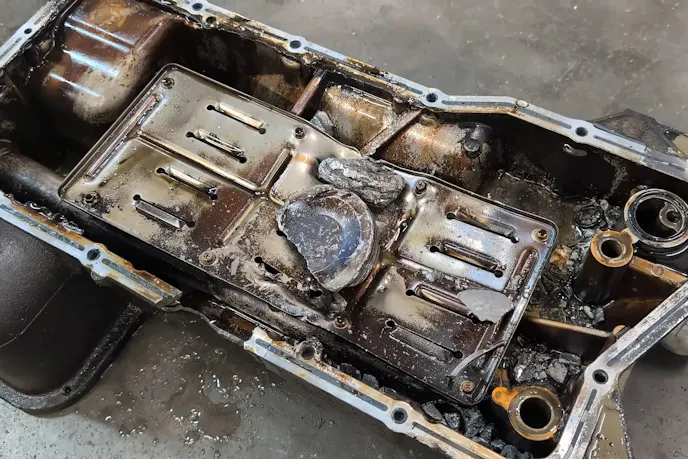
Using as many stock components as possible in his VK56 project means that Nelson was bound to find the weak link sooner or later. Upon initial inspection, the carnage was massive. Pieces of piston, connecting rod, piston rings, and engine block were all sifted out of the containment pan. (ED. NOTE: This is a perfect example of why oil containment devices exist. Yes, oil got onto the track, but it didn’t get under Nelson’s tires, and he was able to safely get the car out of the groove and stopped. Think about that next time you complain about what a PITA the containment device is to mess with.)
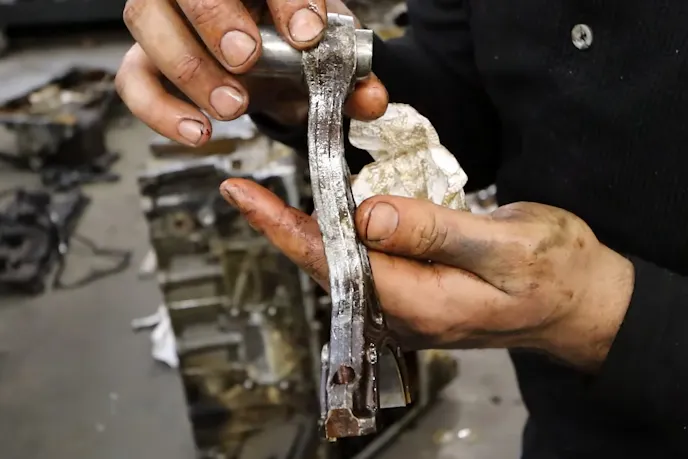
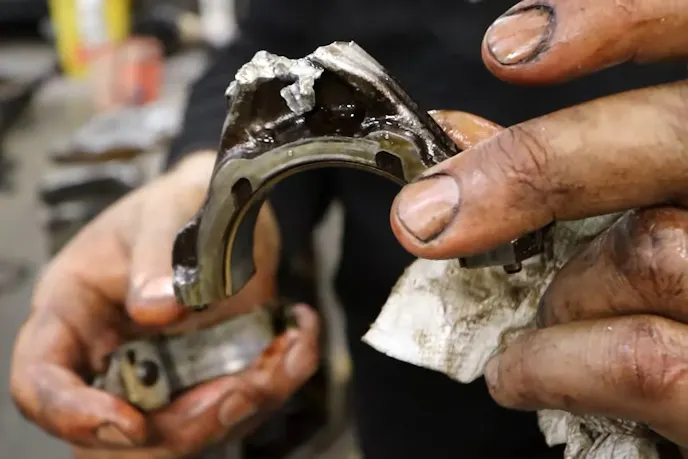
Initial examination of the chunk of connecting rod appears to coincide with Nelson’s hypothesis, that the rod stretched when the tires unloaded, and then when the driveline caught traction again, the sudden load snapped the beam. Once the car was lifted, the expected window into the soul of the engine was present. Through that window, one of the remaining rods was very clearly bent.
A Change Of Hypothesis
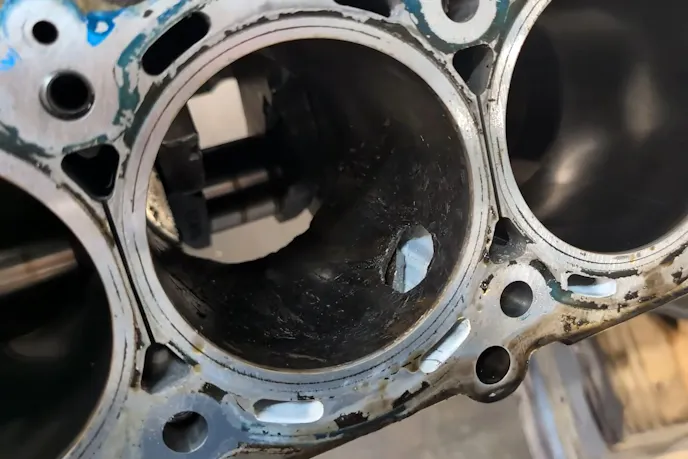
That evidence caused a revision to the hypothesis: now, Nelson is thinking that one rod compressed so much that the piston might have connected with the counterweight as it approached the bottom of its stroke. The amount of carnage that became apparent as the teardown proceeded bordered on sickening, as another window was found in one of the cylinders. Nelson and his dad continued on in the name of science (and morbid curiosity as well, we’re sure) only to reveal something shocking: an almost reusable head gasket. (Don’t reuse headgaskets, kids!)
Another surprise was that the big end of the failed connecting rod was still attached to the rod journal of the crank, and spinning freely, indicating there was no issue with the rod bearings or oiling system issue. Removing a Rod, if you ignore the S-beam design, the bearings looked remarkably good, all things considered, and the wrist pin still freely floated in the small end… although there was no piston attached to it.
As more pistons and rods came out of the VK56, some more things came to light. The piston rings of the undamaged pistons (and some of the damaged ones) all moved freely, and had decent free gap, with no indication of a ring gap issue, or any other ring issue. Interesting, there were some connecting rods that appeared to be perfectly straight, and some that were so bent that they were contacting the counterweights.
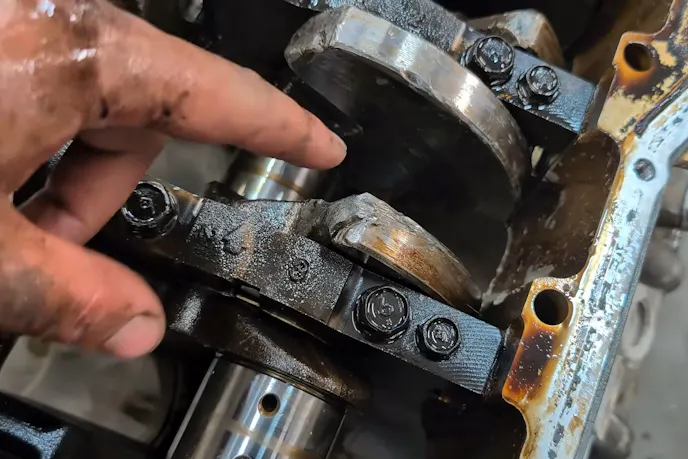
The crankshaft seems to be straight in Nelson’s opinion, with some pretty apparent shrapnel damage on the counterweights. Everything he found, in his mind, points to simply overpowering the rods in the unloading and reloading event on the track. “We were jackhammering the crap out of the rods in this engine,” Nelson explains. He then shares that he thinks that, without the issue on track, pushing the stock short-block even further is possible.
“I think there is still a little bit of headroom on the factory connecting rod, but not a ton,” says Nelson. However, he has no plans on using factory connecting rods again, which is his plan for the next iteration of the VK56: to use aftermarket rods with the factory pistons. We’ll be eagerly waiting for that new version. And, for anyone who still has questions, make sure to watch the video below, as Nelson responds to the most asked questions, and takes a deeper dive into concerns around the fuel system that were raised in the comments.
You might also like
Beyond Cylinder Head Porting: CNC Machining Transforms Modern Engine Building
CNC machining has transformed engine building beyond just cylinder head porting, with almost every machining process able to be automated.