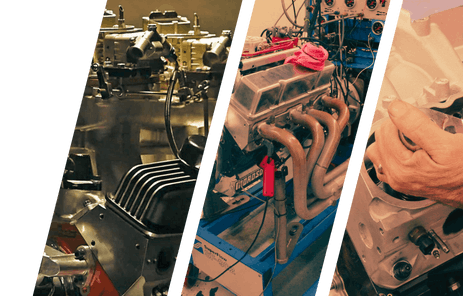

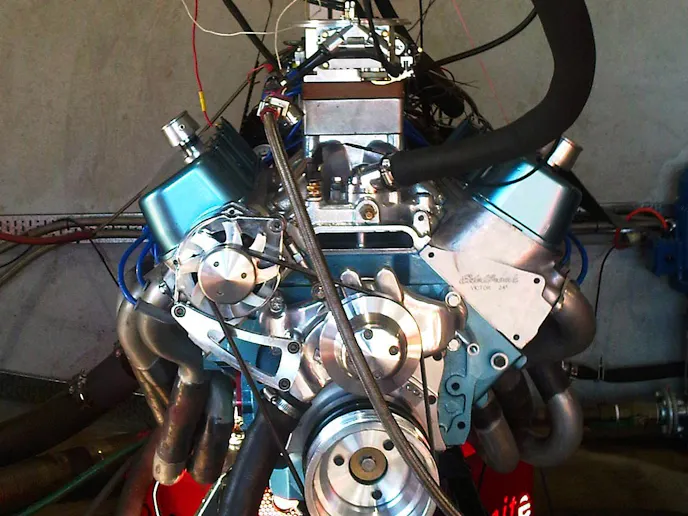
 Fausto Felice believes in big horsepower without big compression, big cams or expensive add-ons like vacuum pumps or electric water pumps. A 20-year engine-building veteran who runs Fausto’s Performance Engines in Queensland, Australia, Felice documented the recent buildup of a 900-horsepower, 572ci big-block and offered plenty of commentary to explain his strategies.
“This is a true street-car engine,” he says. “Race-engine tactics don’t wash with me on a street engine that has to run for hours on end. Making power on pump gas is very challenging and unforgiving. The combination is the key. One foot wrong and it will cost you.”
Felice starts with a Chevy Performance Bowtie block bored and torque-plate honed with heat in the block to 4.560 inch. Rotating assembly consists of a Callies crankshaft (4.375-inch stroke), K1 6.480-inch connecting rods and Wiseco pistons with a 1.12-inch compression height. All components are balanced by Lewis Racing Engines, then assembled with King bearings (.003 clearance on the mains and .0022 on the rods) and ARP fasteners.
“I prepare the bores with quick-seat compound as ring seal is critical to cylinder pressure,” says Felice. “I have tested bores with and without and seen an increase in cranking compression of 20 psi for a given compression ratio.”
LSM Engineering grinds the camshaft to Felice’s specs: 270/278 at .050 duration with .432 lift at the lobes and 112 lobe separation. Felice uses 1.8:1 rockers, resulting in .760-inch lift at the valve. He insists on fat pushrods to complement the valve springs that are rated at 750 pounds open. He also has the cam set up for the LS firing order.
“I like to be different,” says Felice, “and it helps even out the pulses on the crankshaft, which means longer bearing life. And it sounds different, which gets lots of comments at the track.”
Cylinder heads are Edelbrock castings ported by Curtis Boggs at Race Flow Development.
“I have tried many out of the box CNC heads and professionally hand-ported heads on various combinations,” says Felice. “They have performed well, but if chasing power it doesn’t get any better than seeking professional help with port design. Curtis gave me a port that would help achieve the goals I was looking for.”
Previous tests with a similar short block using locally ported heads and smaller Edelbrock manifold produced just over 850 horsepower. Using the RFD heads, an Edelbrock Super Victor II intake manifold and a SV1 carb with its huge 110mm single throttle blade, dyno results jumped to 923 horsepower at 6,925 rpm on pump gas.
“That’s a 70-horsepower increase with the RFD head,” boasts Felice. “The engine breathed better from the crack of the throttle. And to back up the dyno, the car ran three tenths quicker and three mph faster.”
You might also like
Inside Ford Racing’s Return To Formula 1 Engines With EPARTRADE
EPARTRADE dives into Ford Racing's return to Formula 1 as an engine supplier, along with their numerous other engine development programs.