


Where does the advertised duration come from, and who decides how to measure it? Ask one manufacturer, and they’ll tell you one thing; another will tell you something different. They all measure their advertised duration from different starting points, resulting in different duration numbers. Heck, it could be the same exact cam, but if you don’t measure from the same spot, you’ll never know.
Choosing a camshaft with advertised duration in mind is a surefire recipe to find things out the hard way. There is just no way to successfully compare one cam manufacturer’s advertised duration to another, easily.
Bigger is not always better, despite what the internet may have told you. Large duration cams have the potential to make big power at the top end. However, this is only possible if the other engine components support high-RPM power.
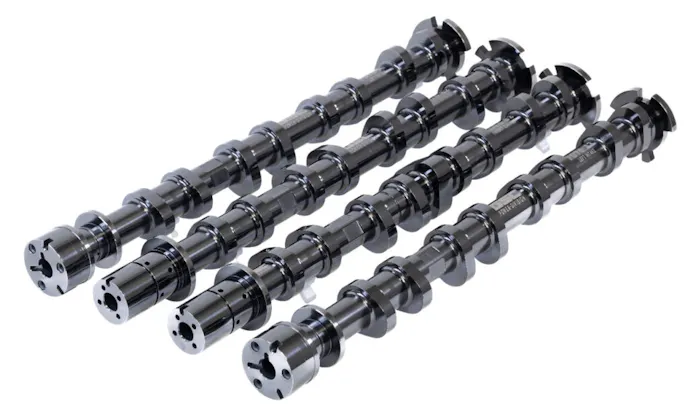
Choosing a cam with less duration is probably the way to go. Doing so can help by making more power under the curve within the desired RPM range. More area under the curve opens the door with the potential for quicker acceleration by making power sooner, getting us down the track faster. Best case scenario, we want to build power and hold torque over the entire band, not just one peak point.
You want to aim for the smallest duration cam you can; to get the power made you’re looking for
OK, great, so what do we do now that we know choosing a cam from advertised duration is just not the way to go? Resist the thought that the bigger advertised duration number is better. You will see some cards that show advertised duration at .004, .006, or .020 inch of lift, if listed at all.
A good place to start would be considering what RPM you are launching the car at, where you are shifting, and what is a safe desired RPM range. From there, we can make a decision on real cam specs.
The industry standard measures the duration starting and ending points of duration at .050 lobe lift. For or import friends, it’s measured at 1mm (.039 inch), which gives us a reliable point of reference to compare one cam to another. Cam companies may list more than one duration on their card, but those who know are only interested in the .050 version.
Cam Card Terminology
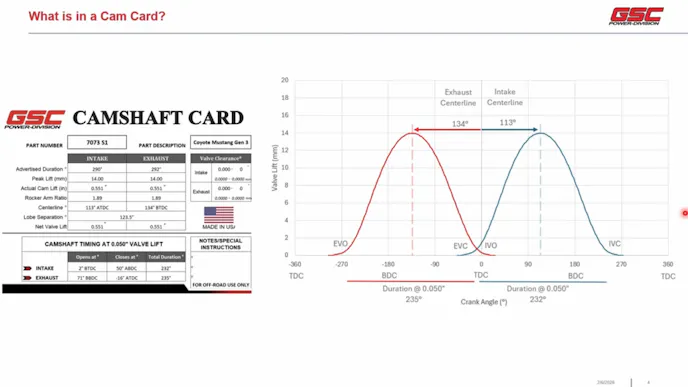
So now that we have some basics out of the way, let’s break this down a little bit more. Cam math has always seemed to be some form of dark art, and in a sense, it can be tricky. Understanding the terminology and having a point of comparison is an absolute.
When we measure cams at .050 lift, we’re trying to stay away from the opening and closing ramps. More aggressive profiles will open the valve quicker, giving us a larger amount of air sooner. With these aggressive lobe profiles, we also need to follow suit with a stiffer valvetrain.
Throwing another monkey wrench into the mix are the specs – are they listed in imperial or metric? The .050 lift previously mentioned would be considered standard for imperial, and 1 mm or roughly .040 would be for metric.
Even with those two designs, you can’t compare one to another without degreeing them in the engine. The .040 lift cam is going to appear to have more duration than the one measured at .050, when in fact they could be identical. Are we confused yet? If you haven’t caught on, that partial lift number is where we start and stop counting to measure the duration.
We haven’t even mentioned how lash affects the actual duration at the valve. Let’s just say, for argument’s sake, we’re measuring duration at .050 lift. The actual duration at the valve will be a bit less. The lift has to close the lash gap between the rocker and valve tip before it starts opening.
Physically having both manufacturers’ cams in hand to degree in the engine just doesn’t make sense. But, all hope is not lost… You can try reaching out to the manufacturers directly. They have the ability to give you the numbers for comparison purposes.
Advertised Duration is just not the number we need to go off of
Under The Curve
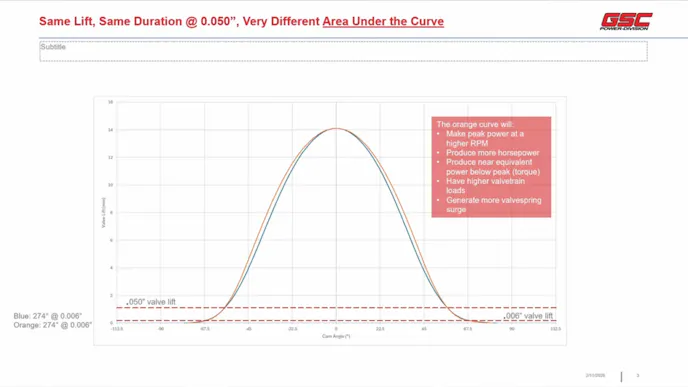
So here’s some food for thought. In the picture above, we see two cams with the same duration and the same lift. They have a much different profile under the curve; this is the ramp acceleration that is very beneficial. Looking at the orange line in comparison to the blue, it’s much wider, which means the valve is opening quicker and remaining open longer under the curve.
The orange curve will:
- Make peak power at a higher RPM.
- Produce more horsepower.
- Produce about the same power below peak torque.
- Have a higher valve train load.
- Generate more valve spring surge.
Having a higher valvetrain load and generating more spring surge is not ideal, but well worth the potential benefits, making it a good tradeoff. One option would be putting the spring closer to coil bind. This will help stabilize the spring, minimizing the surge.
Of course, it’s a completely different negative issue if the induction system won’t sustain the airflow potential the cam is generating. That’s a lesson for another day. Keeping within focus, understanding cam specs is critical before we even think of trying to choose one.
A critical flaw would be not consulting the manufacturer on valve spring selection. They are the ones that have spent many hours testing profiles and lobe designs with the direct intention of making you the most power possible.
It would also be a wise decision to include your cylinder head guy by getting their recommendations for spring selection. Rely on their experience and insight with particulars such as boost levels, port design, and other aspects of your engine build.
Take a look at this video from Headgames Motorworks. In the video, Chris Allmond does an excellent job of defining the GSC cam card information. Both he and David Localio are a great resources in understanding cam terminology and characteristics. As long as you remember that a camshaft is part of the overall system, and don’t immediately grab the one with the biggest numbers on the box, you’re going to be OK.
You might also like
General Motors’ LSY 2.0-Liter Turbo Engine Has Yet Another Issue
General Motors' LSY 2.0L Turbo engine found in multiple brands of vehicle is suffering valvetrain issues due to manufacturing debris.