

We had just finished swapping a carbureted 4.8-liter LS engine into my Chevelle and had the engine running nicely. I set the idle speed and mixture (with no sign of vacuum leaks) and was reviewing the results when purely by accident I noticed the four mounting holes on the passenger front portion of the intake manifold.
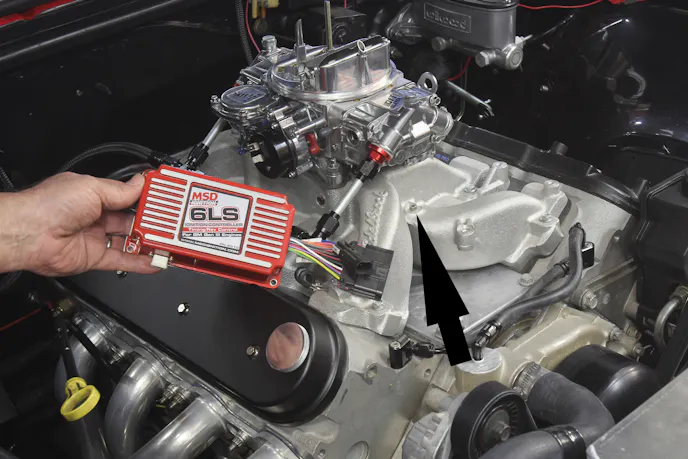
Edelbrock places four drilled and tapped holes in the manifold to mount the MSD ignition control box directly to the intake. We decided to clean up the top of the engine by mounting the MSD ignition box under the dash. While I was looking at the engine, I wondered if the one hole that was positioned over the intake manifold runner might be drilled directly into the port.
I used a very long thin awl to check and sure enough, one hole was drilled directly into the intake port. Since we did not mount the ignition box in Edelbrock’s intended location, we had inadvertently created a vacuum leak. Now if we had bothered to read the instructions for the P/N: 71187 Edelbrock manifold, there’s one short sentence in the four-page manual that points out that if you don’t use the existing mounting holes for the MSD box, you will need to install a 10-32 screw into the hole to prevent a vacuum leak.
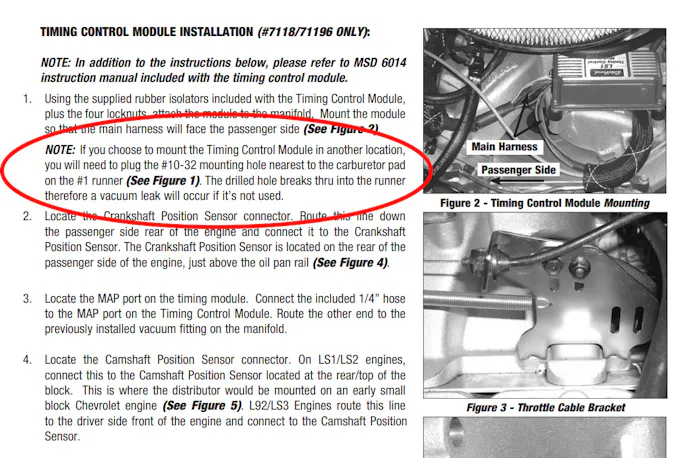
That’s exactly what we did and then made some minor readjustments to the carburetor to compensate for closing the vacuum leak. This is not a huge deal, but it does point out how important it is to read the instructions – even if you think you know exactly how to install that component.
In our case, that cylinder now runs with a much more consistent air-fuel ratio compared to its cousins at idle and part throttle. We caught this quite by accident, but our guess is that there are hundreds of cathedral port LS engines with Edelbrock dual-plane intake manifolds running around right now with this small, unintended vacuum leak.
It’s the little things in life that can often make a big difference.
You might also like
LABS: How To Determine (And Mark) The Proper Oil Level For Your Engine
One of the biggest ways to fight windage is to make sure you have the proper amount of oil in your engine. Not too much, not too little.