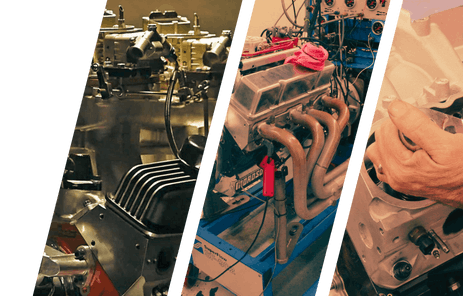

“Wanda” is the nickname of a 1962 Daimler SP250 that competes in vintage road racing events. The name was bestowed upon her as the SP250’s grille looks quite like the mouth of a fish. And many of us remember the classic comedy, “A Fish Called Wanda.”
Despite being called the ugliest car at its 1959 debut at the New York Auto Show, there was one very endearing aspect to the SP250; under the hood (or “bonnet”) was a unique 2.5-liter V8 with aluminum hemispherical cylinder heads. Designed by Edward Turner, best known for his work on Triumph and Ariel Square Four motorcycles, from the outside, the little Daimler looked like a scaled-down version of the first-generation Chrysler Hemi (331-354-392ci variety).

Upon seeing Wanda’s engine, most people ask, “Is that an early Chrysler or Dodge Hemi?” Nope, it’s a Daimler, manufactured in Coventry, England. A factoid of interest to every gearhead is that Gottlieb Daimler (along with his partner, Wilhelm Maybach) is credited with developing the first successful internal combustion engine in 1885.
He later partnered with British investors to found Daimler Motor Company, Ltd., which primarily manufactured stately sedans for royalty. Jaguar purchased Daimler Motors (not to be confused with Daimler Benz) in 1960, and phased out the SP250 in favor of its famed XKE, but the little V8 saw use in Jaguar Mark II sedans through the end of the decade.

While on the outside the little Daimler looks very much like a Chrysler, there’s a notable difference in the valvetrain. The camshaft is positioned relatively high in the block, and the cam followers (lifters) are housed in a removable aluminum valley cover. The “solid” lifters have a contoured base, which interfaces with a custom-ground billet camshaft from Bullet Racing Cams for this build. It has a .310 inch of lobe lift, compared to the original .294 inch, and a far more aggressive lobe profile.
Perhaps the most noteworthy change to the valvetrain is the use of a shaft roller rocker arm system made for “Wanda” by T&D Machine. In addition to being much more efficient and sturdy than the OEM setup, the rocker arm ratio has been upped to 1.6:1 from the factory’s 1.56:1. The factory aluminum cylinder heads were ported and polished, and fitted with Manley stainless steel valves, valve springs and retainers. Combustion chamber sealing comes from Cometic head gaskets, with ARP head studs doing the clamping.

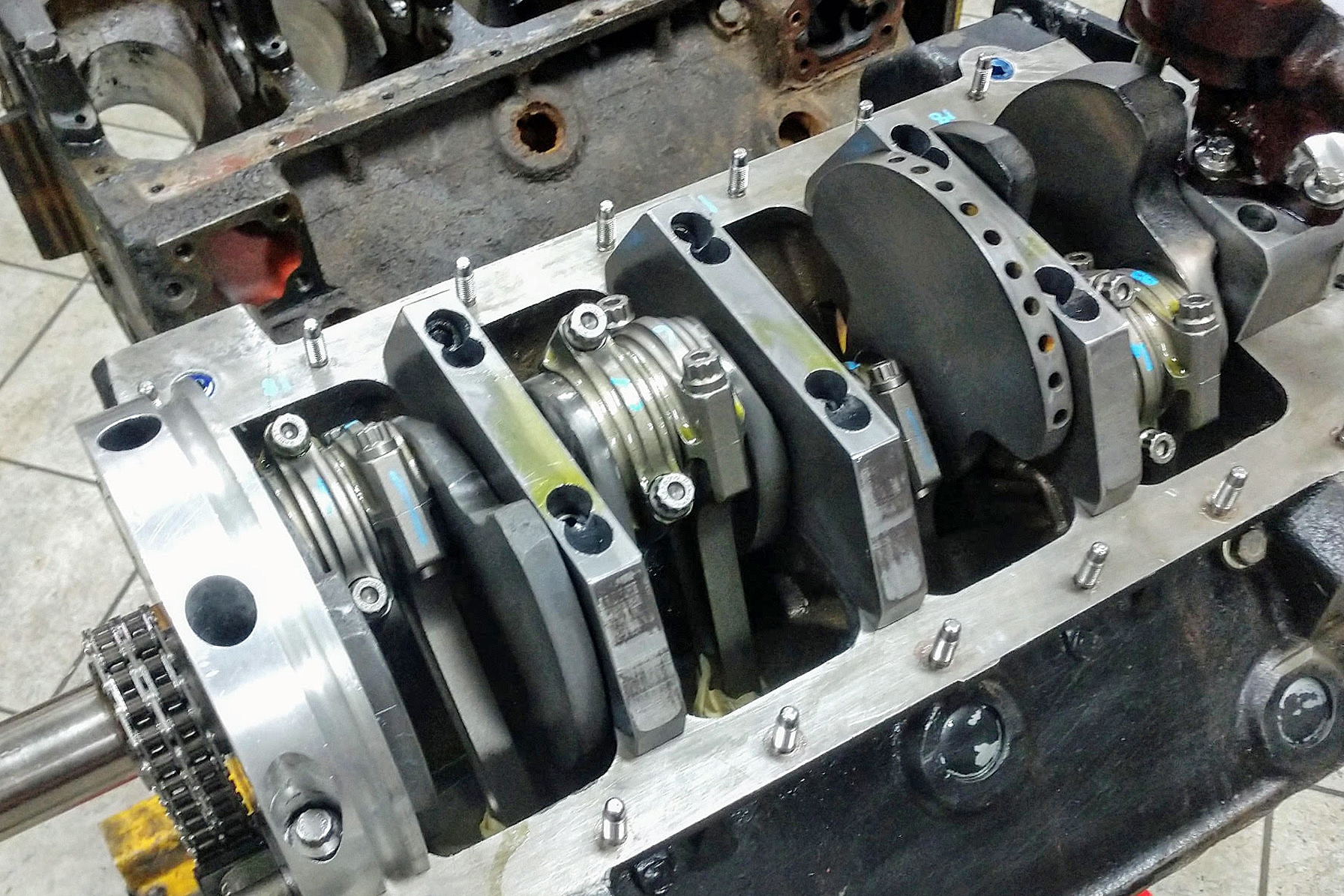
Compression has been increased considerably, with custom 12.5:1 forged aluminum pistons from Diamond Pistons, which have been fitted with Total Seal rings. In the truest form of modernization, the top rings are gas-ported for even better ring seal. The pistons are mounted on Manley I-Beam rods via Trend Performance tool steel wrist pins. ARP connecting rod bolts secure the rod caps to the connecting rod.
Wanda’s crank is a billet assembly from Marine Crankshaft, with the bottom end secured with special custom-made main caps and ARP fasteners. The design is the result of a collaboration with noted UK drag racer Robin Read, whose Daimler-powered Top Fuel dragster has gone as quick as 6.37 at nearly 210 mph in the quarter-mile.

The standard intake system from Daimler features a pair of SU downdraft carburetors. SUs with a 1.500-inch bore were OEM, but Wanda came from Connecticut with a racing history and a pair of 1.750-inch throated units from a Jaguar XKE.
Vintage road racing rules permit intake system modifications as long as the same number of “barrels” or “throats” are utilized. For instance, a popular modification among small-bore vintage racers is replacing a pair of SUs with a Weber. For Wanda, it was decided to replace the SUs with a Holley 350 cfm two-barrel carb that can be found in a number of stock car classes.

The intake manifold was fabricated by John Schiess, with the carb rotated 90 degrees to position the carb throats some 20-percent closer to the outboard manifold runners. Not the end-all-be-all, other combinations will be considered and tested in the future.
Wanda, with a tired and relatively stock engine, was put on a chassis dyno a decade ago and produced readings of 87.48 horsepower at the rear wheels. Fitted with its freshly refurbished engine, she was recently taken out to the famed Westech Performance facility in Mira Loma, CA, and put through her paces.

Right off the trailer, Wanda pumped out a baseline of 133 horsepower and 118 pound-feet of torque. Then came a series of incremental jet, power valve, and shooter nozzle changes, plus advance curve adjustments and a new set of hotter spark plugs.
On the ninth pull, power maxed out at 183 rear-wheel horsepower. More importantly, the torque curve progressed from looking like a roller coaster to a near-flat line, wavering only 10 to 15 lb-ft of torque from 3,500 to 6,500 rpm — an ideal powerband for road racing.

The honest reality is that any high-performance engine requires finessing to obtain optimum power. And unlike a drag car, where you can go to a strip and make pass after pass, road racing vehicles have limited track time. The day spent at Westech probably saved two or three days at the track. And had the added benefit of technical input from folks who dyno engines for a living.
A 50-horsepower increase on a naturally aspirated engine on the dyno is impressive no matter how you cut it. When you factor in the percentage of increase — 38 percent — those types of gains don’t come along all that often. And now, Wanda is ready to attack the turns on the road course with more power and a better curve, to boot.


You might also like
Engine Pro Releases Sportsman Series Flexplates And Bolt Kits
Engine Pro's new line of Sportsman Series flexplates proves that you don't need a big pricetag to handle big horsepower.